

Learning Worksheets Number Charts
Free printable PDFs · ages 4–8
Free Printable Number Charts: 1–20, 1–50 and 1–100
Four free number charts in one place: a 1 to 20 chart with number words, a 1 to 50 chart, a classic hundreds chart and a blank fill-in hundreds chart.
Free PDFs · A4 or US Letter · No sign-up
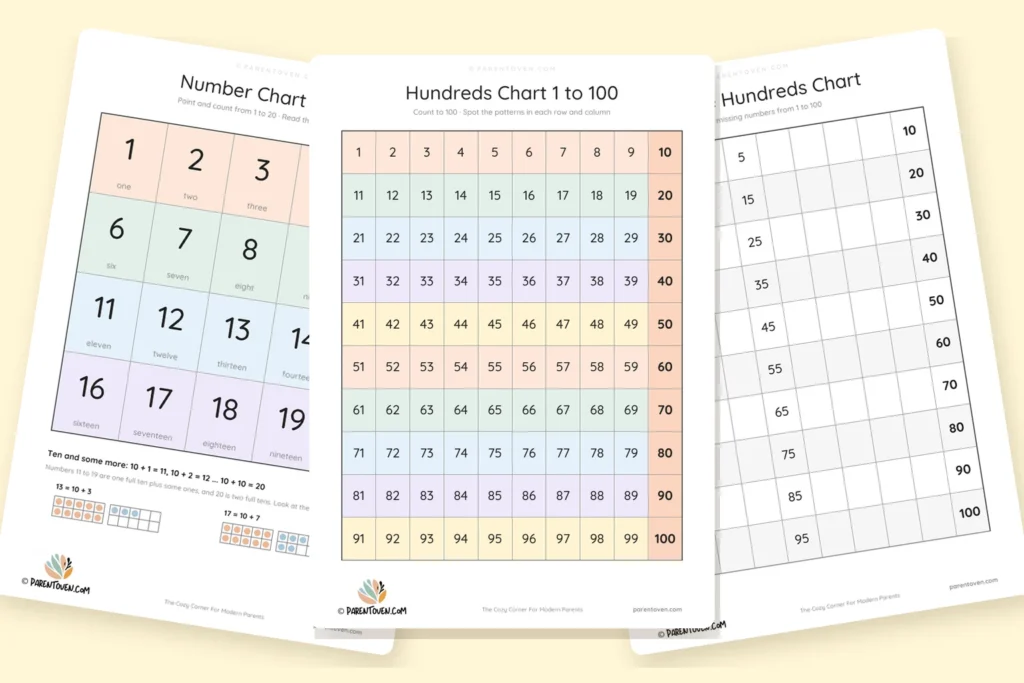
Pick a chart
Four number charts to print
Each chart is a single A4 page (the blank chart has two). Download one or all four.
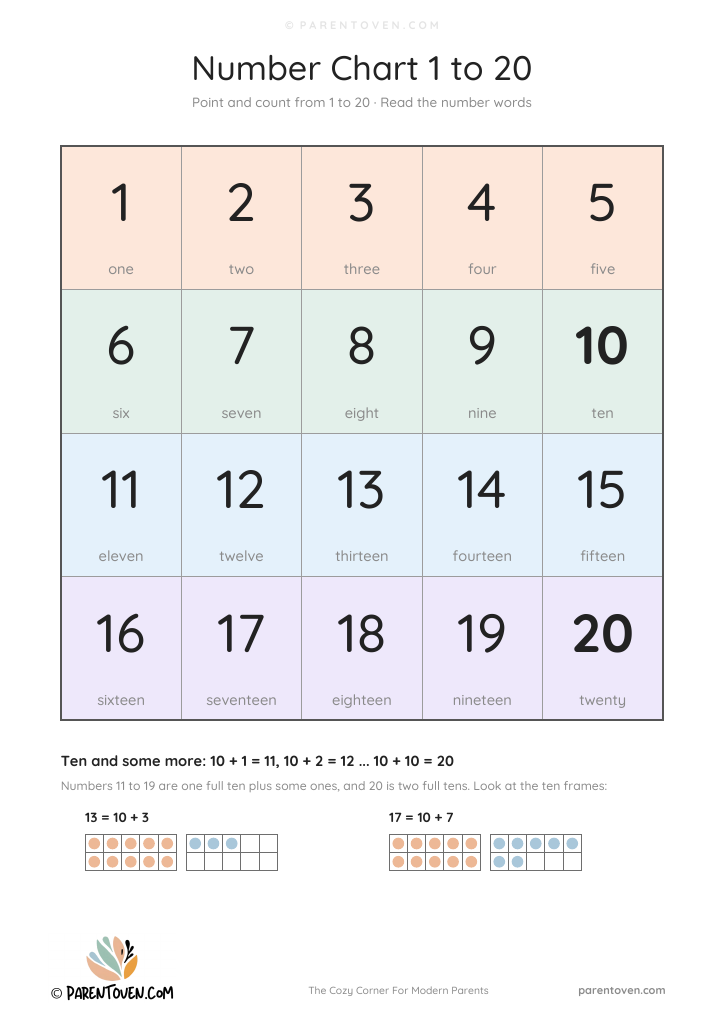
Number chart 1 to 20
Four rows of five, each with the number and its word, plus ten frames that show 11 to 20 as ten and some more. Perfect for first counting and for reading number words.
- Point and count from 1 to 20, then back down again.
- Cover a number with a coin and ask which one is hiding.
- Read the number words aloud, then find the matching number.
A4 · PDF, 80 KB
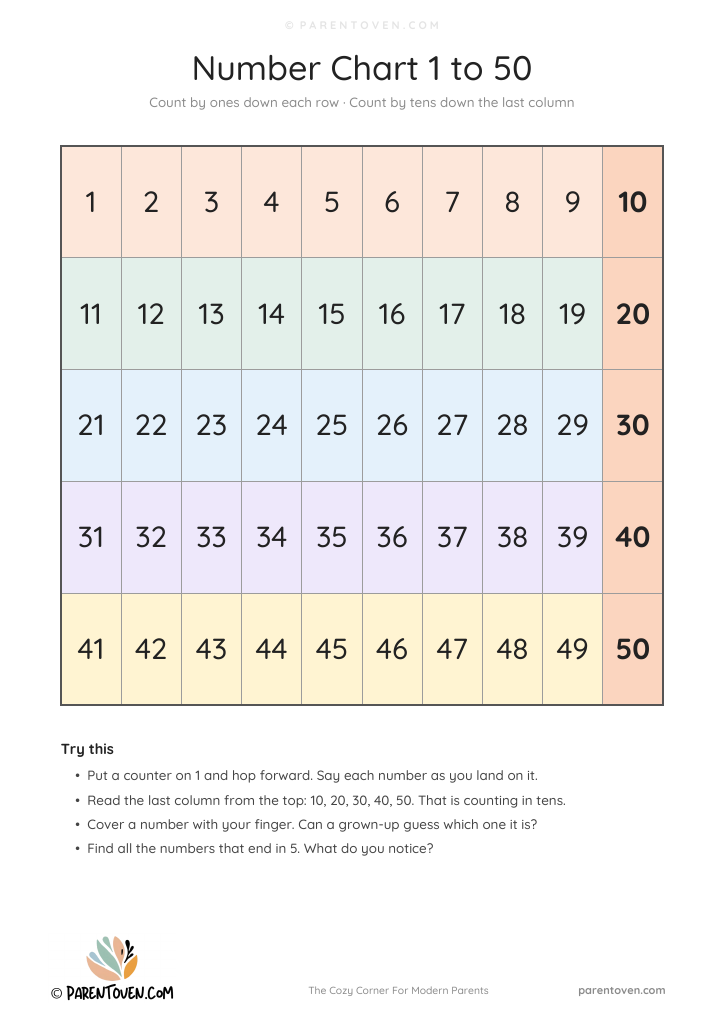
Number chart 1 to 50
Five rows of ten. The last column, 10 to 50, is shaded so children can count in tens down the side. A good bridge between 20 and the full hundreds chart.
- Hop a counter along the rows, saying each number.
- Count in tens down the shaded column: 10, 20, 30, 40, 50.
- Find every number that ends in 5 and colour it in.
A4 · PDF, 78 KB
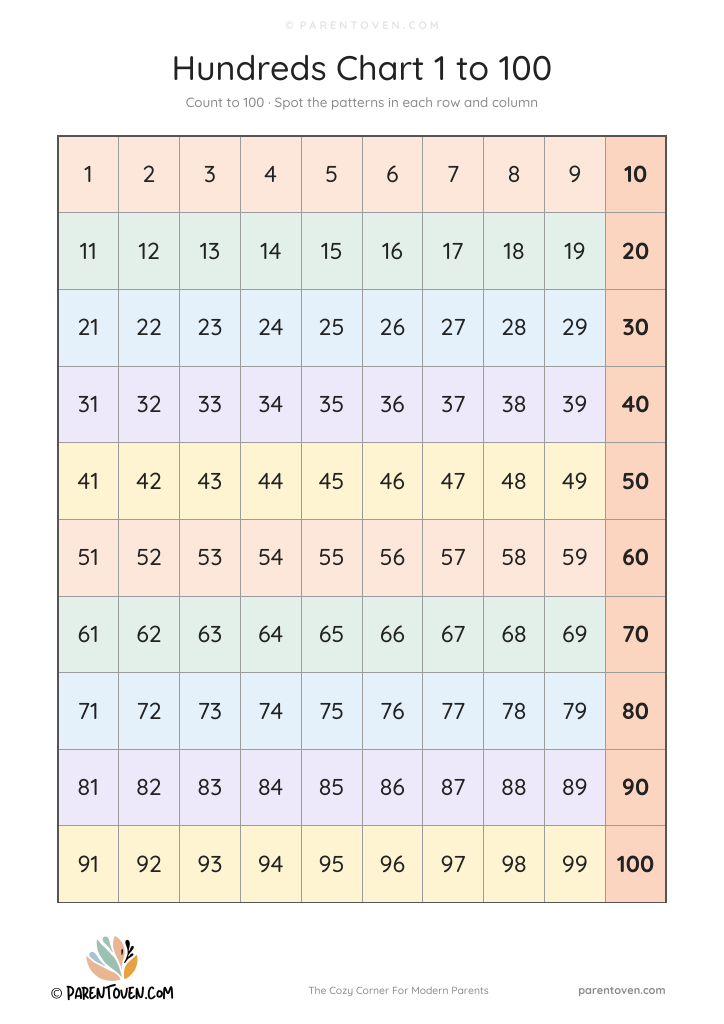
Hundreds chart 1 to 100
The classic hundreds chart: ten rows of ten with soft row colours and the tens column shaded. Use it for counting to 100, skip counting and spotting number patterns.
- Count to 100 in ones, then in tens.
- Colour every second number to see the even-number pattern.
- Put your finger on a number, then move one row down. What happened? You added ten.
A4 · PDF, 79 KB
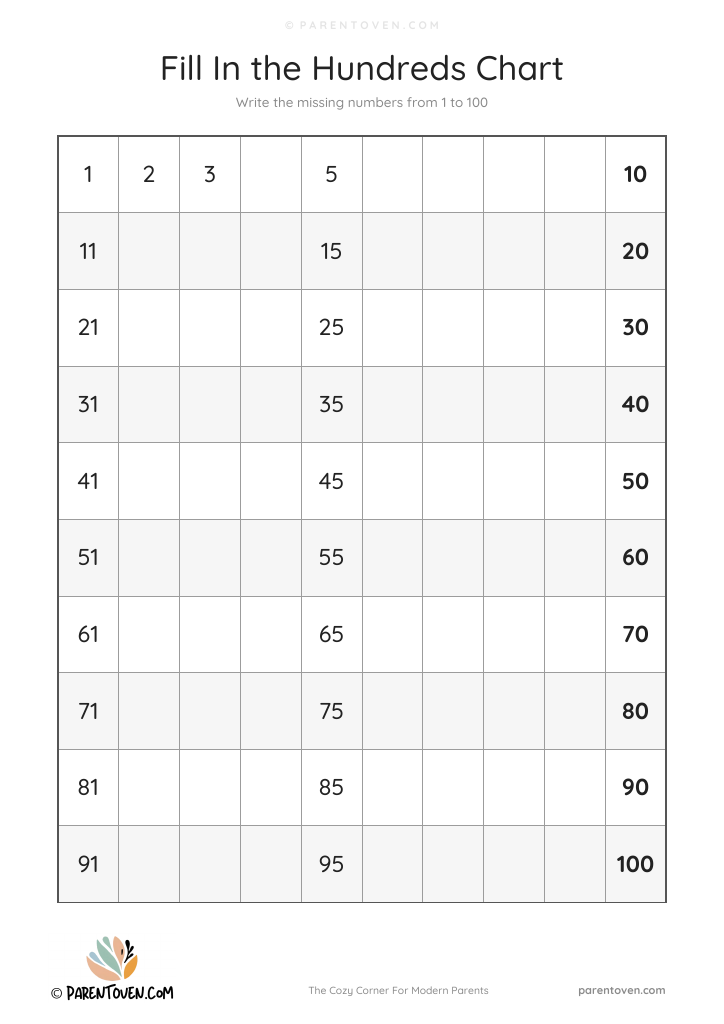
Blank hundreds chart (fill-in)
Two pages: the first has some numbers filled in (each row starts with its 1 and has its 5 and 10) so children can fill the gaps; the second is completely blank except for 1.
- Fill in one row a day instead of the whole chart at once.
- Use the partly filled page first, then the blank page when your child is ready.
- Compare the finished chart with the printed hundreds chart to check.
A4 · PDF, 79 KB · 2 pages
Hundreds chart games
- Missing number: cover five numbers with coins or sticky notes and ask your child to work out what is underneath.
- Ten more, ten less: pick a number, then move one square down (ten more) or one square up (ten less).
- Snake path: start at 1 and roll a dice; move that many squares and say the number you land on. First to 100 wins.
- Pattern colouring: colour every number ending in 0, then every number ending in 5. Two straight columns appear.
Number patterns to look for
Along each row, the ones digit goes up by one. Down each column, the tens digit goes up by one and the ones digit stays the same. Once children notice this, counting to 100 stops being a long list to memorise and becomes a pattern they can read.
Still learning to write the numbers? Try number tracing 1 to 10 and number tracing 11 to 20 first.
Put the charts to work with our maths worksheets: skip counting by 2s, 5s and 10s, missing numbers and before, after and between.
Frequently Asked Questions
What is a hundreds chart?
A hundreds chart is a 10-by-10 grid with the numbers 1 to 100 in order. Each row holds ten numbers, so patterns such as counting in tens appear as straight columns.
Which number chart should we start with?
Start with the 1 to 20 chart while your child is learning to count past ten. Move to the 1 to 50 chart, then the hundreds chart once counting to 30 or so feels easy.
How do you use a blank hundreds chart?
Children write the missing numbers in order. It shows whether they understand how the numbers run along each row and down each column. Start with the partly filled page.
What age are number charts for?
The 1 to 20 chart suits ages 4 to 6. The 1 to 50 and 1 to 100 charts are popular from about 5 to 8, in kindergarten and the first years of school.
Can I use these charts in my classroom?
Yes. All charts are free for home and classroom use. Please share the page link rather than re-uploading the PDFs.
Can you make a worksheet on another topic?
We would love to hear your idea. Email us at parentoven@gmail.com.
More Free Maths Worksheets
Also try: shapes worksheets · colour worksheets · all free worksheets