

Learning Worksheets Phonics L blends
Free printable PDF · blends · ages 6–7
L blends Worksheet: bl, cl, fl, gl, pl and sl (Free PDF)
Black, clap, flag, glue, plum and slide: l-blends are pairs of consonants where you can still hear both sounds, sliding quickly together.
Free for home and classroom use · A4 · 3 pages · PDF, 191 KB
What’s in the PDF
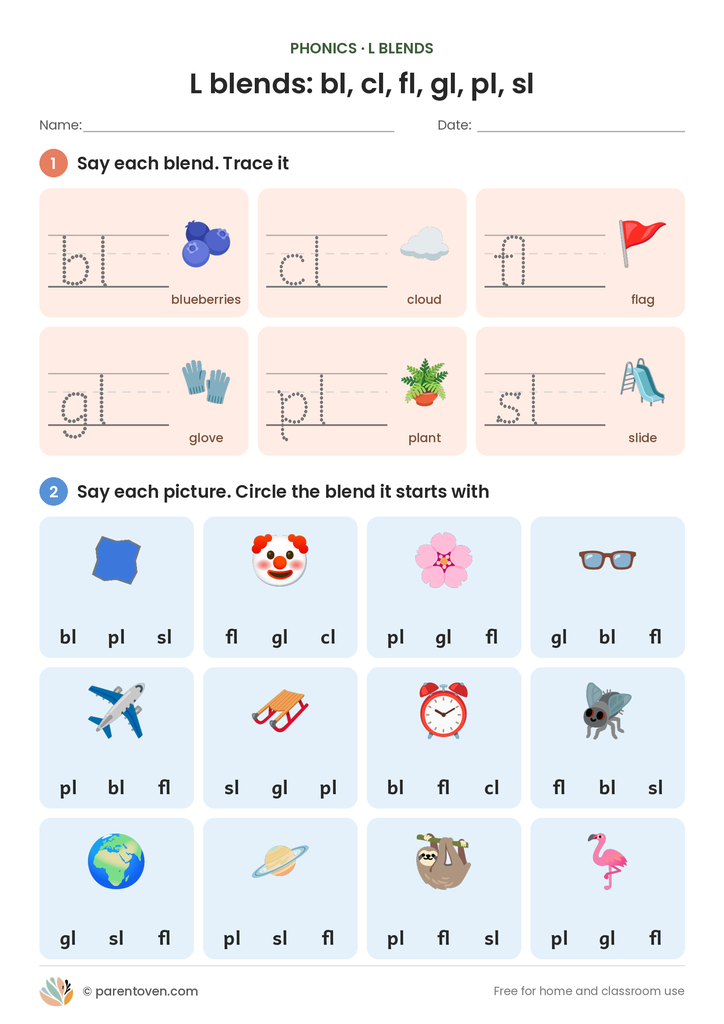
- Page 1: trace each blend (bl, cl, fl, gl, pl and sl) next to a picture, then circle the blend that starts each of 12 pictures.
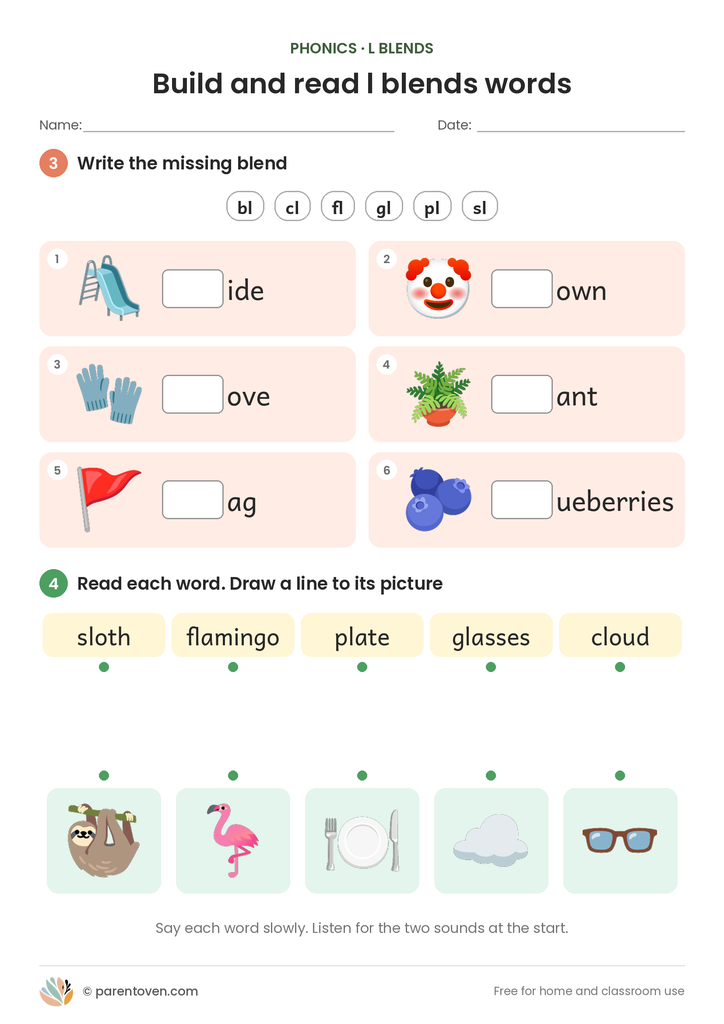
- Page 2: write the missing blend for six picture words, then read five words and match them to their pictures.
- Page 3: an answer key with every picture name.
Read the instructions aloud for children who are still learning to read. Say each picture name together first.
What are l blends?
A blend is two or three consonants together where each sound is still heard, such as b and l in blue. That is different from a digraph like sh, where two letters make one new sound. The l-blends are bl, cl, fl, gl, pl and sl.
How to say the blends
Say the first sound, then glide straight into the l without adding a vowel between them: b-l, not “buh-luh”. For practice, stretch it slowly (f-l-ag), then speed it up until it sounds like one smooth start (flag).
Examples
- bl: blue, block, black, blink
- cl: clap, clock, cloud, clown
- fl: flag, flat, flower, fly
- gl: glad, glass, globe, glove
- pl: plan, plate, plant, plum
- sl: slip, sled, slide, sloth
How to teach it
Start with words you can hear clearly, like flag, clap and slip. Say each sound as you touch a finger: f, l, a, g. Then push the first two fingers together and say fl as one quick chunk. On the worksheet, children trace each blend with its picture, circle the blend each picture starts with, then write the missing blend and match words to pictures.
Common mix-ups
Children often drop the second sound, reading “fag” for flag or “sip” for slip, because the l is quick and quiet. Ask them to point to every letter as they read. Another mix-up is adding a vowel between the sounds, as in “buh-lue”.
Game: Blend slide
Draw a slide on paper. Put the first letter at the top and l in the middle. Your child slides a toy down while saying the sounds, getting faster each time: s… l… sl! Then add an ending to make a word.
Questions to ask
- Can you hear both sounds at the start?
- Which blend starts this word: bl, cl or fl?
- What happens if we take away the l? (slip becomes sip)
Practise next
Try R blends, S blends, sh digraph. Warm up with the letter l sound. Reading CVC words confidently first? See our CVC word worksheets.
L blends questions
What is the difference between a blend and a digraph?
In a blend, you hear each letter’s sound (b and l in blue). In a digraph, two letters make one new sound (sh in ship).
When should children learn blends?
Usually once they can read CVC words like cat and sun confidently, often at age 5 or 6. Blends turn three-sound words into four-sound words, like lap into clap.
More answers in the phonics FAQ.
More Free Phonics Worksheets
Also try: CVC words · sight words · grade 1 worksheets