

Learning Worksheets Grammar for Kids Capitals and full stops
Free printable PDF · 2 levels · ages 5–7
Capital Letters and Full Stops Worksheet (Free PDF)
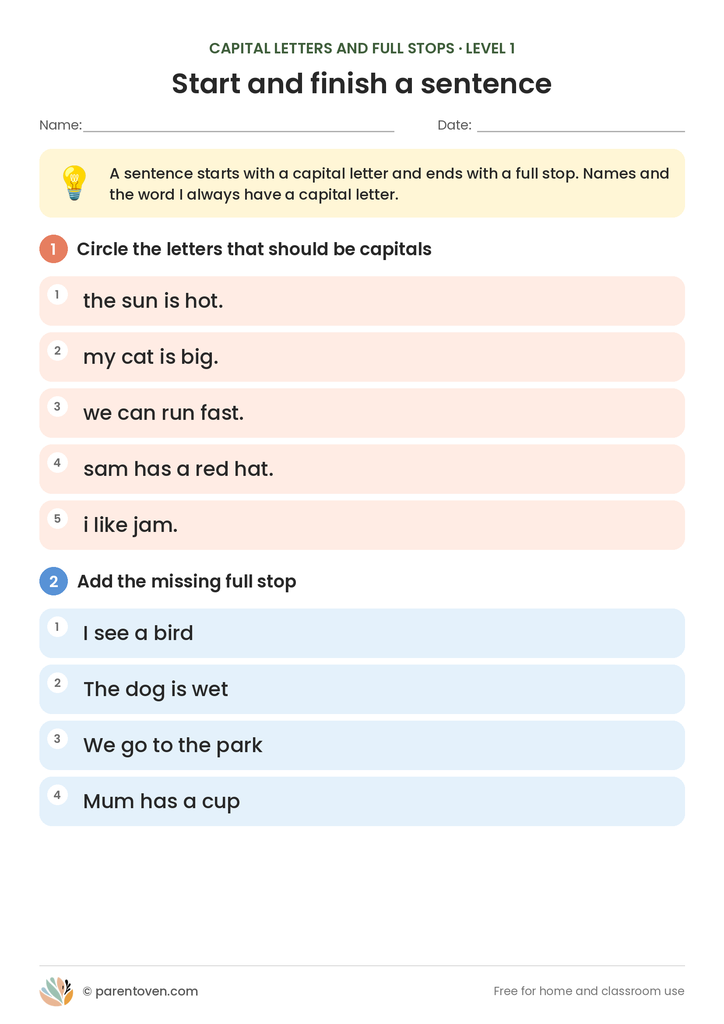
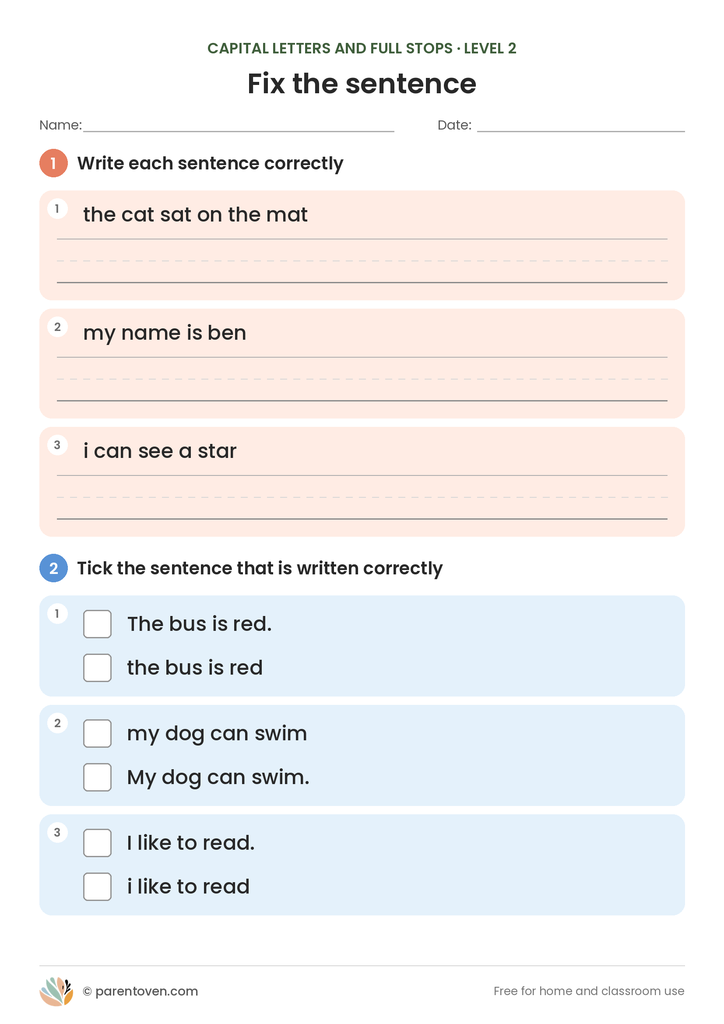
Every sentence starts with a capital letter and ends with a full stop. Children circle letters that need capitals, add missing full stops, fix sentences and spot the correct one.
Free for home and classroom use · A4 · 3 pages · PDF, 125 KB
What’s in the PDF
- Page 1 (Level 1, easier): a rule box, five sentences where children circle the letters that should be capitals, and four sentences that need a full stop.
- Page 2 (Level 2, harder): rewrite three sentences correctly on handwriting lines, then tick the correctly written sentence in three pairs.
- Page 3: an answer key for both levels.
Read the instructions aloud for early readers. Children can point or say the answer before they write it.
What are capital letters and full stops?
A capital letter shows where a sentence begins, and a full stop (called a period in American English) shows where it ends. Names of people and places, and the word I, always have a capital letter, wherever they are in a sentence.
Examples
- The sun is hot.
- My name is Ben.
- I like to read.
- We went to the park.
- Sam and I can swim.
How to teach it
Read a sentence aloud and stop at the full stop with a little pause. Show that the next sentence starts with a capital. When your child writes, ask them to check two things only: is there a capital at the start, and a full stop at the end? A small tick for each builds the habit.
Common mix-ups
Children often add capitals in the middle of words or forget the word I. Some put a full stop at the end of every line rather than every sentence. Reading their writing aloud helps them hear where sentences really end.
Game: Sentence detective
Write three short sentences with mistakes: no capitals, no full stops, a lowercase name. Your child is the detective and circles every mistake with a coloured pencil.
Questions to ask
- Where does this sentence start?
- What do we put at the end?
- Which words always need a capital?
Practise next
Try nouns, pronouns, verbs. Practise neat capitals with alphabet tracing A to Z.
Capitals and full stops questions
Is it a full stop or a period?
Both words mean the same dot at the end of a sentence. Full stop is used in British English and period in American English.
Why does I always have a capital letter?
It is a rule of English writing. The word I is always a capital, even in the middle of a sentence.
More answers in the grammar for kids FAQ.
More Free Grammar Worksheets
Also try: sight words · CVC words · maths worksheets