

Learning Worksheets Maths Money
Free printable PDF · grade 2 · ages 6–8
Money Worksheet: Counting Coins (Free Printable PDF)
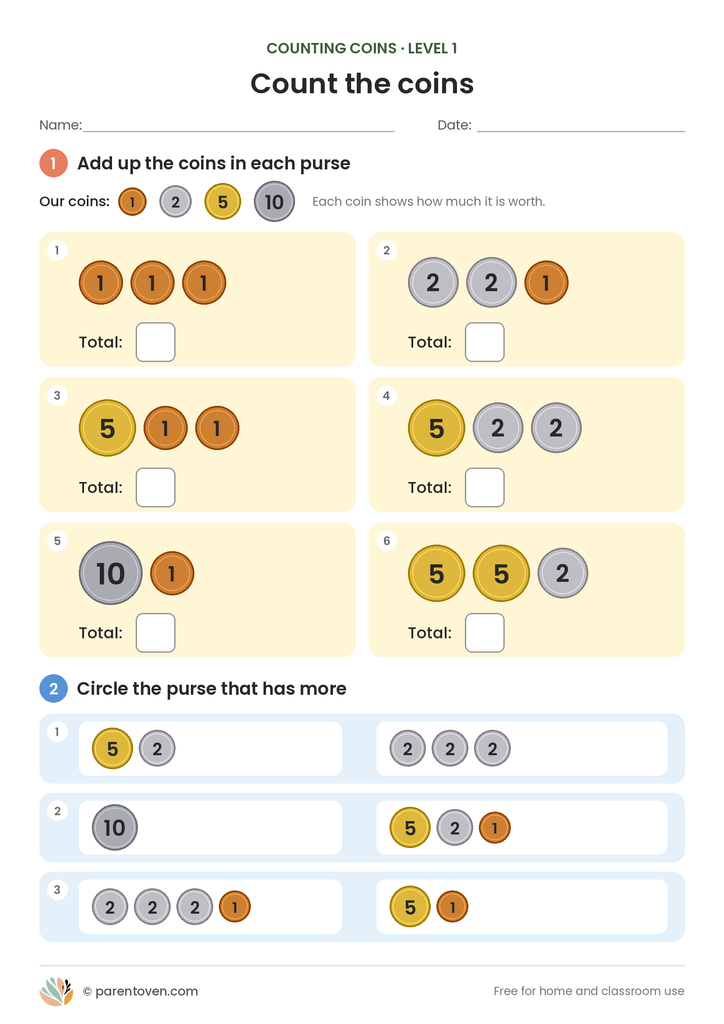
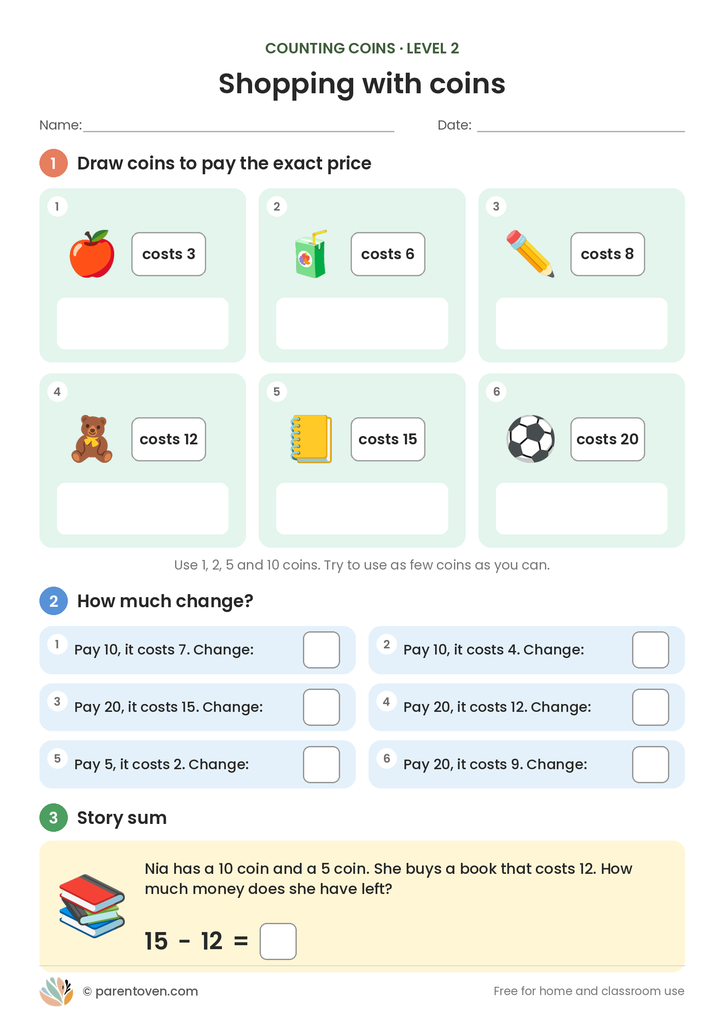
Count coins and pay for things using simple coins worth 1, 2, 5 and 10. The coins are generic, so the worksheet works with any currency, from dollars and pounds to rupees and euros.
Free for home and classroom use · A4 · 3 pages · PDF, 151 KB
What’s in the PDF
- Page 1 (Level 1, easier): It has six purses of coins to add up, such as 5 + 2 + 2, plus three pairs of purses where children circle the one with more money.
- Page 2 (Level 2, harder): It has six price tags where children draw coins to pay the exact amount, six “how much change?” questions within 20, and a shopping story problem.
- Page 3: an answer key for both levels.
Print one level at a time. If Level 1 feels easy, move straight on to Level 2.
How to teach money
Children first need to understand that a coin’s value is not the same as the number of coins: one 10 coin is worth more than three 2 coins. Count bigger coins first, then count on with the smaller ones. Use real coins from your own currency if you have them, matching them to the 1, 2, 5 and 10 coins on the sheet.
What to watch for
The most common mistake is counting coins instead of adding their values, so 10 + 1 becomes 2. Encourage children to say the value of each coin aloud as they touch it. For change, act it out: pay with a 10 coin, then count up from the price to 10.
Game: Corner shop
Set up a play shop with toys and price labels from 1 to 20. Your child pays with play or real coins and you give change. Then swap roles so they have to work out the change for you.
Everyday practice
Let your child pay for something small at a shop, or count the coins in a money box. Talking about prices while shopping, such as which costs more, builds money sense.
Questions to ask while they work
- Which coin is worth the most?
- Can you make 7 in a different way?
- How much change do you get from 10 if it costs 6?
Practise next
Try addition within 20, subtraction within 20, place value. Counting coins builds on skip counting by 2s, 5s and 10s.
Money questions
Why do the worksheets use generic coins?
Families use many different currencies. Coins worth 1, 2, 5 and 10 match the most common coin values around the world, so the skills transfer to your own money.
What money skills do children learn in grade 2?
Most grade 2 children learn to count mixed coins, make amounts in different ways, compare amounts and work out simple change.
How can I help my child count coins?
Sort the coins from biggest to smallest value, then count on: 10, 15, 17, 18. Practising with real coins at home helps a lot.
More answers in the maths worksheets FAQ.
More Free Grade 2 Maths Worksheets
Also try: grade 2 worksheets · second grade sight words · phonics worksheets