

Learning Worksheets Maths Telling time
Free printable PDF · grade 2 · ages 6–8
Telling Time Worksheet: O’clock and Half Past (Free PDF)
Read and draw o’clock and half past times on an analogue clock. Children read the hour hand and minute hand, write times in words and digits, and draw the hands themselves.
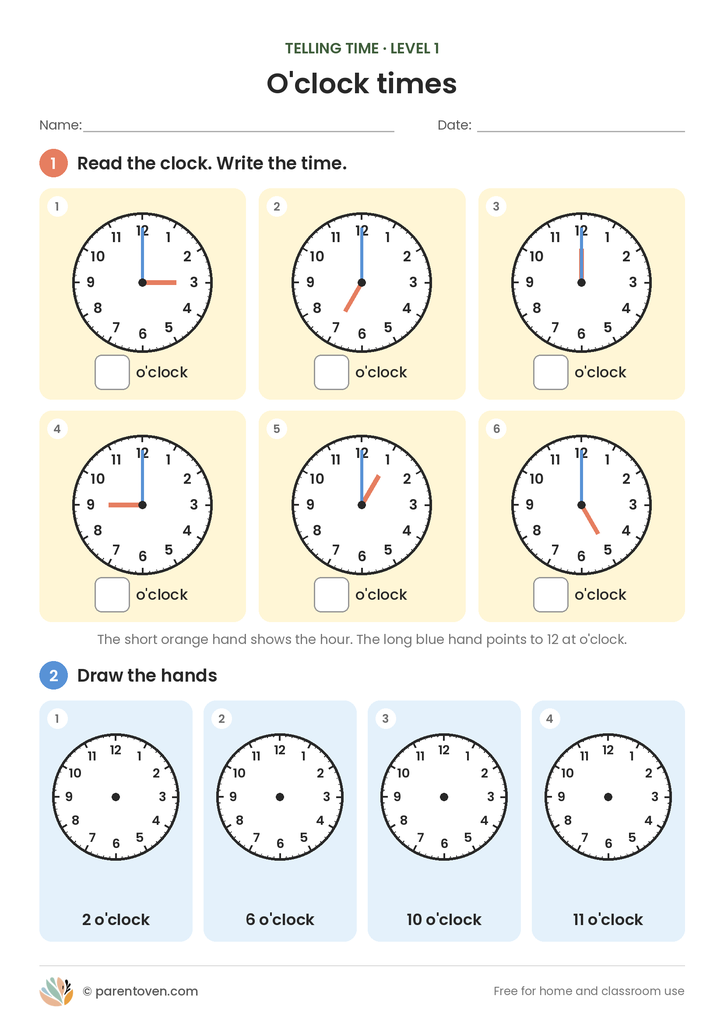
Free for home and classroom use · A4 · 3 pages · PDF, 154 KB
What’s in the PDF
- Page 1 (Level 1, easier): It has six o’clock clocks to read and write, plus four blank clock faces where children draw the hands for times such as 2 o’clock.
- Page 2 (Level 2, harder): It has six clocks showing half past or o’clock times to write in digits, such as 4:30, and four blank clocks to draw half past times.
- Page 3: an answer key for both levels.
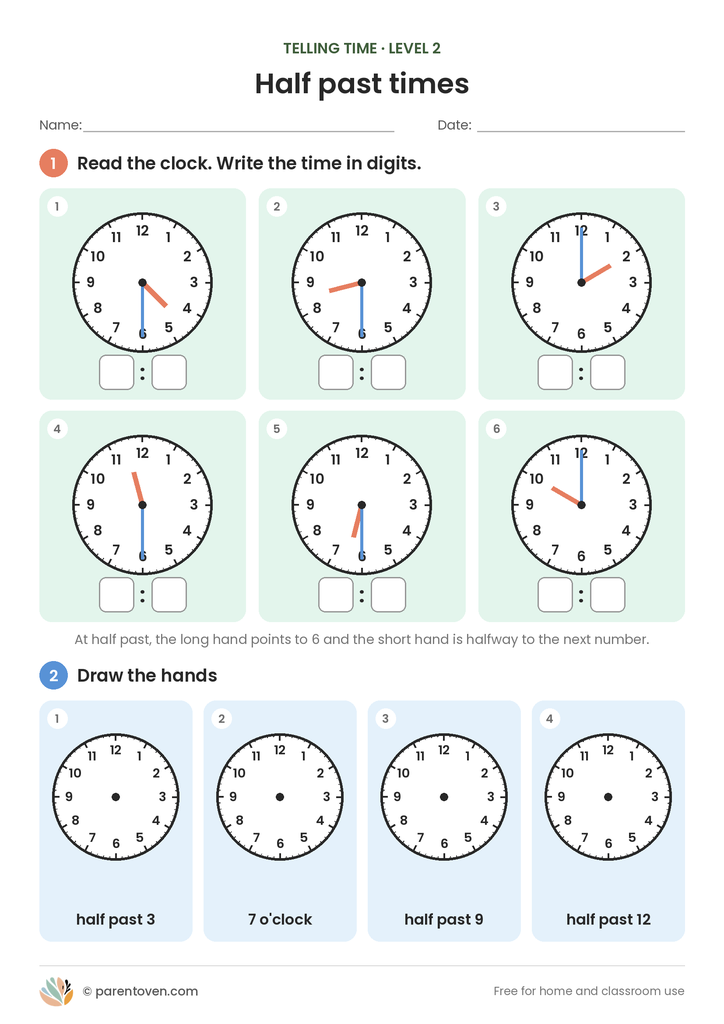
Print one level at a time. If Level 1 feels easy, move straight on to Level 2.
How to teach telling time
Start with the two hands. The short hand shows the hour and the long hand shows the minutes. At o’clock, the long hand points straight up at 12. At half past, it points straight down at 6, and the short hand has moved halfway to the next number. A toy clock or a paper plate clock with split-pin hands lets children move the hands themselves.
What to watch for
Children often mix up the two hands, reading the long hand as the hour. Colour-coding helps: on our worksheets the hour hand is orange and short. At half past, some children read the hour hand as the next number; remind them it is still the earlier hour until the long hand comes back to 12.
Game: What time is it, Mr Wolf?
Play the classic game, but the wolf shows the time on a toy clock instead of saying it. Players read the clock and take that many steps. At 12 o’clock, it is dinner time and the wolf chases!
Everyday practice
Point to a clock at key moments of the day: we eat lunch at 12 o’clock, bath time is half past 6. Children who hear times linked to routines learn them much faster.
Questions to ask while they work
- Which hand is the hour hand?
- Where does the long hand point at half past?
- What time will it be in one hour?
Practise next
Try place value, money, addition within 20. Counting round the clock in fives is easier after practising skip counting by 5s.
Telling time questions
What age do children learn to tell time?
Most children start with o’clock and half past at around 6 or 7, then learn quarter past, quarter to and five-minute times by around 8.
Should children learn analogue or digital time first?
Both are useful. Analogue clocks show how time passes around the face, while digital times are easier to read. Our worksheets practise writing analogue times in digits, like 4:30.
What does half past mean?
Half past means 30 minutes after the hour. Half past 3 is 3:30.
More answers in the maths worksheets FAQ.
More Free Grade 2 Maths Worksheets
Also try: grade 2 worksheets · second grade sight words · phonics worksheets