

Learning Worksheets Sight Words Sight word “think”
Free printable PDF · Dolch first grade · ages 6–7
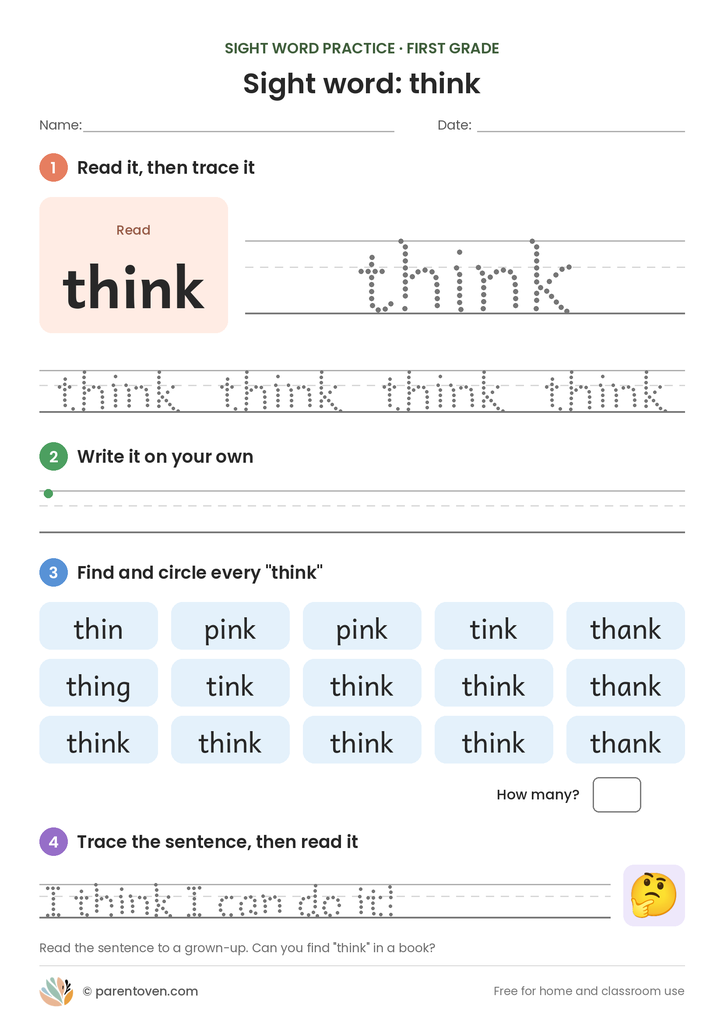
Sight Word “think” Worksheet: Read, Trace and Circle
“Think” means to use your brain: I think it will rain, let me think. It is a great word for talking about ideas.
Try this game: I think it is…
Put an object in a bag. Your child feels it without looking and guesses: I think it is a spoon. Then they look to check. Take turns.
Teaching tips for “think”
Think starts with th and ends with ink, as in pink and sink. Show your child how to make a “thinking face” and tap their head. Ask questions with no right answer: what do you think a cat dreams about? Every “I think…” answer uses the word.
“think” in a sentence
- I think it is sunny.
- Let me think.
- What do you think?
- I think I can do it!
What to learn next
Good next words are “know” and “thank”, because know is another thinking word, and thank looks very similar.
You will find “think” at number 38 of 41 on the Dolch first grade list. Most children reach it at ages 6–7, once the primer words feel easy. It contains the th digraph, so it pairs well with our th digraph worksheet.
Inside the free “think” PDF
Four short activities: trace “think”, write it on your own, find it in a grid with thank, thin, pink, thing and tink, and trace the sentence “I think I can do it!”.
“think”: quick answers
Is think easy to sound out?
Yes, once children know the th sound. Th-i-n-k has the -ink chunk, as in pink.
What is the difference between think and thank?
Only one letter. Think is about ideas; thank is about being grateful. Saying them in sentences helps.
More First Grade Sight Word Worksheets
Also try: phonics worksheets · CVC word worksheets · cursive letter tracing · all free worksheets