

Learning Worksheets Sight Words Sight word “has”
Free printable PDF · Dolch first grade · ages 6–7
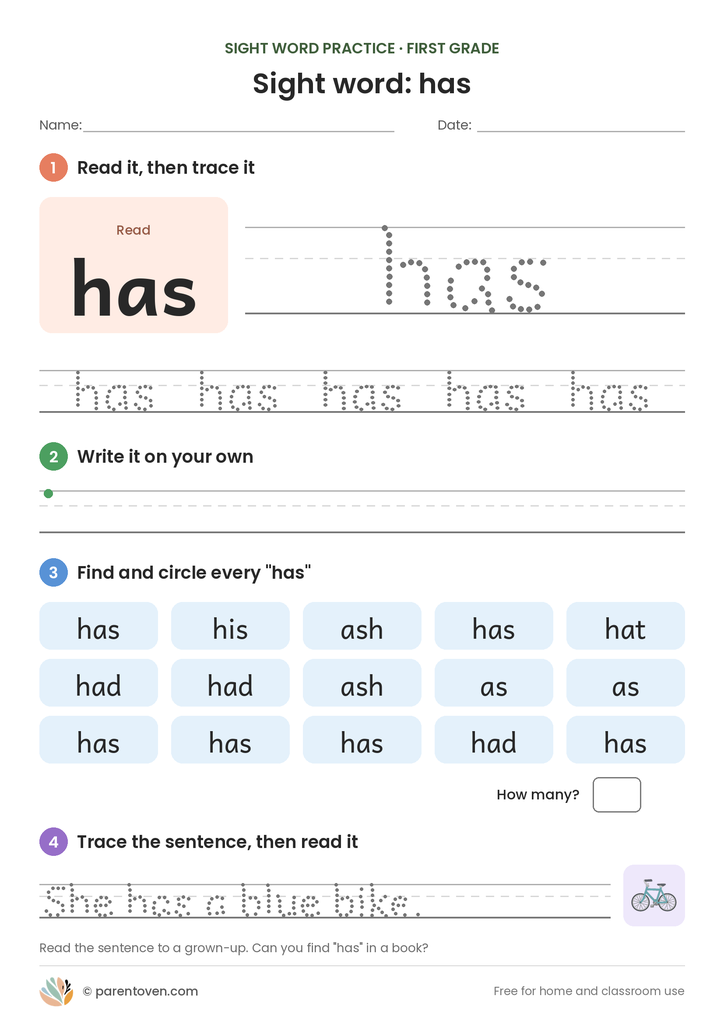
Free Sight Word “has” Worksheet for Kids
“Has” tells us that someone owns or holds something now: she has a kite, the cat has a toy. It is used with he, she, it and names.
Play Who has it?
Pass a small toy around a circle while music plays. When it stops, everyone points and says “Mia has it!” or “Teddy has it!”. Write has on a card and hold it up each time.
Helping your child learn “has”
Has looks like it should end with /s/, but the s buzzes like /z/. Say it slowly with your child and feel the buzz on your teeth. Then play a “who has it?” game: hide a coin in one hand and ask your child to guess. “Dad has it!” uses the word naturally.
Example sentences
- She has a blue bike.
- The cat has a toy.
- Who has my sock?
- He has two pets.
Where to go next
After this one, move on to “had” and “his” (they share the same first letter and are often confused).
On the Dolch first grade list, “has” sits at number 15 of 41. Children often learn it between ages 6–7, building on the primer words.
The “has” page at a glance
Children trace “has”, write it from memory, hunt for it among had, hat, as, his and ash, and finish by tracing “She has a blue bike.”.
Parents ask about “has”
When do children use has instead of have?
Has goes with he, she, it and single names: she has, Sam has. Have goes with I, you, we and they.
Why does has sound like haz?
The s at the end of short words often says /z/, as in is, his and as.
Still curious? Read the sight words FAQ.
More First Grade Sight Word Worksheets
Also try: phonics worksheets · CVC word worksheets · cursive letter tracing · all free worksheets