

Learning School readiness checklist
Free printable · ages 4–6 · 2 pages
School Readiness Checklist: Free Printable for Ages 4 to 6
A friendly, two-page checklist of 26 everyday skills that help children settle into school, from opening a lunch box to taking turns. It is not a test: tick what your child can do and turn the rest into games. Page 2 shows when children start school in India and around the world.
A4 PDF, 270 KB · prints in colour or black and white
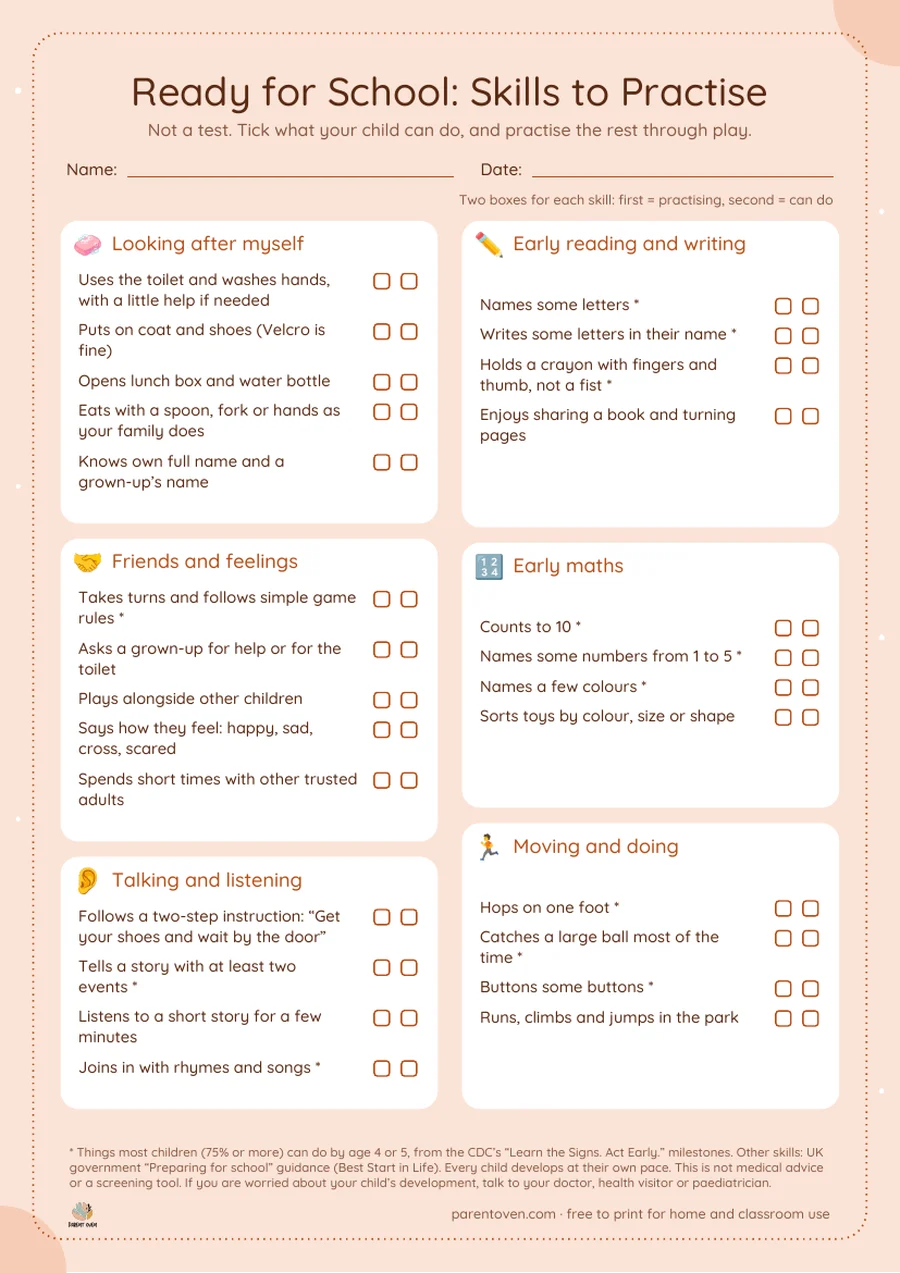
What is on the checklist
Six areas, 26 skills
Items marked * are CDC milestones: things most children (75% or more) can do by age 4 or 5. The others come from the UK government’s “Preparing for school” guidance.
🧼 Looking after myself
- Uses the toilet and washes hands, with a little help if needed
- Puts on coat and shoes (Velcro is fine)
- Opens lunch box and water bottle
- Eats with a spoon, fork or hands as your family does
- Knows own full name and a grown-up’s name
🤝 Friends and feelings
- Takes turns and follows simple game rules *
- Asks a grown-up for help or for the toilet
- Plays alongside other children
- Says how they feel: happy, sad, cross, scared
- Spends short times with other trusted adults
👂 Talking and listening
- Follows a two-step instruction: “Get your shoes and wait by the door”
- Tells a story with at least two events *
- Listens to a short story for a few minutes
- Joins in with rhymes and songs *
✏️ Early reading and writing
- Names some letters *
- Writes some letters in their name *
- Holds a crayon with fingers and thumb, not a fist *
- Enjoys sharing a book and turning pages
🔢 Early maths
- Counts to 10 *
- Names some numbers from 1 to 5 *
- Names a few colours *
- Sorts toys by colour, size or shape
🏃 Moving and doing
- Hops on one foot *
- Catches a large ball most of the time *
- Buttons some buttons *
- Runs, climbs and jumps in the park
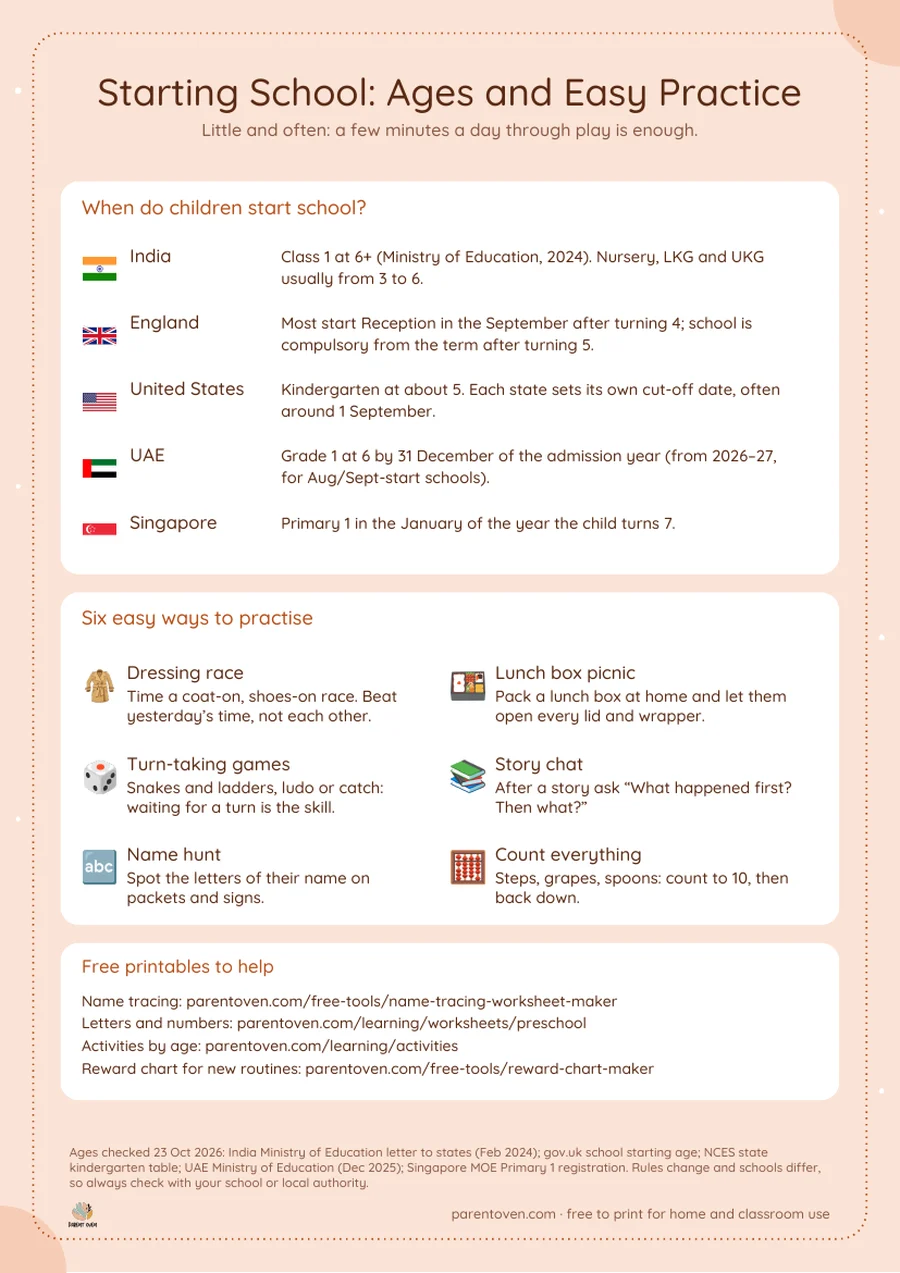
When do children start school?
Starting ages differ a lot between countries, and even between schools and states. These were checked on 23 October 2026; always confirm with your school or local authority.
| Country | When children start school |
|---|---|
| India | Class 1 from age 6+. The Ministry of Education asked all states to set 6 as the minimum age for Class 1 from 2024–25, in line with NEP 2020. Most children go to nursery, LKG and UKG (or an anganwadi) from about 3 to 6. Source: Indian Express, Feb 2024 |
| England | Most children start Reception full-time in the September after their fourth birthday. School is compulsory from the term after a child turns 5. Source: GOV.UK |
| United States | Kindergarten usually starts at about 5. Each state sets its own cut-off date; in many it is around 1 September. Source: NCES state table |
| UAE | From 2026–27, Grade 1 at 6 by 31 December of the admission year, and KG1 at 4, for schools starting in August or September. April-start schools use 31 March. Source: UAE Ministry of Education |
| Singapore | Primary 1 starts in the January of the year a child turns 7. Children born 2 January 2020 to 1 January 2021 start in January 2027. Source: MOE Singapore |
How to use the checklist
- Print it and fill it in together over a week, not in one sitting.
- Use the first box for “practising” and the second for “can do”.
- Pick one or two “practising” skills a week and turn them into a game.
- Look again a month later and tick the new ones.
Easy ways to practise at home
- Dressing race: time coat-on and shoes-on, and beat yesterday’s time.
- Lunch box picnic: let them open every lid and wrapper themselves.
- Turn-taking games: snakes and ladders, ludo or catch.
- Story chat: after a story, ask “What happened first? Then what?”
- Name hunt: spot the letters of their name on packets and signs, then trace it with our name tracing maker.
- Count everything: stairs, grapes, spoons. Try our counting 1 to 10 worksheet.
More ideas: activities for 4-year-olds · activities for 5-year-olds · preschool worksheets
What if my child cannot do these yet?
That is completely normal. Many of these skills develop during the first year of school, and teachers expect a wide range. Tell the school about anything your child finds hard, like using the toilet alone, so they can help from day one.
Not medical advice. This checklist is for fun and practice at home. It is not medical advice, a diagnosis or a screening tool. Children develop at different rates. If you are worried about your child’s development, talk to your doctor, health visitor or paediatrician. Milestones from the CDC “Learn the Signs. Act Early.” programme; practical skills from Best Start in Life: Preparing for school (UK government).
School readiness questions
At what age is a child ready for school?
There is no single age. In India Class 1 starts at 6+, while in England most children start Reception at 4. Readiness is more about independence, confidence and curiosity than a birthday.
Does my child need to read before starting school?
No. Knowing some letters and enjoying books helps, but teachers teach reading at school. Talking, singing and sharing stories at home matter most.
Should I delay school if my child is not ready?
Some countries allow a later start; in England, for example, a child can start Reception later or part time. Talk to the school and, if you have developmental worries, your doctor or health visitor.
Is this a developmental screening tool?
No. It is a practice checklist for home. For milestone checklists, see the CDC; for any concerns, talk to a health professional.
Get ready together
Also try: fun firsts keepsake checklist · reading path