
Learning Worksheets Seasonal Winter
Free printable PDFs · ages 3–7 · 43-page pack with answers
Free Winter Worksheets for Kids (Printable PDF Pack)
Twelve winter worksheets for ages 3 to 7, plus a 14-day winter-break plan that turns them into one short activity a day. Children trace winter lines, count snowflakes in ten frames, sort animals that hibernate, migrate or adapt, read simple sentences and solve a maze. Most sheets have an easier and a harder level, answer keys are at the back, and every sheet comes in colour or ink-saving black and white. It works with or without snow: a snowy December in Canada or a foggy January in Delhi.
Winter is December to February in the north · Free · A4 (prints on US Letter) · no sign-up
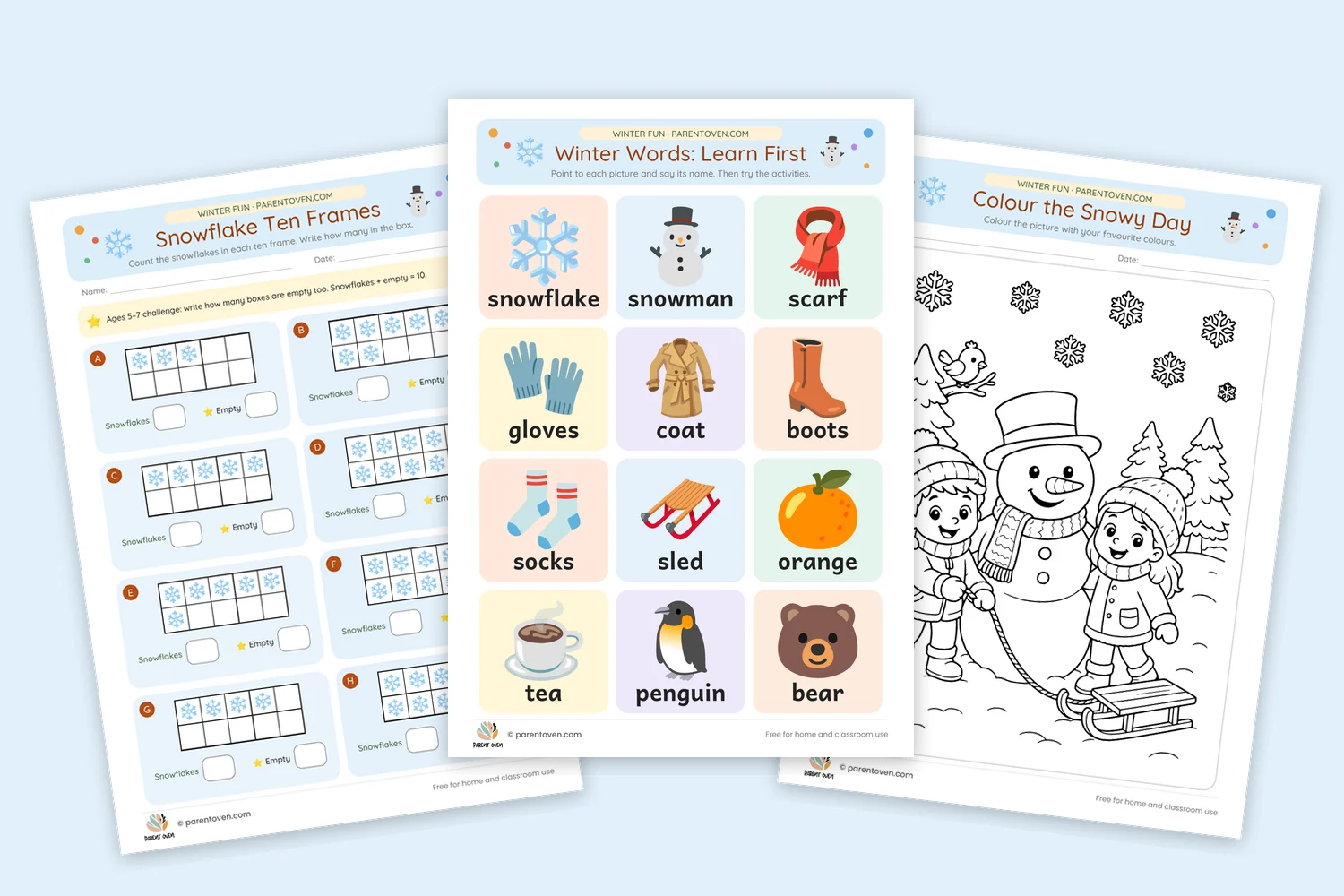
Picture chart · 12 sheets in two levels · 14-day plan · 2 coloring pages · answer keys · colour 788 KB, black and white 738 KB
Free winter printables
12 winter worksheets and 2 coloring pages
Each sheet is a separate PDF in colour and in black and white, so you can print only what you need. The same winter words come back across the sheets, so children keep meeting them in new ways.
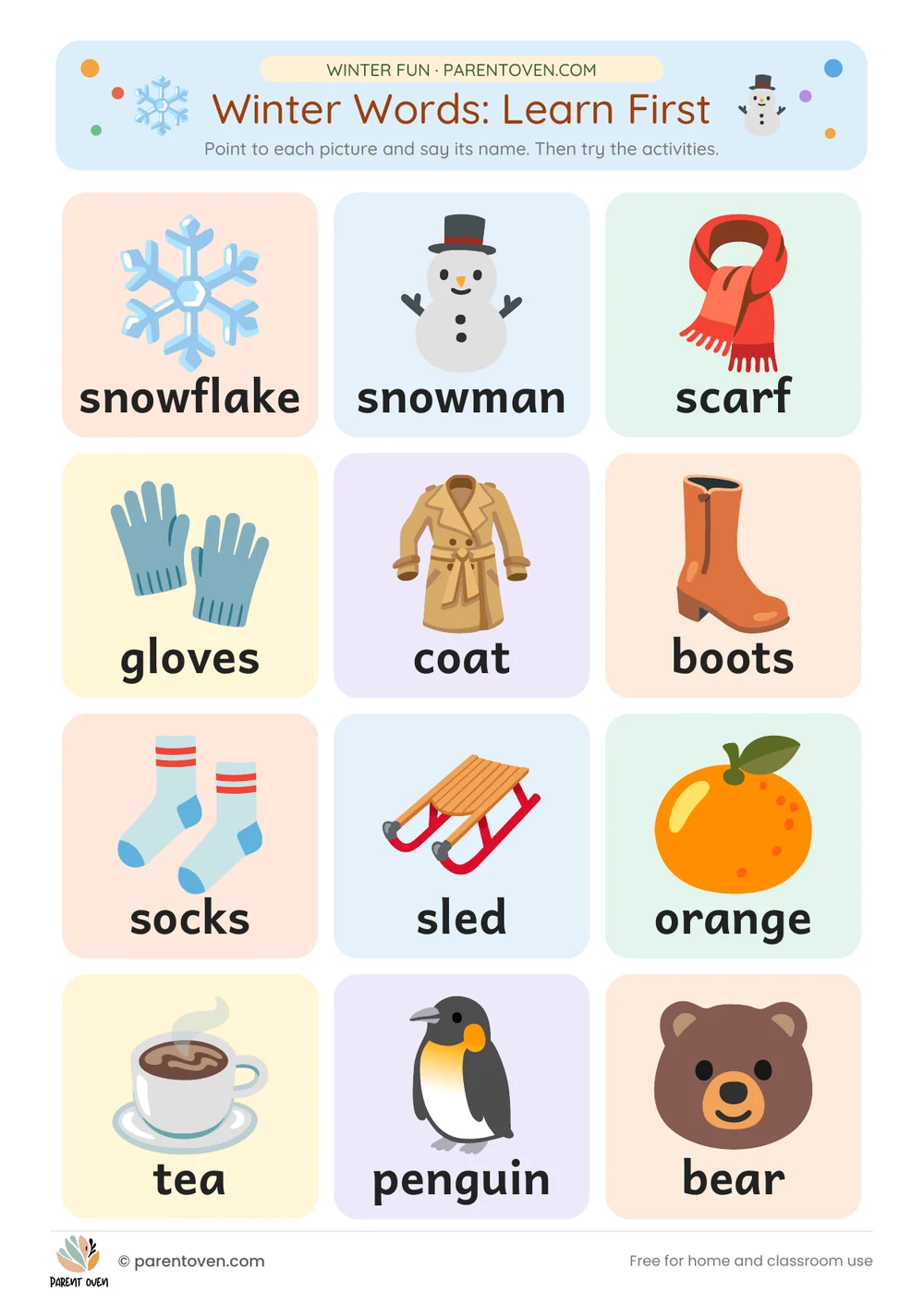
Winter words and tracing
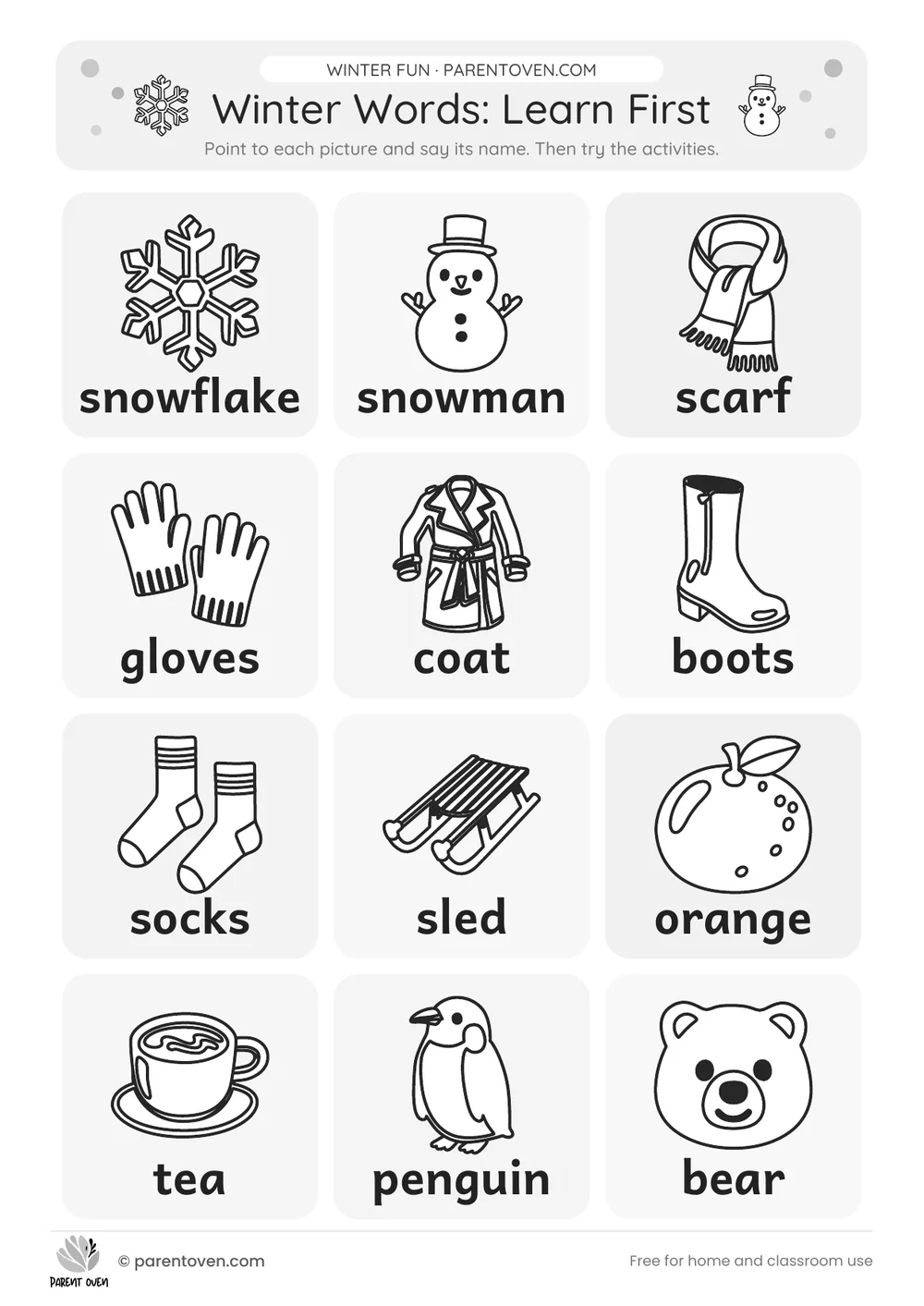
Talk about a picture chart of 12 winter words (snowflake, scarf, gloves, boots, orange, tea and more), then trace seven of them. Level 2 shows only the picture: children write each word on the lines, with a word bank to help.
A4 · 3 pages · colour 225 KB · black and white 193 KB
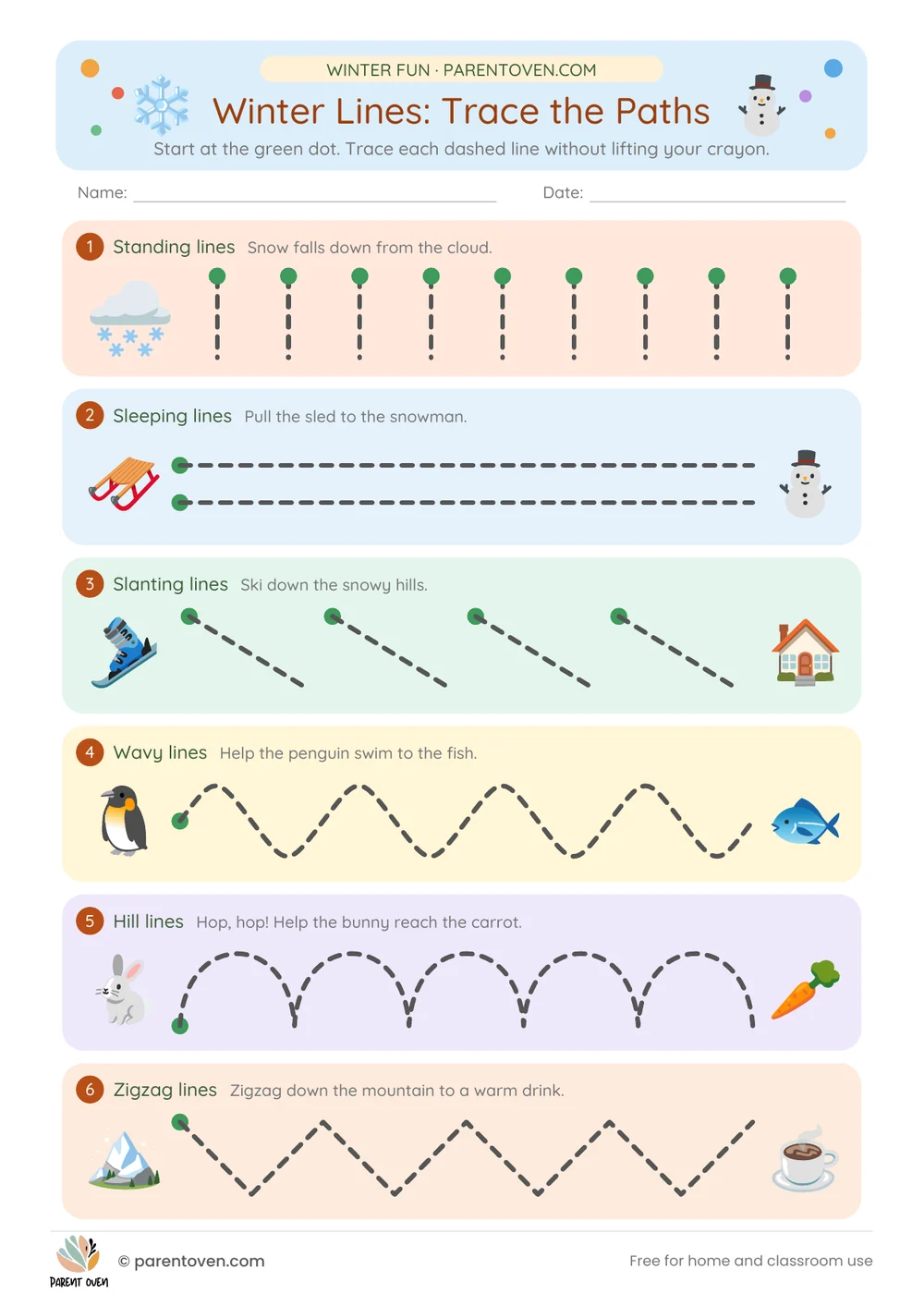
Winter lines: pre-writing tracing
Six dashed paths in the order small hands usually manage them: standing, sleeping and slanting lines, waves, hills and zigzags, each starting at a green dot. Level 2 has smaller lines for a pencil.
A4 · 2 pages · colour 172 KB · black and white 137 KB
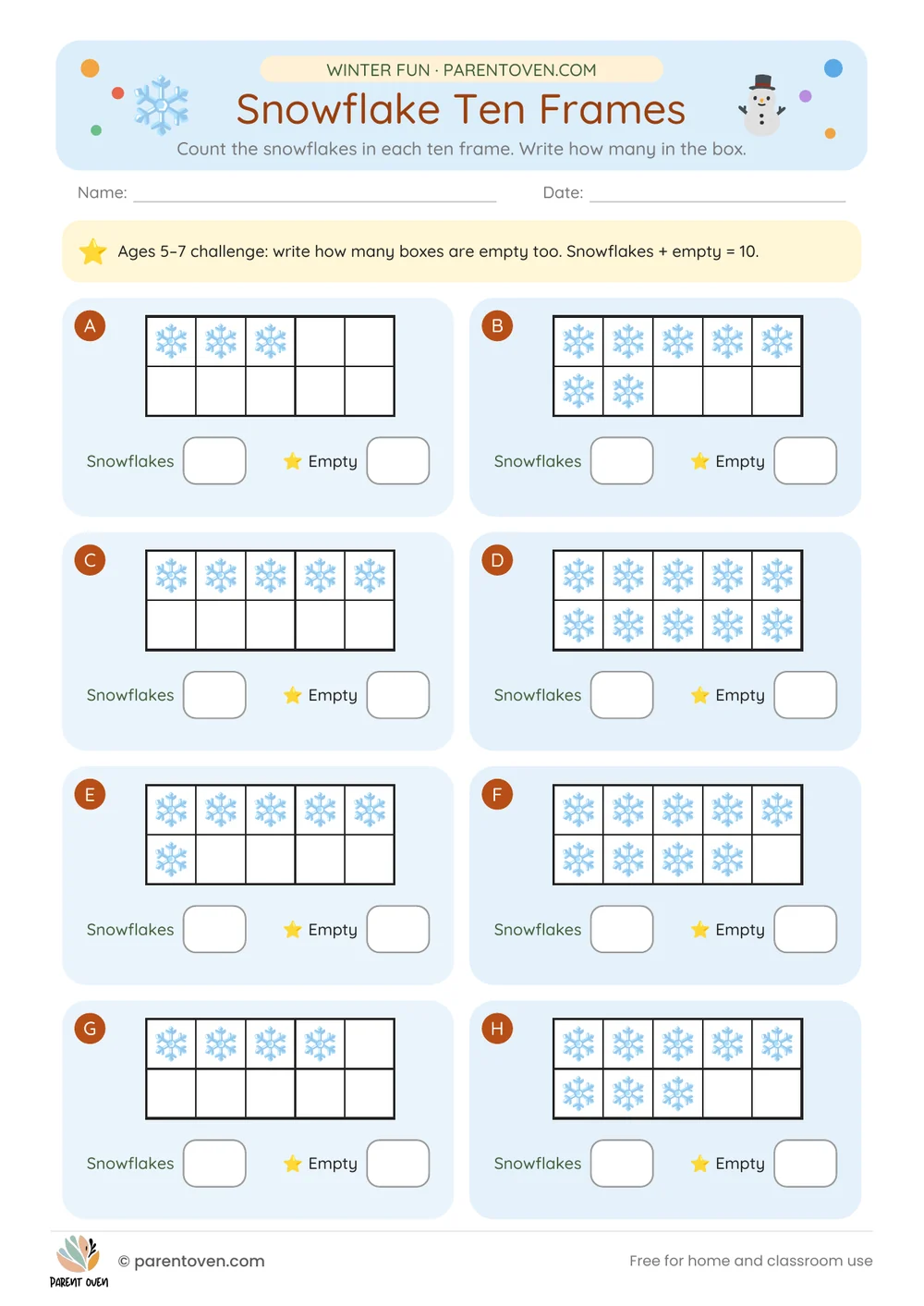
Snowflake ten frames
Count 3 to 10 snowflakes in eight ten frames, filled top row first. Older children also write how many boxes are empty: snowflakes and empty boxes always make 10. Level 2 uses double ten frames for teen numbers, such as 10 + 2 = 12.
A4 · 4 pages with answers · colour 172 KB · black and white 140 KB
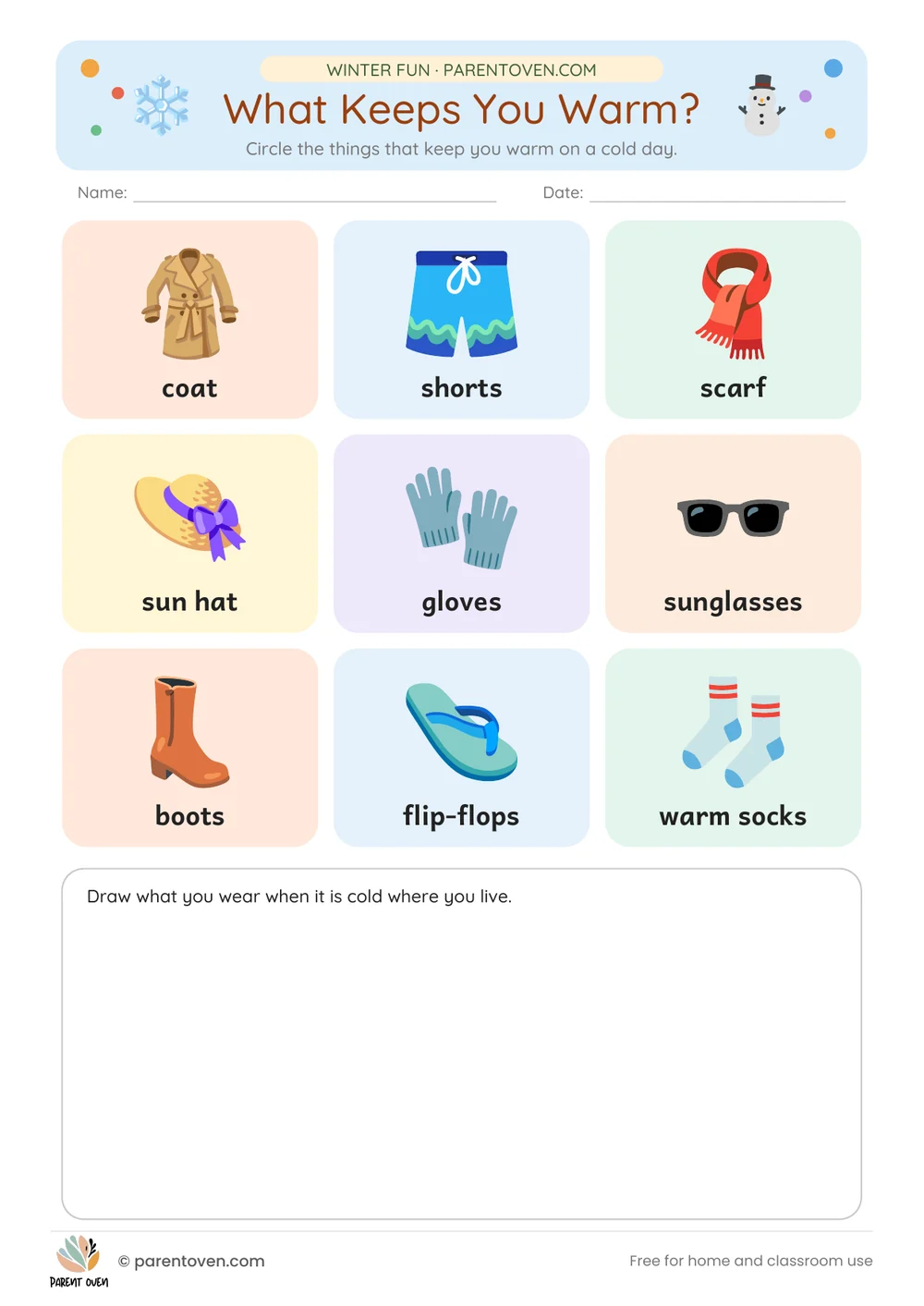
Dress for the weather
Level 1: circle the five things that keep you warm, and talk about why sunglasses and flip-flops do not. Level 2: tick what you would wear on a snowy day, a foggy, cold morning and a cool, rainy day.
A4 · 4 pages with answers · colour 197 KB · black and white 163 KB
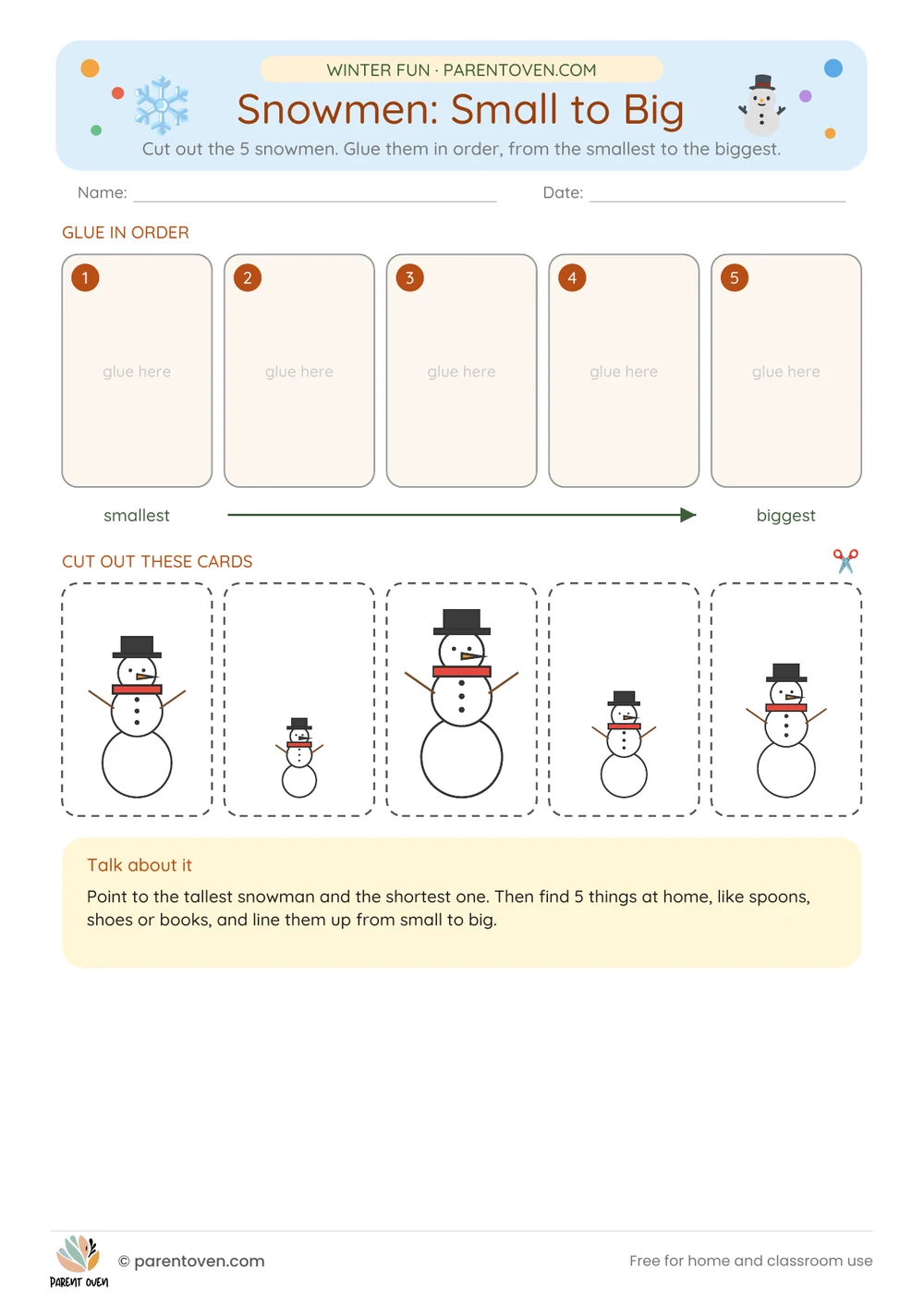
Snowman sizes and shapes
Cut out five snowmen and glue them in order from smallest to biggest. Level 2: count the circles, triangles and rectangles in a snowy garden, then build your own snowman from shapes.
A4 · 4 pages with answers · colour 172 KB · black and white 140 KB
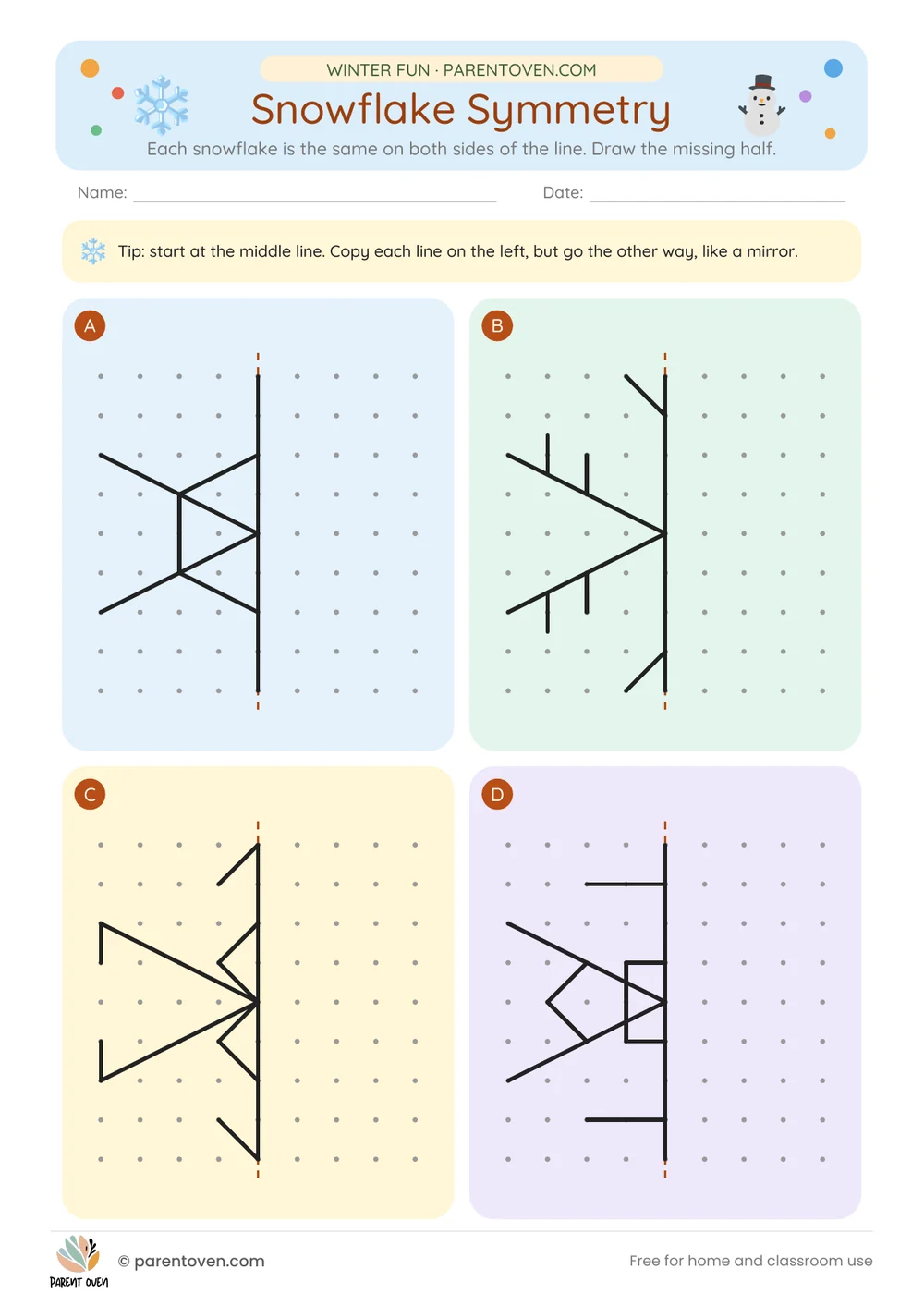
Snowflake symmetry
Draw the missing half of four snowflakes on a dot grid, like a mirror. Level 2: count the six arms of a real snowflake, design your own on six guide lines, then fold and cut a paper one.
A4 · 3 pages with answers · colour 169 KB · black and white 137 KB
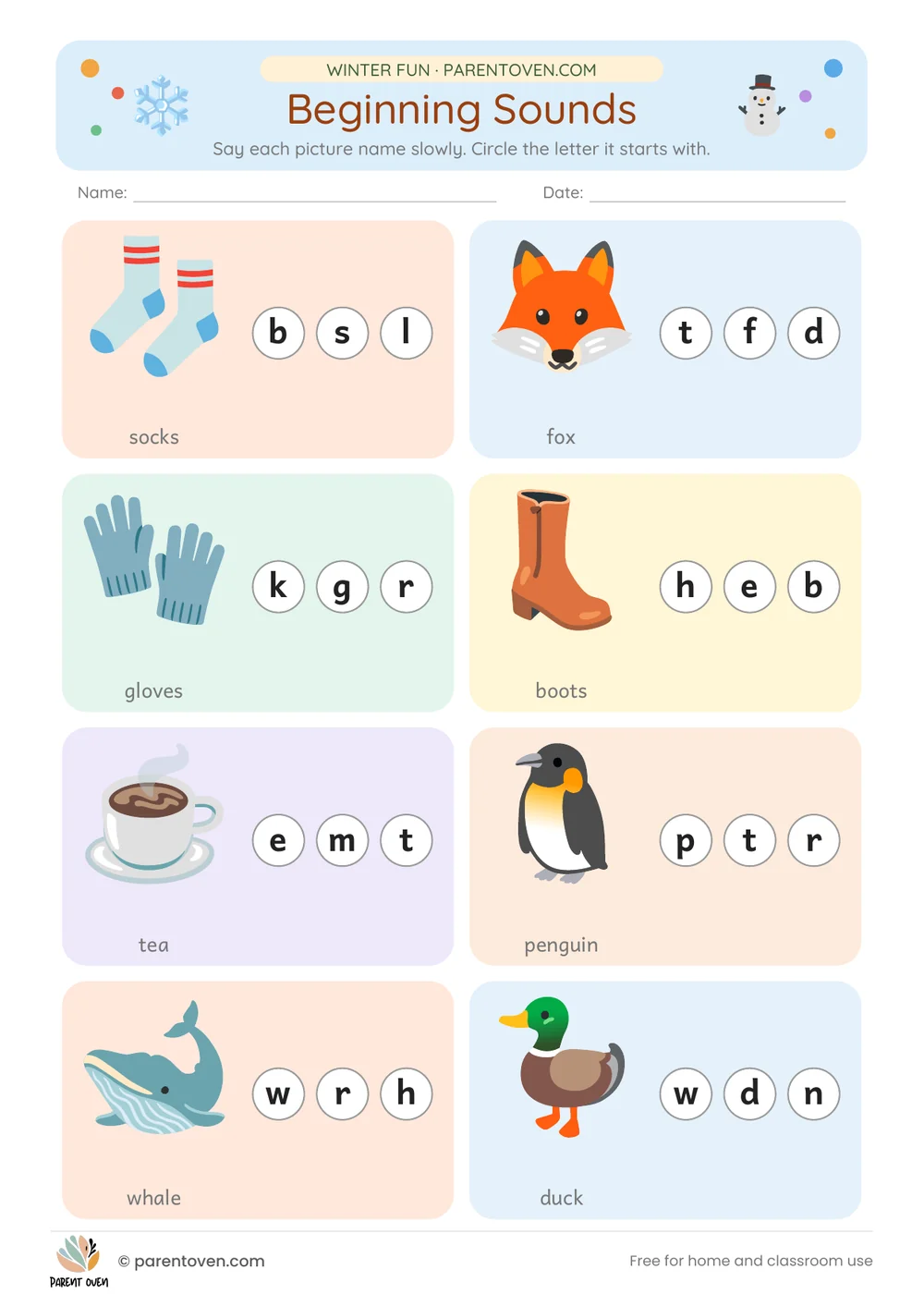
Winter sounds and reading
Level 1: say each picture name slowly and circle its first letter (socks, fox, gloves, boots…). Level 2: read six short sentences, such as “The cup is hot.”, and circle the picture that matches.
A4 · 4 pages with answers · colour 222 KB · black and white 186 KB
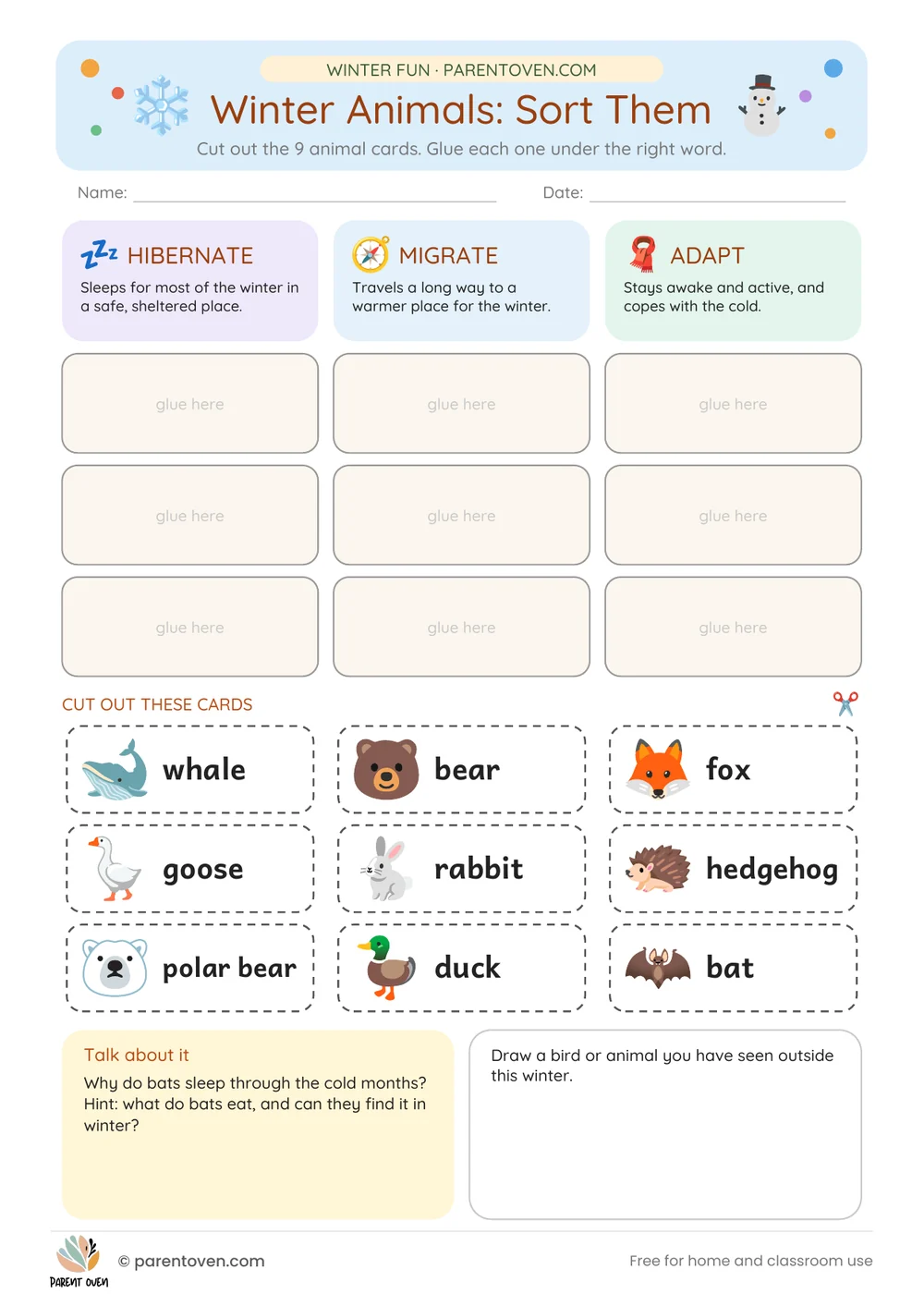
Winter animals: hibernate, migrate or adapt
Cut out nine animals and glue each under the right word: bear, hedgehog and bat hibernate; goose, duck and humpback whale migrate; polar bear, fox and rabbit stay active. Level 2: eight true-or-false sentences, such as “Sloth bears in India hibernate.”
A4 · 4 pages with answers · colour 199 KB · black and white 163 KB
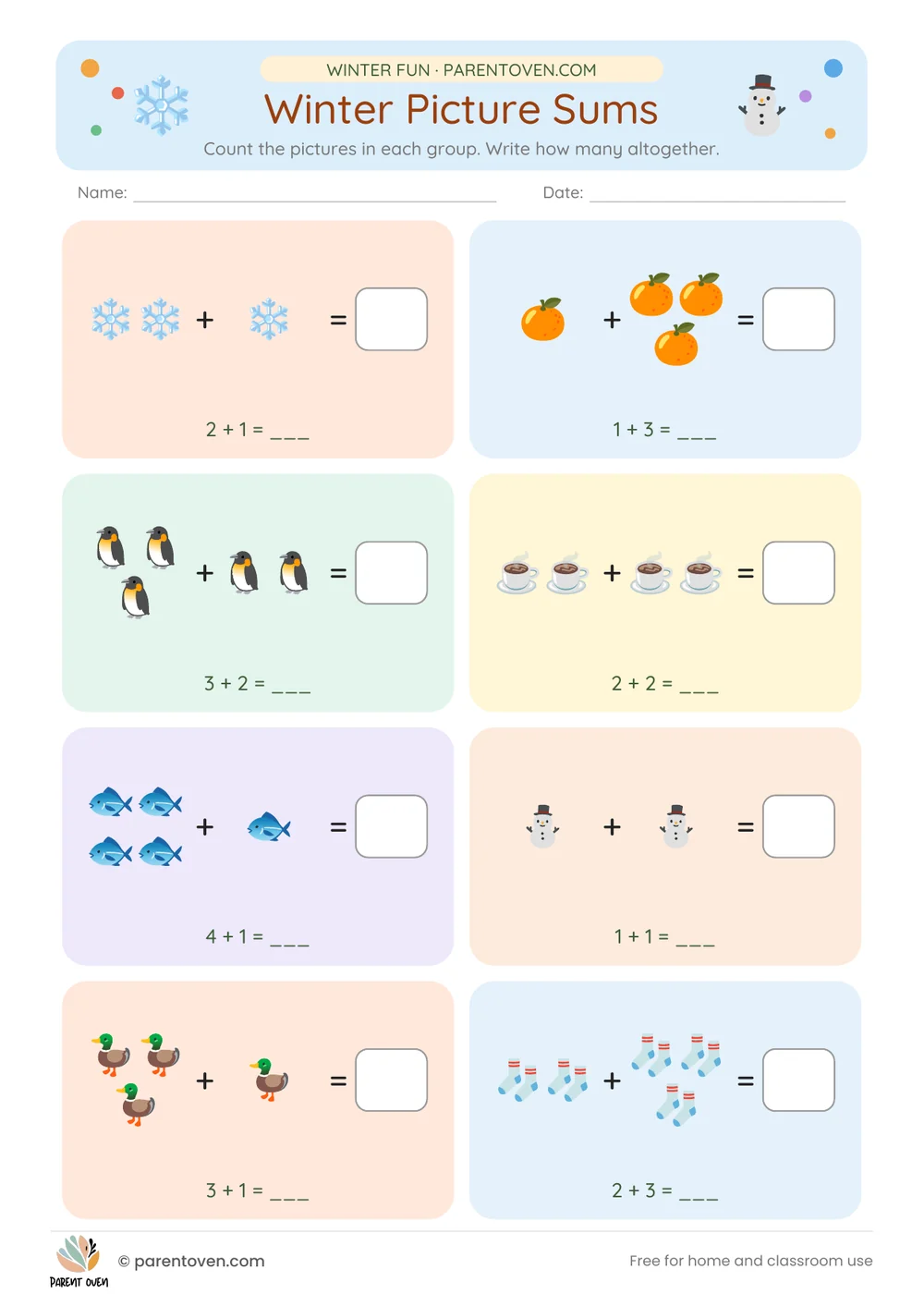
Winter maths: add and take away
Level 1: picture sums within 5. Level 2: adding and taking away within 10, the missing numbers that make 10 (7 + __ = 10) and two short word problems.
A4 · 4 pages with answers · colour 179 KB · black and white 146 KB
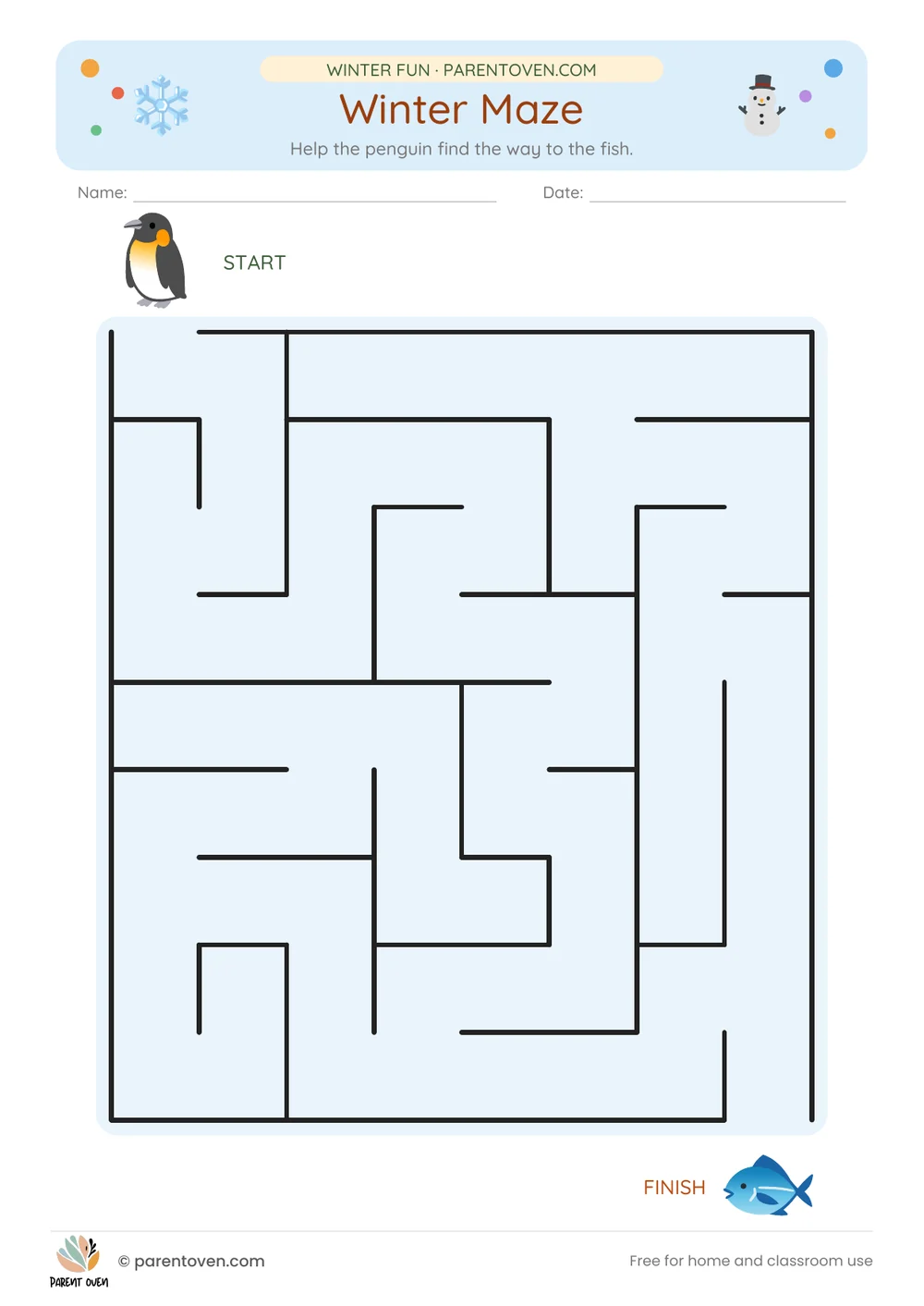
Winter maze and word search
Help the penguin reach the fish in a wide-path maze and a trickier Level 2 maze, then find eight winter words (across and down only) with a picture word bank.
A4 · 6 pages with answers · colour 193 KB · black and white 159 KB
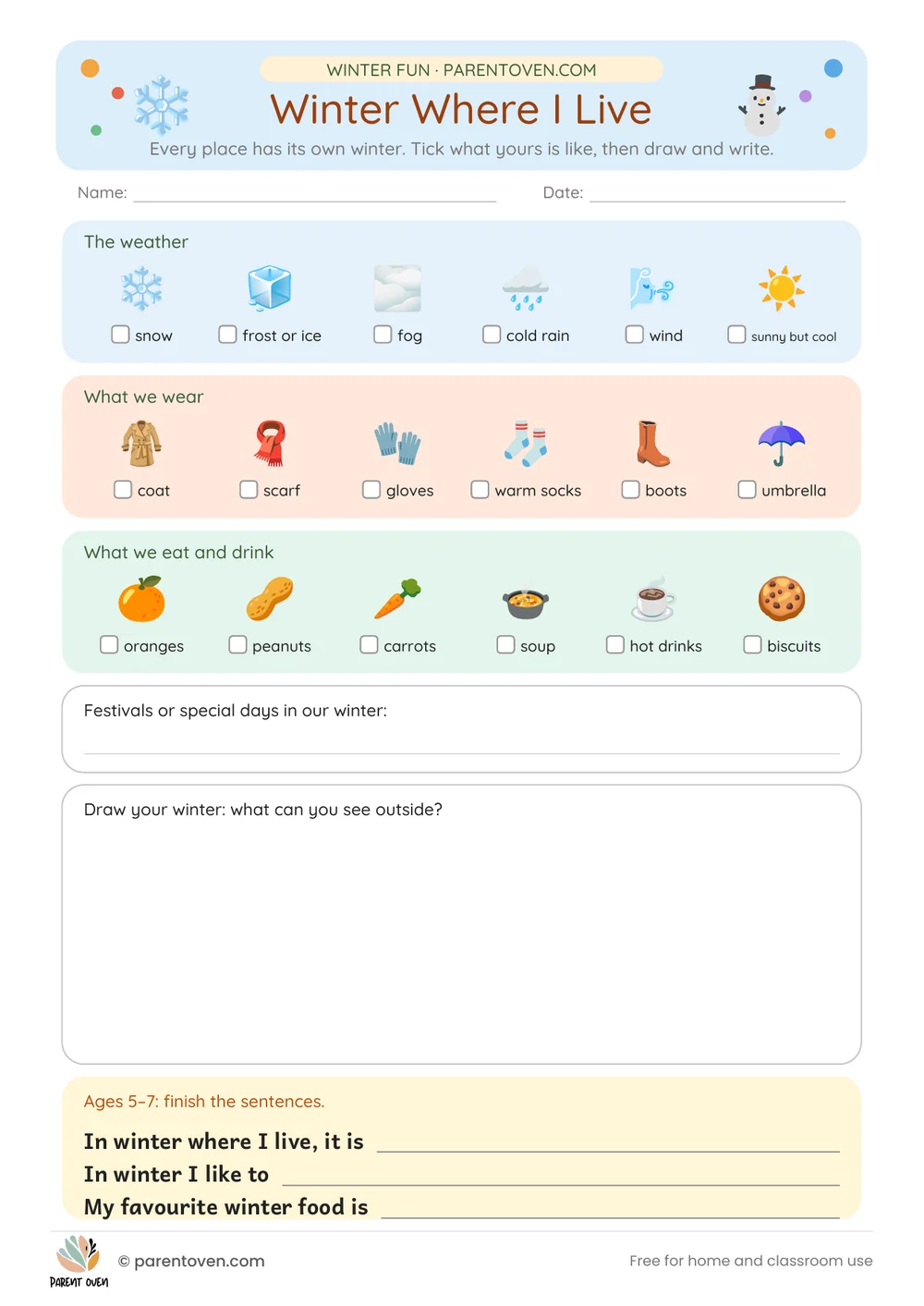
Winter where I live
Tick your weather (snow, frost, fog, cold rain, wind, or sunny but cool), what you wear and what you eat and drink. Then write your festivals or special days and draw your winter. Older children finish three sentences.
A4 · 1 page · colour 199 KB · black and white 163 KB
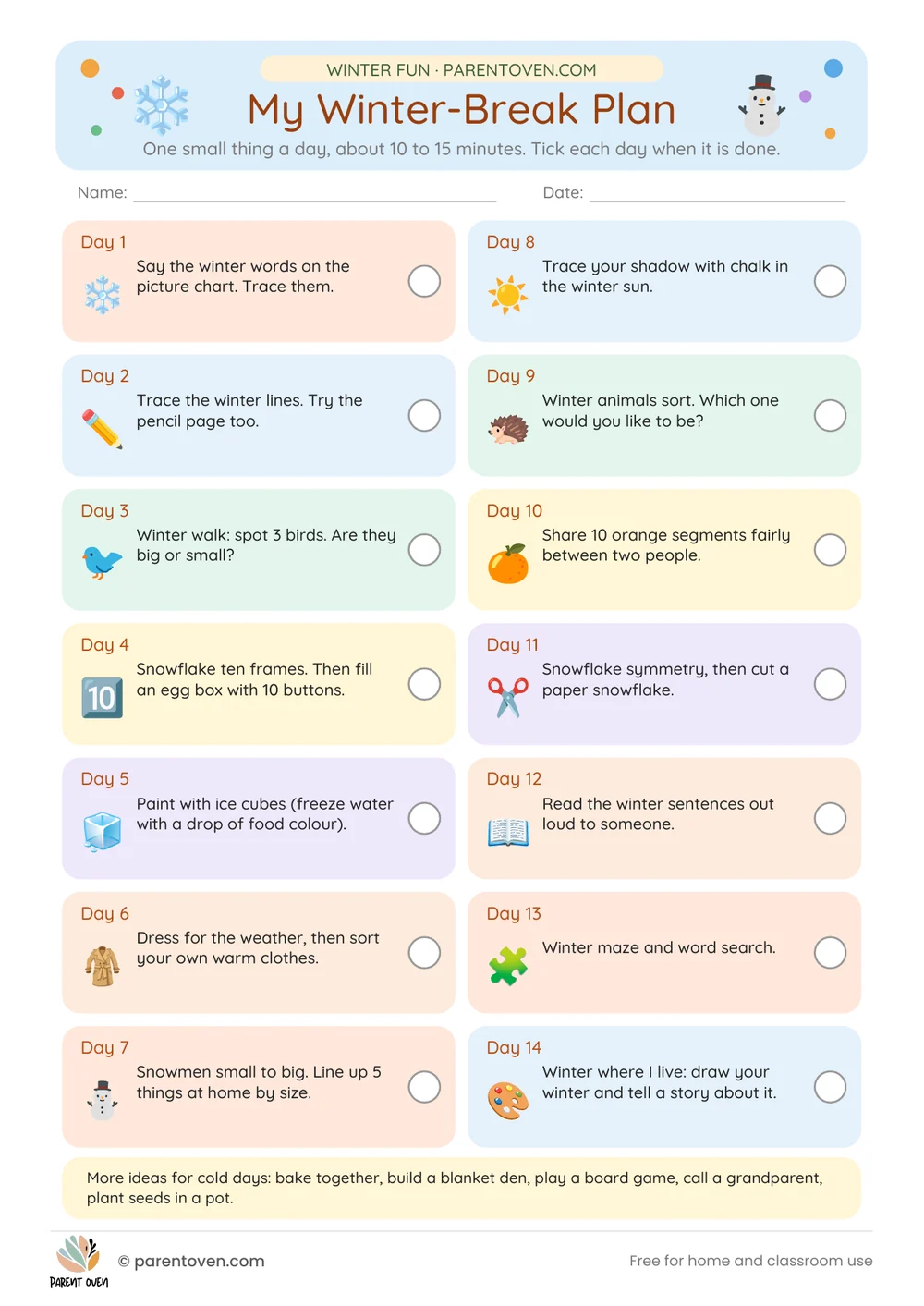
14-day winter-break plan
One small thing a day for two weeks, 10 to 15 minutes each, mixing the sheets with off-screen ideas: spotting birds, painting with ice cubes, tracing shadows in the low winter sun. Days are numbered, not dated, and a blank plan is included.
A4 · 2 pages · colour 174 KB · black and white 137 KB
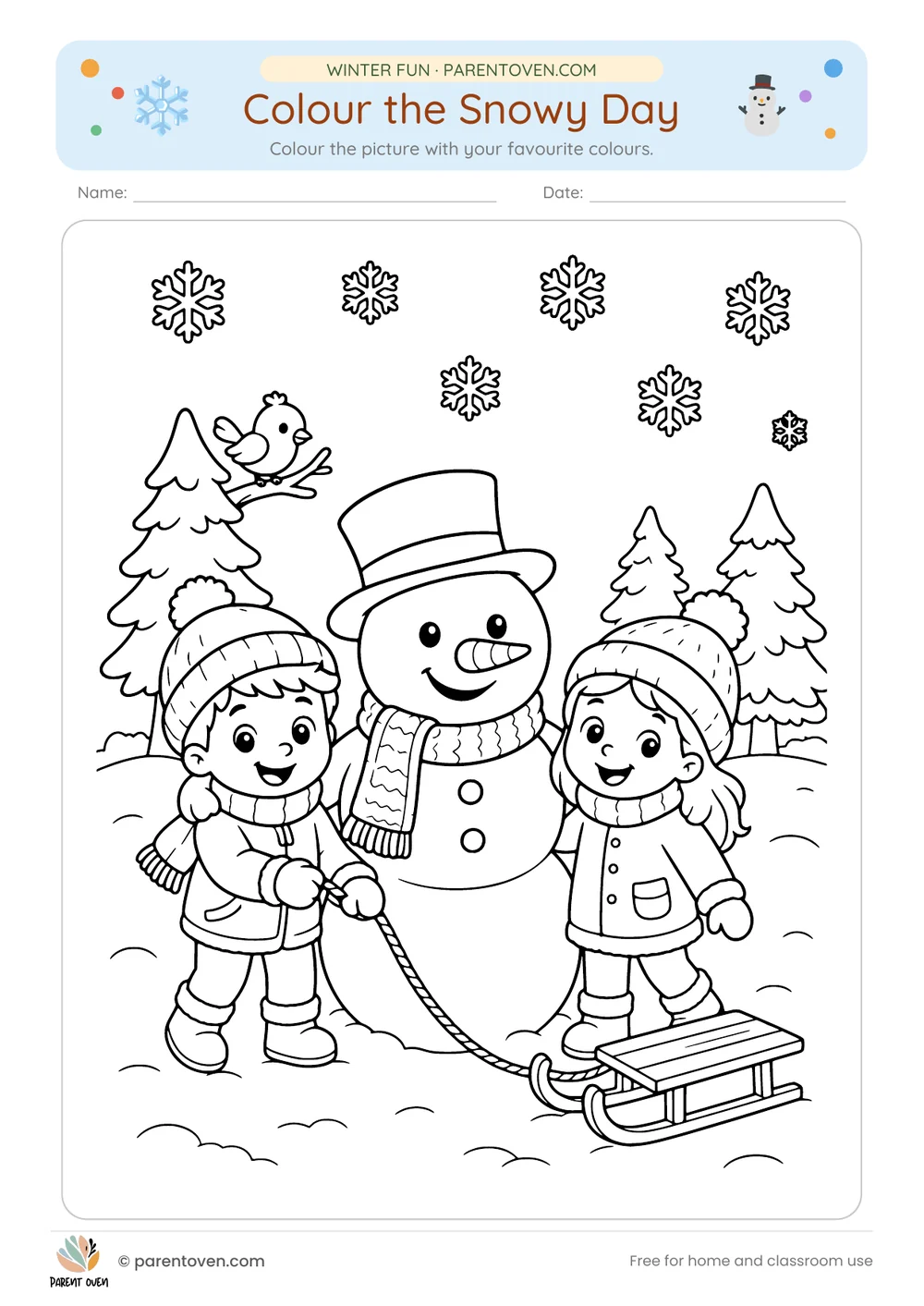
Winter coloring pages
Two pages to colour: children building a snowman with a sled, and a grandmother reading to a child on a cosy winter evening.
A4 · 2 pages · colour 410 KB · black and white 379 KB
Ink-saving black-and-white versions
Every sheet has a black-and-white PDF next to the colour one. The pictures are true outline drawings instead of colour pictures, the backgrounds are white or very light grey and there are no heavy fills, so a home printer uses far less ink. The layouts, levels and answer keys are the same, and children can colour the pictures in.
How to use the pack
- Start with the picture chart (5 minutes). Name each picture, let your child say it back and ask one question: “Where does a bear sleep in winter?” Children remember words they have talked about, not words they have only seen.
- Do one sheet a day, not the whole pack. Short, regular practice works better than one long session the day before school starts again. The 14-day plan spreads the sheets out for you.
- Match the level to the child, not the age. If a sheet takes more than 15 minutes or ends in tears, go back to Level 1. If it takes two minutes, try Level 2.
- Use real things too. Fill an egg box with 10 buttons after the ten frames, sort the family’s warm clothes after “Dress for the weather”, and line up five spoons from small to big after the snowmen.
- Check with the answer key together. Finding and fixing their own mistake teaches more than being told. Where more than one answer can be right, the key says so.
What to expect at each age
A rough guide, not a test: children move at different speeds, and that is normal.
Age 3–4
- Preschool, nursery or LKG
- Picture chart and coloring pages
- Standing and sleeping lines first
- Ten frames up to 5, with help
- Circle the warm clothes; a grown-up cuts
Age 4–5
- Pre-K, reception or UKG
- Ten frames to 10 and picture sums
- Beginning sounds
- Ordering the snowmen and the animal sort (read the headings aloud)
- The wide-path maze
Age 5–7
- Kindergarten to Grade 1 (Class 1)
- The make-10 challenge and teen numbers
- Reading the winter sentences
- True or false, maths within 10 and word problems
- Word search and writing about their own winter
Skills covered
- Fine motor and pre-writing: line and word tracing, cutting, gluing and the mazes.
- Number: counting to 20, writing numbers, bonds to 10, and adding and taking away within 10. The make-10 questions match US Common Core K.OA.A.4 and the England EYFS goal of recalling some number bonds to 10.
- Early reading: beginning sounds, CVC words, early sight words and the word search.
- Science and the world: how animals survive winter, weather and clothing, symmetry and shapes, and how winter differs from place to place.
Common mistakes and quick fixes
- Counting a snowflake twice. Touch each one and say the number, or cross it off lightly in pencil.
- Starting the line at the wrong end. Put a finger on the green dot first, then go. For left-handed children, turn the sheet slightly to the right.
- Drawing snowflakes with eight arms. Real snowflakes have six, because ice crystals are six-sided. Count the arms together on the symmetry sheet.
- Saying the letter name instead of the sound. “/s/ for socks”, not “ess for socks”. The sound is what helps children read.
- Thinking every animal sleeps all winter. Many stay awake and adapt, and some birds fly to India for the winter. The answer page gives one true fact for each animal.
No snow? This pack still works
In Canada and much of the US, winter can mean weeks of snow. In the UK it is more often grey, wet and windy. Across north India it brings foggy mornings and sunny afternoons, with snow only in the mountains of Kashmir, Himachal Pradesh and Uttarakhand, while Chennai and Mumbai stay warm. So the pack includes fog, rain and winter foods like oranges and peanuts, not only snow. In Australia or South Africa, winter is June to August, and the pack works then too.
The shortest day in the northern half of the world, the December solstice, is Monday 21 December 2026 (in India the exact moment falls early on 22 December).
Using it in the winter break
In the US, UK and Canada, schools usually break for about two weeks around Christmas and New Year. Many north Indian schools close in early January instead; Delhi’s winter vacation in 2025–26 ran from 1 to 15 January. Dates vary by state and school. The 14-day plan fits either break.
Printing tips
- The PDFs are A4. On US Letter paper, choose “Fit to page” or “Scale to fit” so nothing is cut off.
- Print the cut-and-glue sheets (snowmen and animals) on thicker paper if you have it.
- To save ink, use the black-and-white PDFs below each sheet: outline pictures, light backgrounds and no heavy fills.
- Put a tracing sheet in a plastic sleeve and use a whiteboard marker to reuse it.
Sources: Polar Bears International · US Fish & Wildlife Service: polar bear · Smithsonian’s National Zoo: sloth bear · Royal Observatory Greenwich: winter solstice · Common Core: Kindergarten Operations and Algebraic Thinking · Telegraph India: Delhi winter vacation.
Keep going on Parent Oven
Christmas worksheets
Christmas words, story sequencing and an ornament craft.
New Year worksheets
A fresh-start pack for the first week of January.
Makar Sankranti and Pongal worksheets
Kites, harvest and sun for mid-January. Also see the Republic Day worksheets.
Number tracing 1 to 10
The next step after winter lines, with alphabet tracing A to Z too.
Addition within 10
More practice after the winter maths, plus subtraction within 10.
CVC word worksheets
Short words to read after the winter sentences, and sight word worksheets.
Animal worksheets
More animals to sort and name, and animal flash cards.
Activities by age
Screen-free ideas for cold indoor days. Make more puzzles with the maze generator and word search maker.
Winter worksheet questions
Are these winter worksheets free?
Yes. Every PDF on this page is free for home and classroom use, with no sign-up.
What ages are they for?
Ages 3 to 7, from preschool or nursery to Grade 1 (Class 1). Most sheets have two levels, so siblings can work on the same topic side by side.
Do the worksheets have answer keys?
Yes. The ten frames, dress for the weather, snowmen, symmetry, reading, animal sort, maths, maze and word search sheets all have answer pages. In the full pack they are together at the back.
Is there a black-and-white version to save ink?
Yes. Every sheet, and the full 43-page pack, has a black-and-white PDF with outline pictures and light backgrounds. Children can colour the pictures in, too.
We don’t get snow. Are these still useful?
Yes. The skills (counting, tracing, reading, sorting) don’t depend on snow, and the pack includes fog, rain and cool sunny days too. The “Winter where I live” sheet lets children describe their own winter.
Are these Christmas worksheets?
No. This pack is about the season, so you can use it from December to February. For Christmas activities, see our Christmas worksheets.
More Holiday Printables
Also try: alphabet tracing · maths worksheets · coloring pages