

Learning Worksheets Seasonal Valentine’s Day
Free printable PDFs · ages 3–7 · 19-page pack with answers
Free Valentine’s Day Worksheets for Kids: Friendship and Kindness Pack
A Valentine’s pack about friendship, not romance: learn 12 kind words from a picture chart (heart, card, hug, gift, smile…), then trace them, hear first sounds, count, continue patterns, put a “being a good friend” story in order and make a friendship card. Answer keys are at the back.
Valentine’s Day is on Sunday 14 February 2027 · Free · A4 (prints on US Letter) · no sign-up
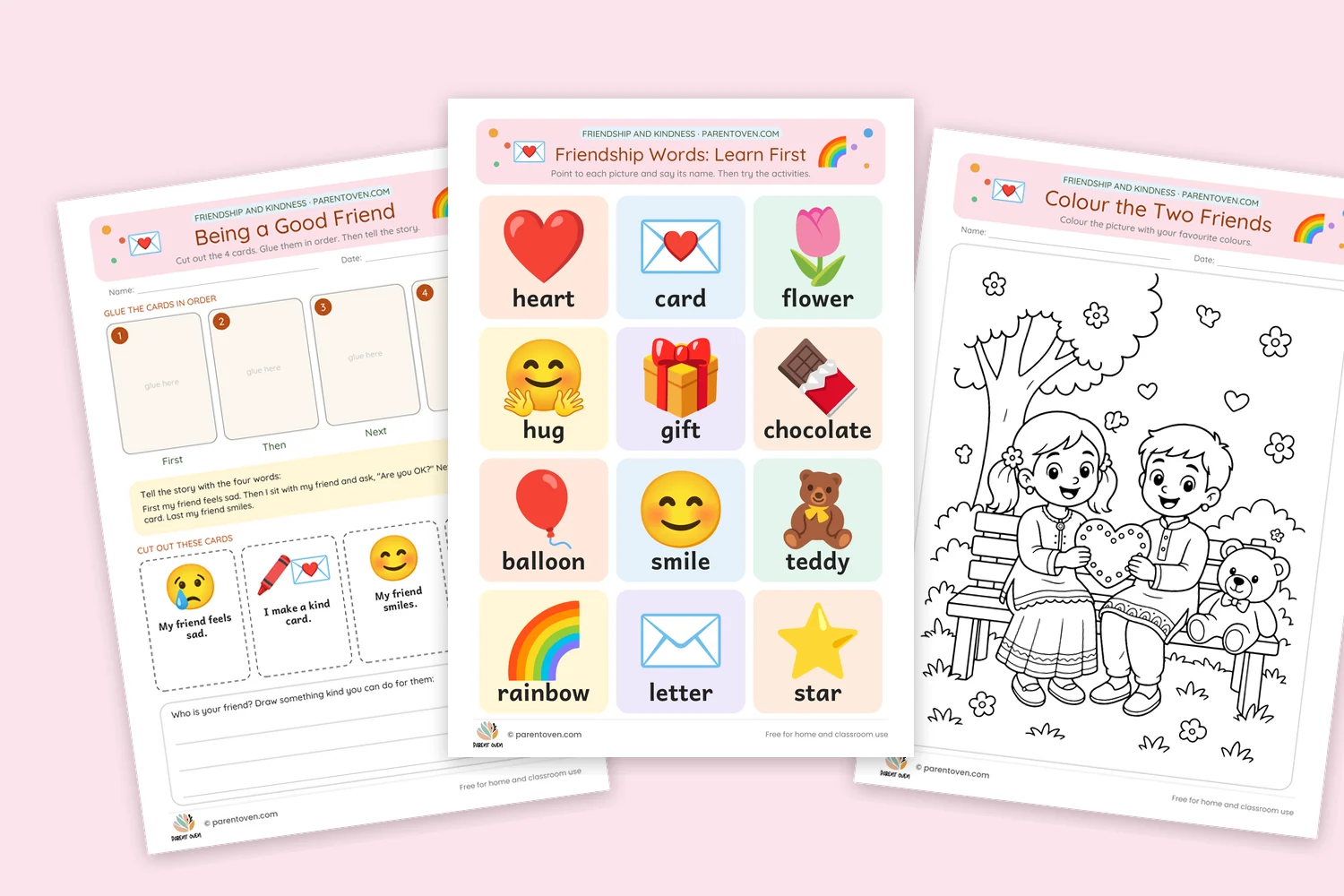
Learn-first chart · 9 activities · craft · 2 coloring pages · answer keys · PDF, 451 KB
Free Valentine’s Day printables
10 single Valentine’s Day worksheets
Every sheet uses the same 12 words from the learn-first chart, so children meet each word several times in different ways.
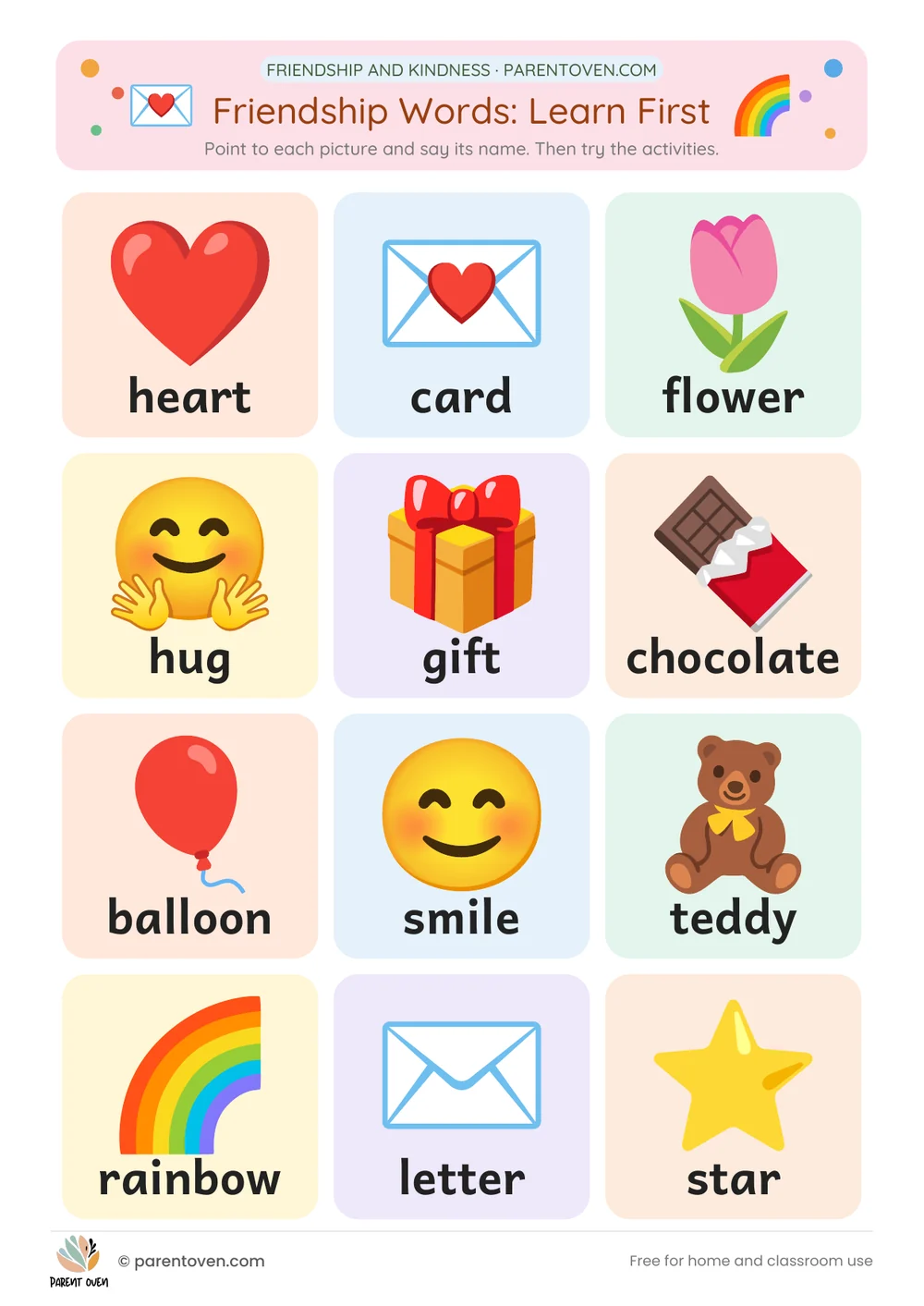
Friendship words and tracing
Learn-first chart of 12 words (heart, card, flower, hug, gift, smile, teddy, rainbow…), then trace seven in single-line letters.
A4 · 2 pages · PDF, 218 KB
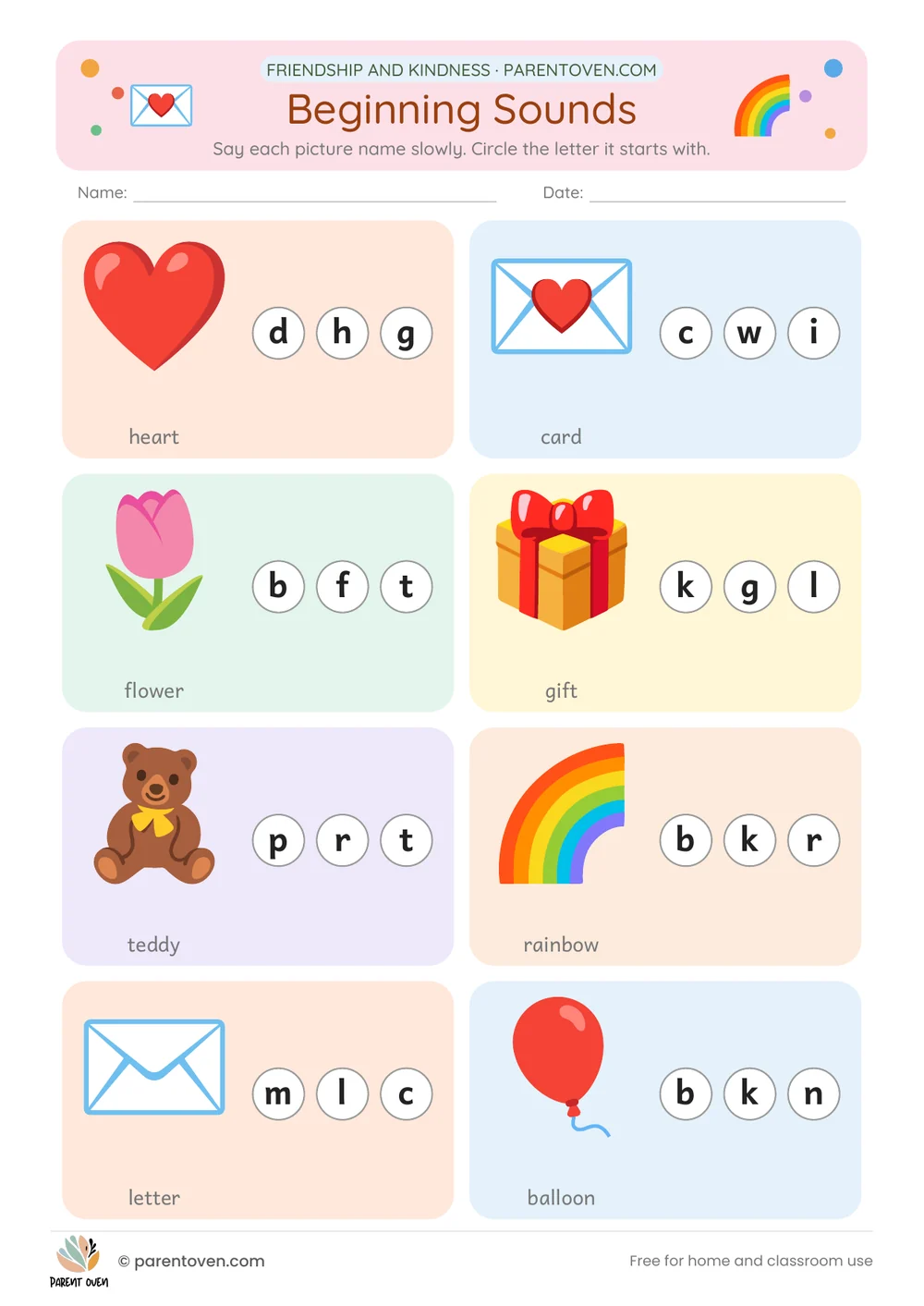
Friendship beginning sounds
Say each picture name slowly and circle its first letter: heart, card, flower, gift, teddy, rainbow, letter, balloon.
A4 · 3 pages with answers · PDF, 199 KB
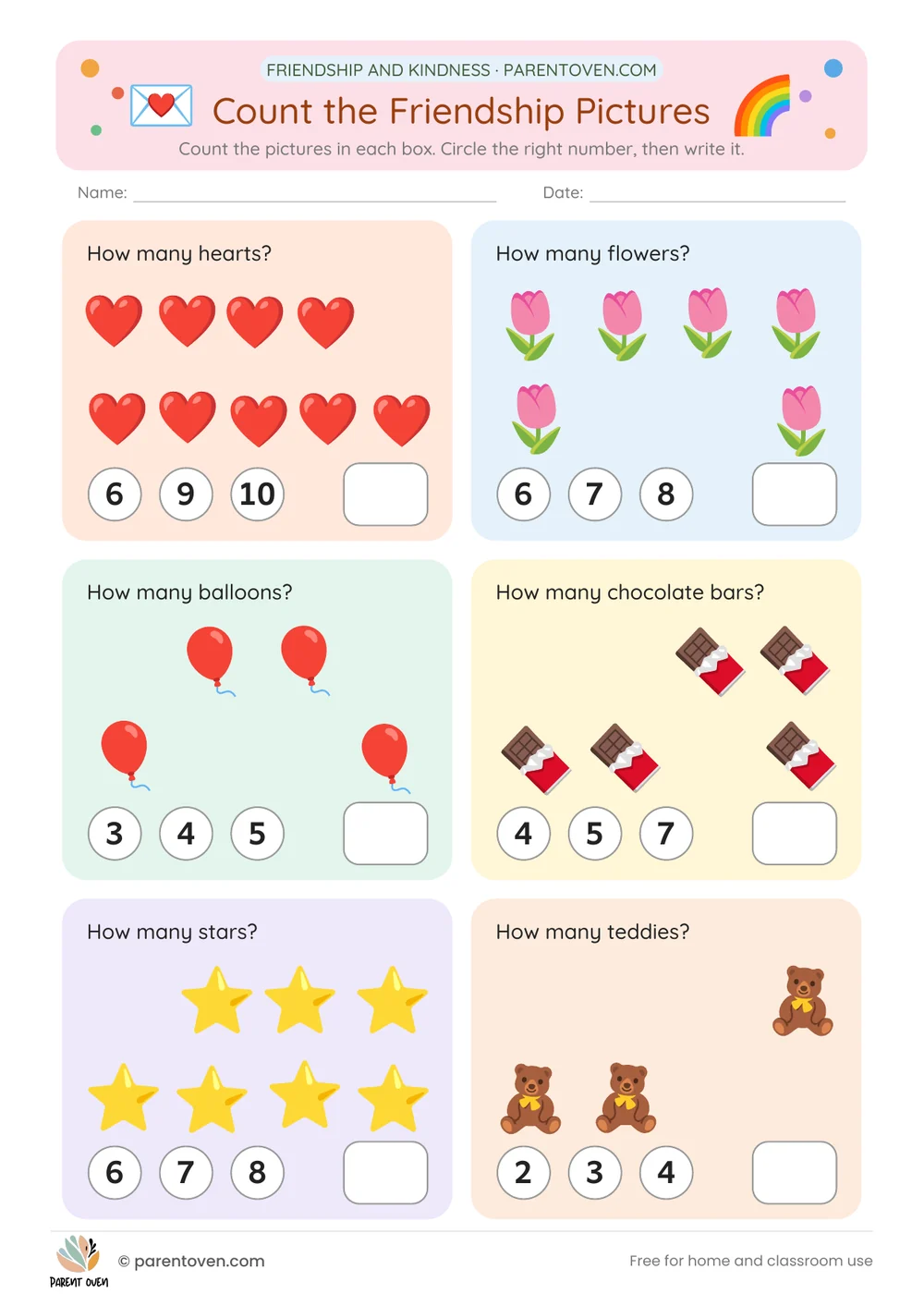
Count the friendship pictures
Count hearts, flowers, balloons, chocolates, stars and teddies (up to 9), circle the number and write it.
A4 · 2 pages with answers · PDF, 165 KB
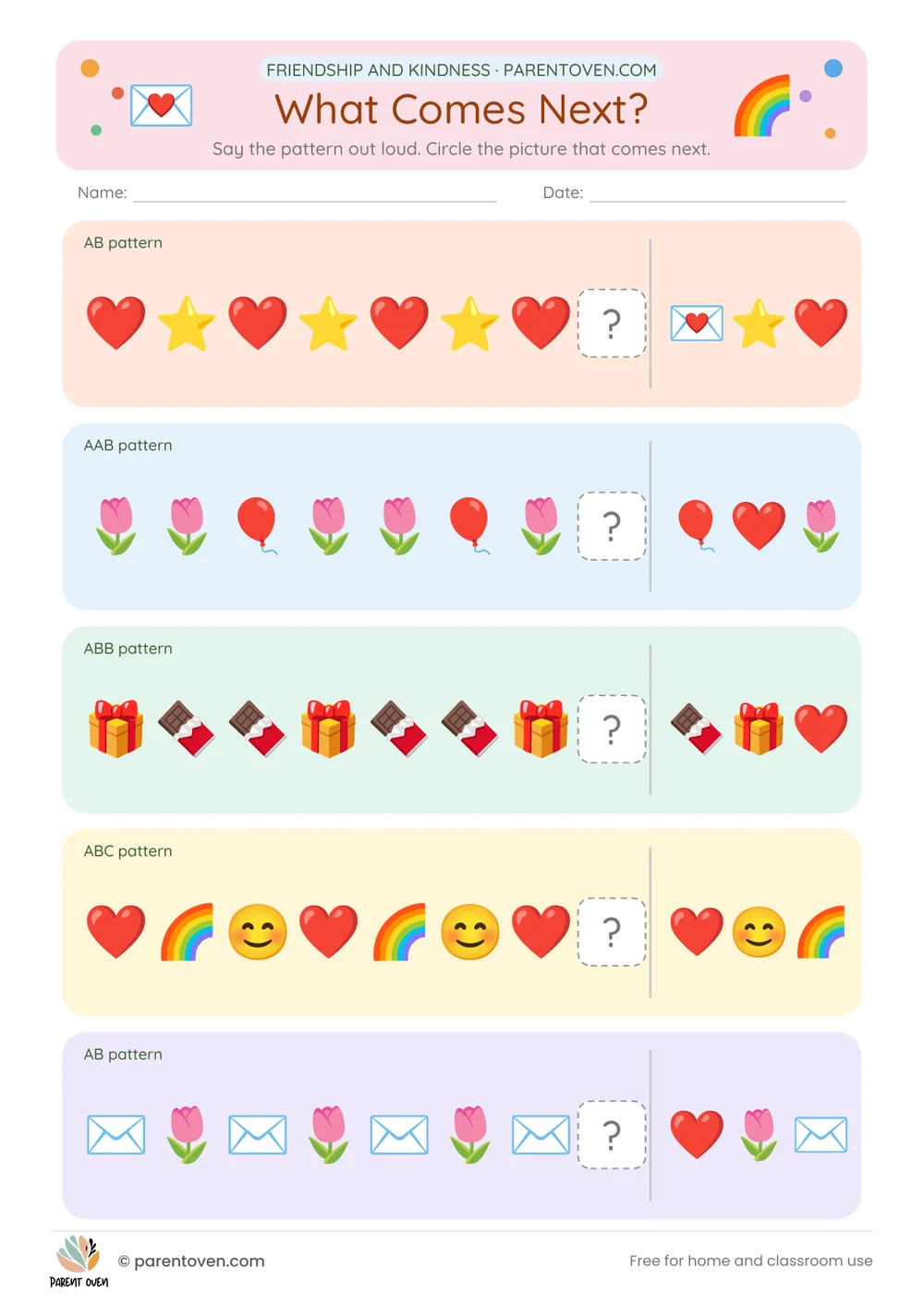
Friendship patterns
What comes next? Five rows of AB, AAB, ABB and ABC picture patterns with three choices each.
A4 · 2 pages with answers · PDF, 147 KB
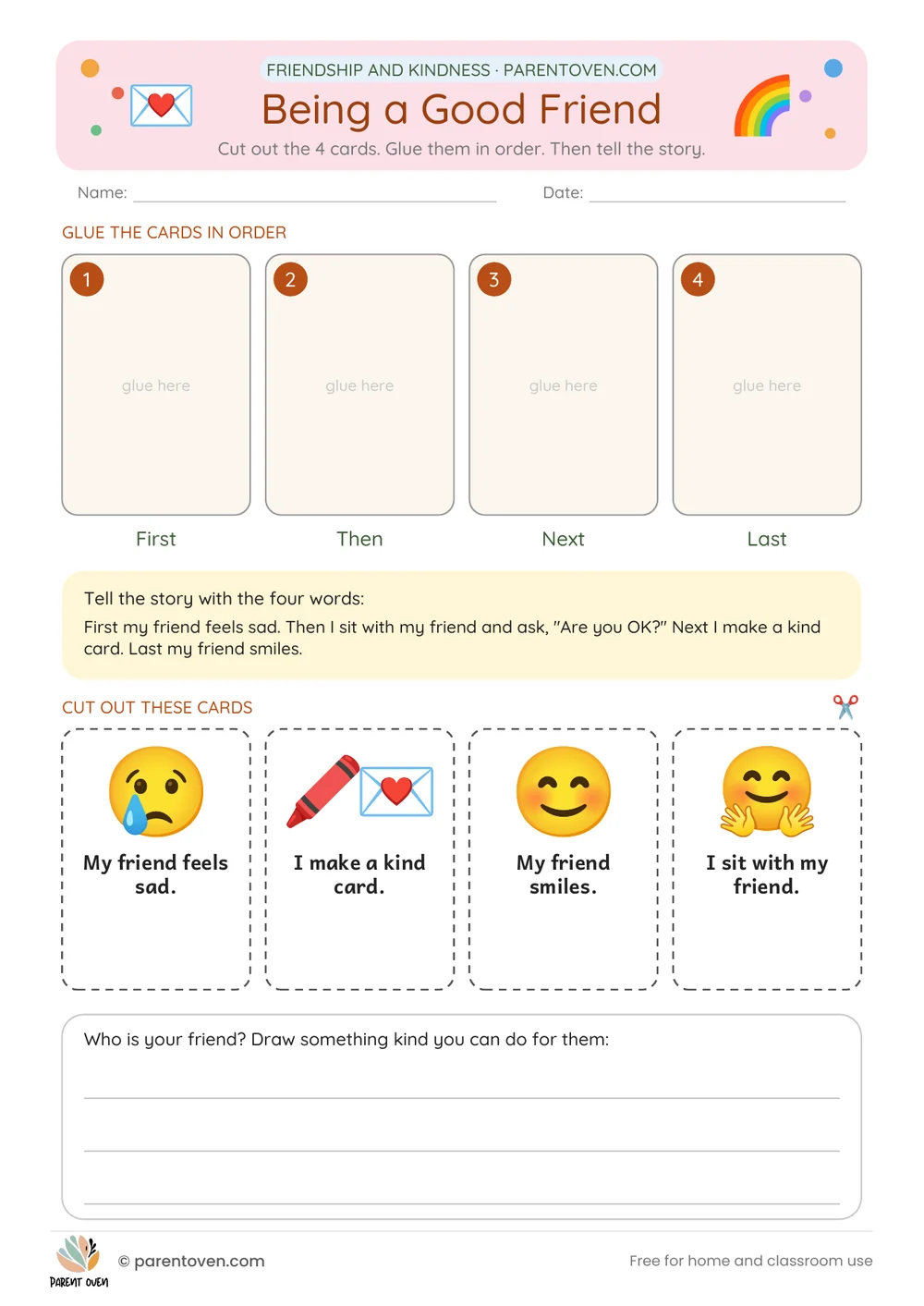
Being a good friend (cut and glue)
Four cards: my friend is sad, I sit with them, I make a kind card, my friend smiles. Order and glue, then draw your own kind act.
A4 · 2 pages with answers · PDF, 167 KB
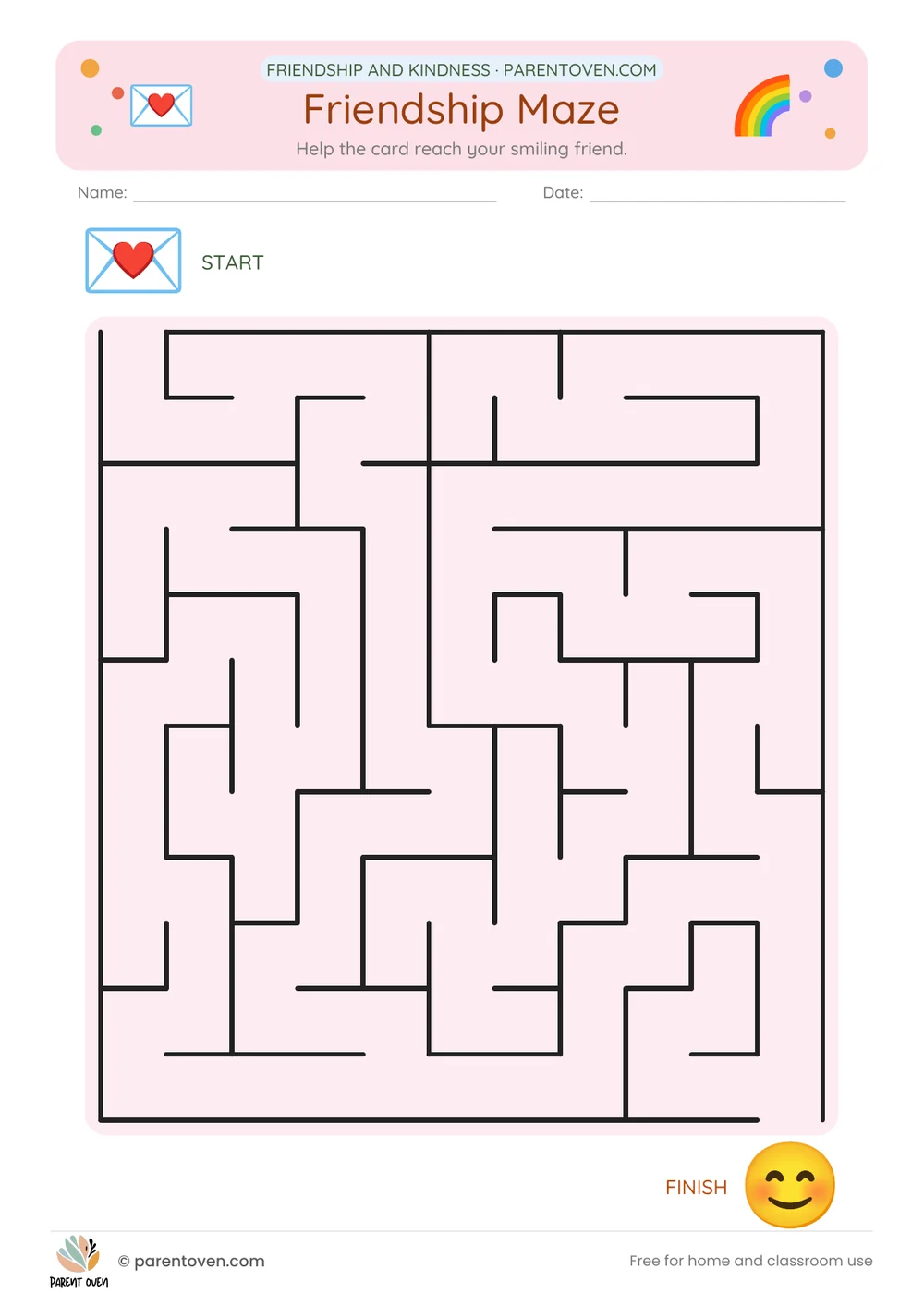
Friendship maze
Help the card reach your smiling friend. Wide paths and an answer page.
A4 · 2 pages with answer · PDF, 136 KB
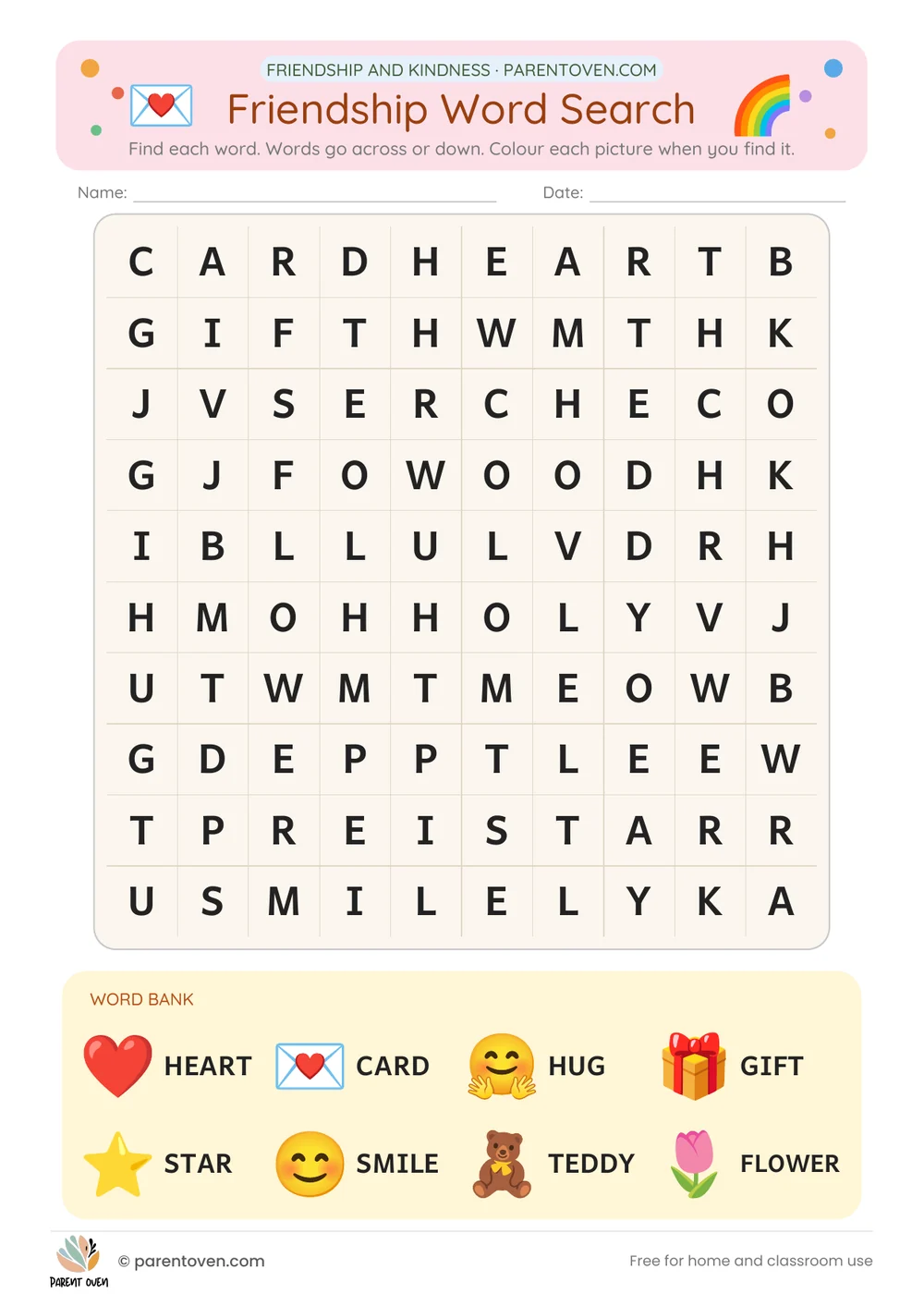
Friendship word search
Eight words hidden across and down only, with a picture word bank for early readers.
A4 · 3 pages with answers · PDF, 178 KB
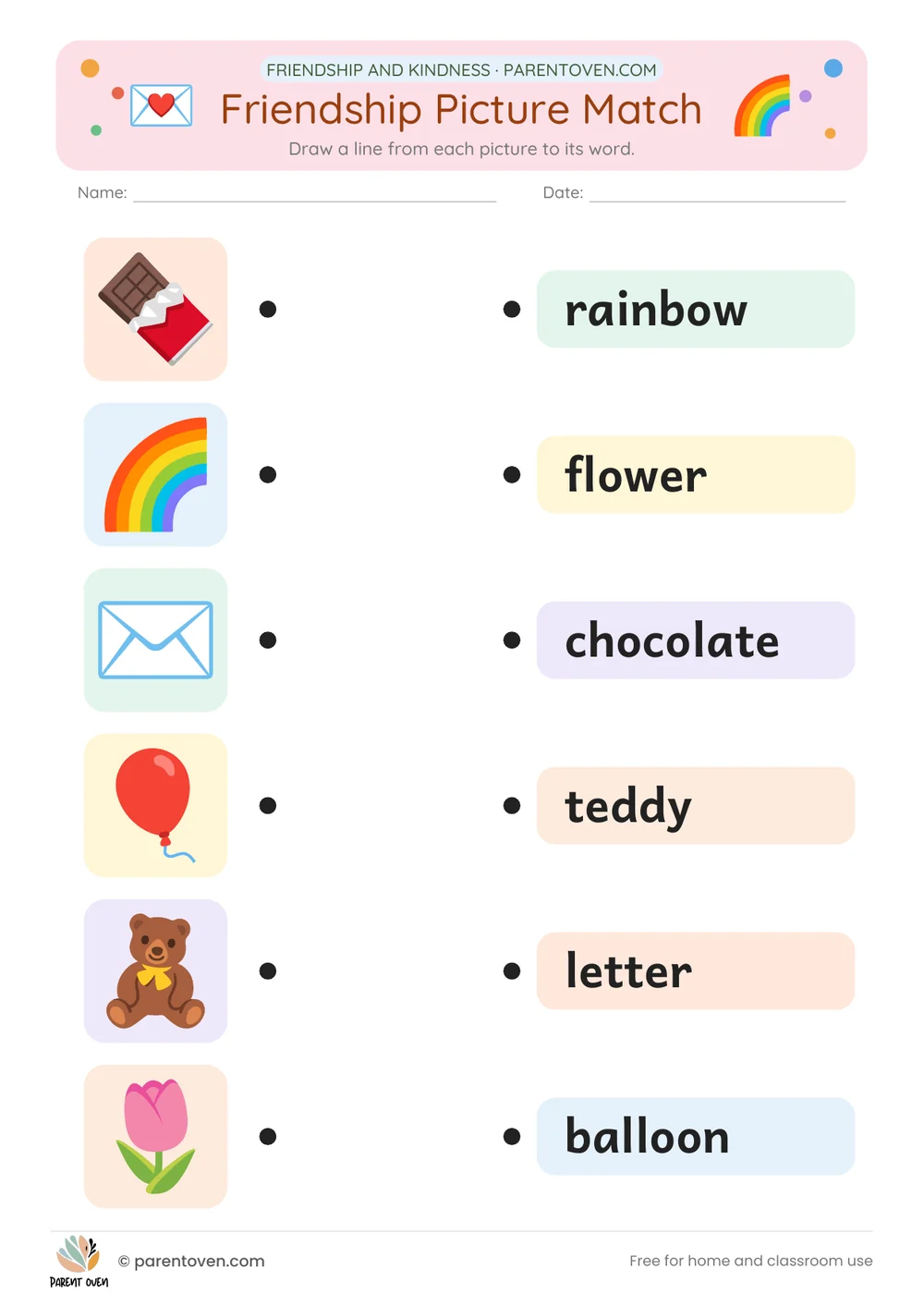
Friendship picture match
Draw a line from each picture to its word: chocolate, rainbow, letter, balloon, teddy, flower.
A4 · 2 pages with answers · PDF, 162 KB
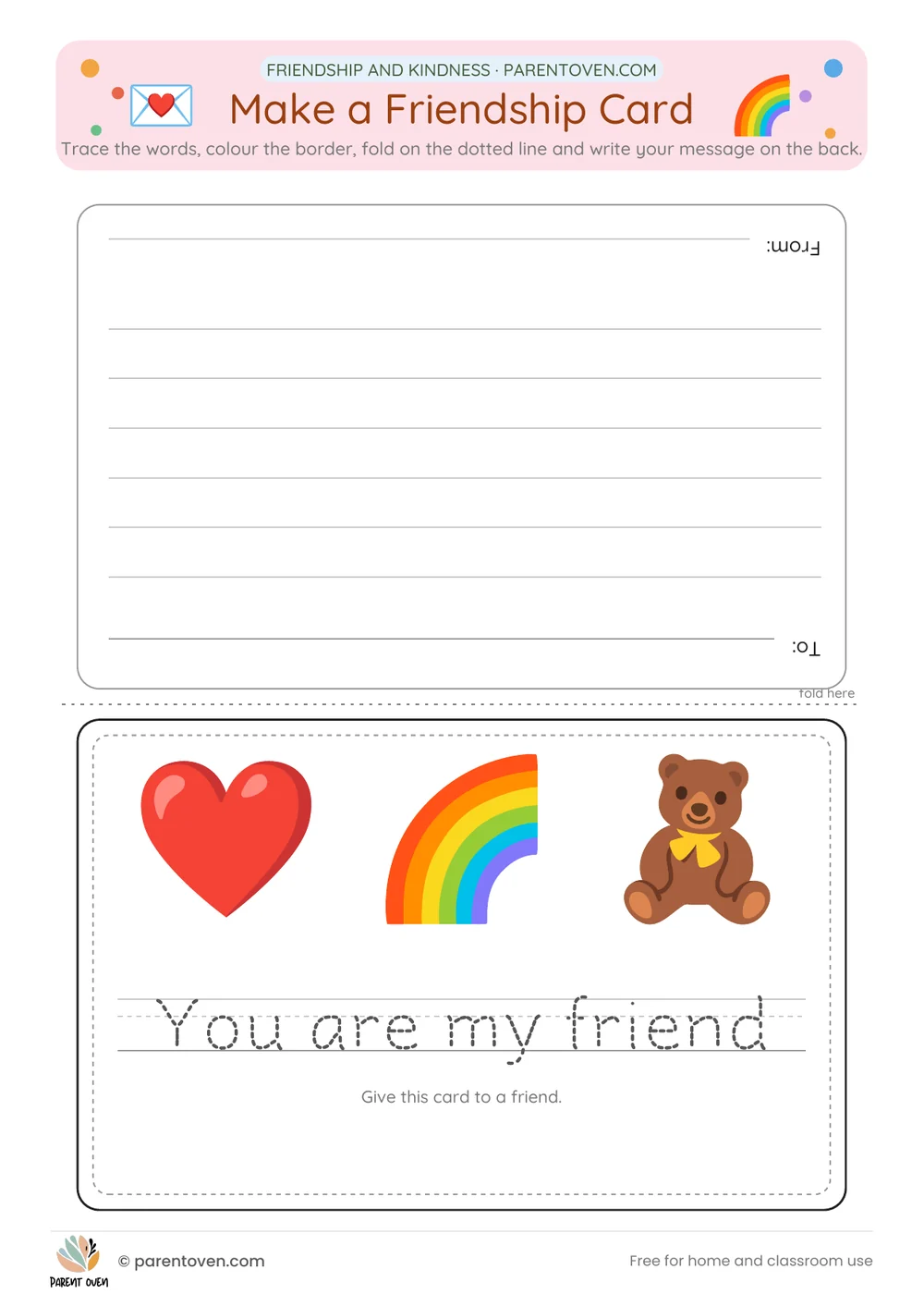
Make a friendship card
A fold-in-half card: trace “You are my friend” on the front and write To, a message and From on the back.
A4 · 1 page · PDF, 141 KB
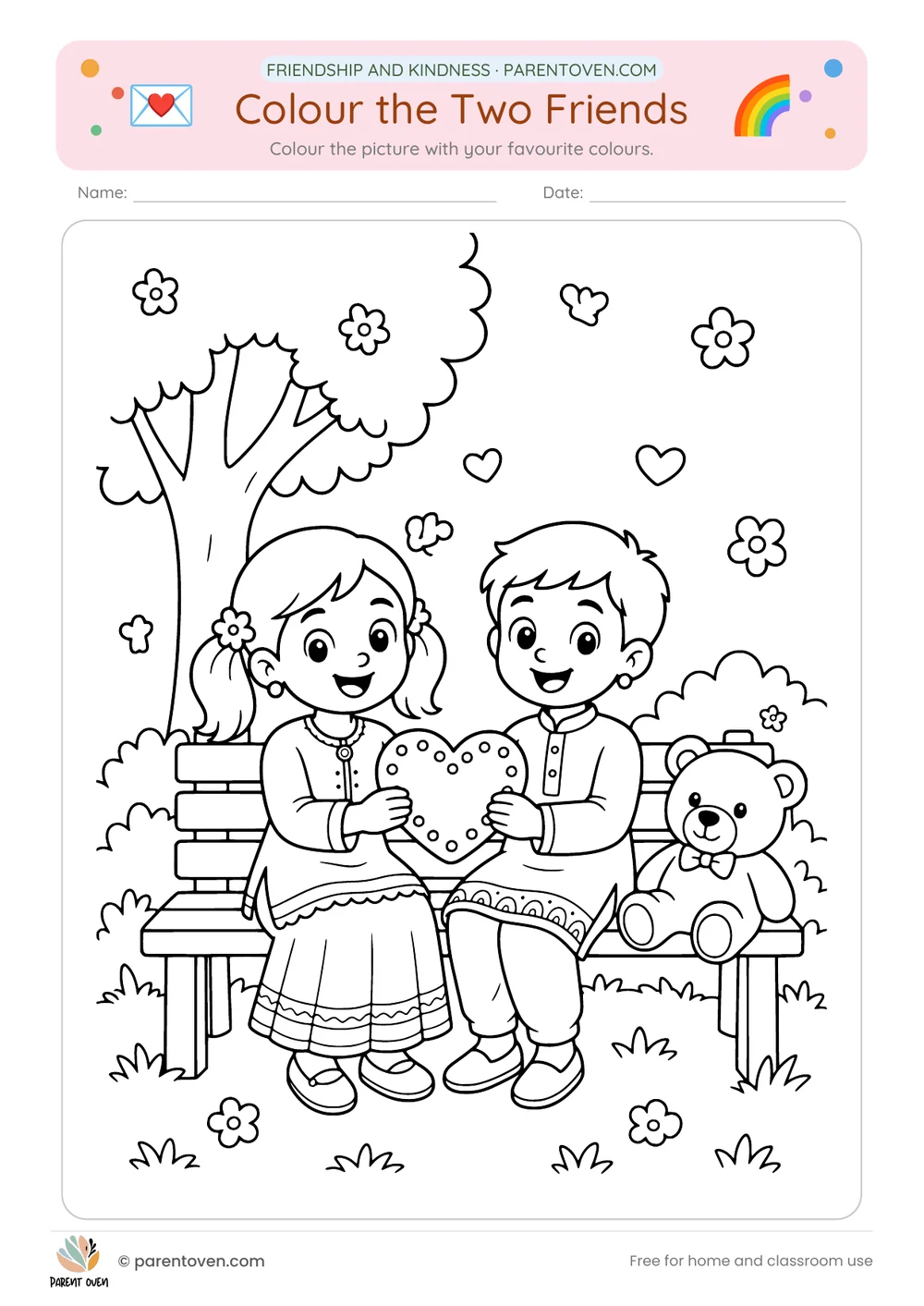
Friendship coloring pages
Two pages: two friends sharing a heart-shaped cookie on a bench, and a teddy with heart balloons.
A4 · 2 pages · PDF, 282 KB
How to teach with this pack
Do one or two sheets a day in the week before Valentine’s Day rather than the whole pack at once. This order works well:
- Start with the picture chart (5 minutes). Say each word and ask a kindness question: “When do we give a hug? What makes you smile?”
- Trace slowly, saying the sounds. Start each letter at the top: “h-u-g, hug”. Hug is a three-letter CVC word, ideal for blending.
- Beginning sounds: stretch the first sound. Say “hhh-eart” and “t-t-teddy”. Card starts with c, making a /k/ sound.
- Story sequencing: talk about feelings. Before gluing, ask “How do you know the friend is sad? What could you do?” Naming feelings is the real lesson on this page.
- Counting: touch each picture once. Nine hearts is the hardest box. Cross off each one as it is counted.
- Make the card for someone real. “You are my friend” uses the sight words you and my. Leave finger spaces between words when tracing, then help your child write the friend’s name.
- Do one kind act. Use the draw box on the story page to plan one real kind thing for the week, then do it.
What to expect at each age
A rough guide, not a test: children move at different speeds, and that is normal. For reference, the US Common Core asks kindergarteners to count up to 10 scattered objects (K.CC.B.5) and to hear the first sound in simple words (RF.K.2.D).
Age 3–4
- Picture chart, colouring and matching
- Counting up to 5 with your help
- AB patterns (heart, star)
- Talking about happy and sad faces
- 10 minutes at a time
Age 4–5
- Counting up to 10, crossing off as they go
- Beginning sounds for most letters
- AB and AAB patterns
- Retelling the friendship story
- Tracing “You are my friend”
Age 5–7
- Word search on their own
- ABB and ABC patterns
- Writing a short message on the card
- Explaining how a friend might feel
- Planning and doing a kind act
Common mistakes and quick fixes
- Leaving someone out. If cards are going to school, make one for every child in the class or none at all.
- No spaces between words. Put a finger down after each word: “You · are · my · friend”.
- Skipping the feelings talk. The story page works best when your child says how each person feels.
- Counting hearts twice. Cross off each one as it is counted.
- Naming the letter instead of the sound. “/h/ for heart”, not “aitch for heart”.
When is Valentine’s Day 2027?
Valentine’s Day is Sunday 14 February 2027. Because it falls on a Sunday, many schools will mark it on Friday 12 February.
Why a friendship pack?
For young children, the day is a gentle way to practise kindness: noticing feelings, making something for someone and saying something nice. In Finland, 14 February is Ystävänpäivä, “Friend’s Day”, when people send cards to friends, family and neighbours. That is the spirit of this pack.
Talking about feelings
Children learn feeling words the same way they learn picture words: by hearing them used about real moments. Name feelings as they happen (“You look proud”, “Your friend seems sad”) and the story page will make sense straight away.
Sources: thisisFINLAND: Finns treasure friendship on Valentine’s Day.
Keep going on Parent Oven
Heart shape worksheets
Trace and draw hearts for the front of the card.
The sight word “you”
The first word of the card; read, trace and write it (also try my).
Pink colour worksheets
Find and colour pink things.
Raising an emotionally intelligent child
Everyday ways to help children name and manage feelings.
Reward chart maker
Make a kindness chart: one sticker for each kind act.
Name tracing worksheet maker
Trace a friend’s name before writing it on the card.
Valentine’s Day worksheet questions
Are these Valentine’s Day worksheets free?
Yes. Every PDF is free for home and classroom use, with no sign-up.
What age are they for?
Ages 3 to 7. See “What to expect at each age” above for which pages suit your child.
Do they include answer keys?
Yes. Beginning sounds, counting, patterns, story sequencing, maze, word search and matching have answer pages at the back of the pack and inside each single PDF.
Is this pack suitable for school?
Yes. It is about friendship and kindness only, with no romantic content, so it suits preschool and primary classrooms.
Will they print on US Letter paper?
Yes. The PDFs are A4; choose “Fit to page” in your print settings.
More Holiday Printables
Also try: alphabet tracing · maths worksheets · coloring pages