Learning Worksheets Phonics Two and three letter words
Free printable PDF · UKG · ages 5–6 · 3 levels · answer key
Two and Three Letter Words Worksheets for UKG
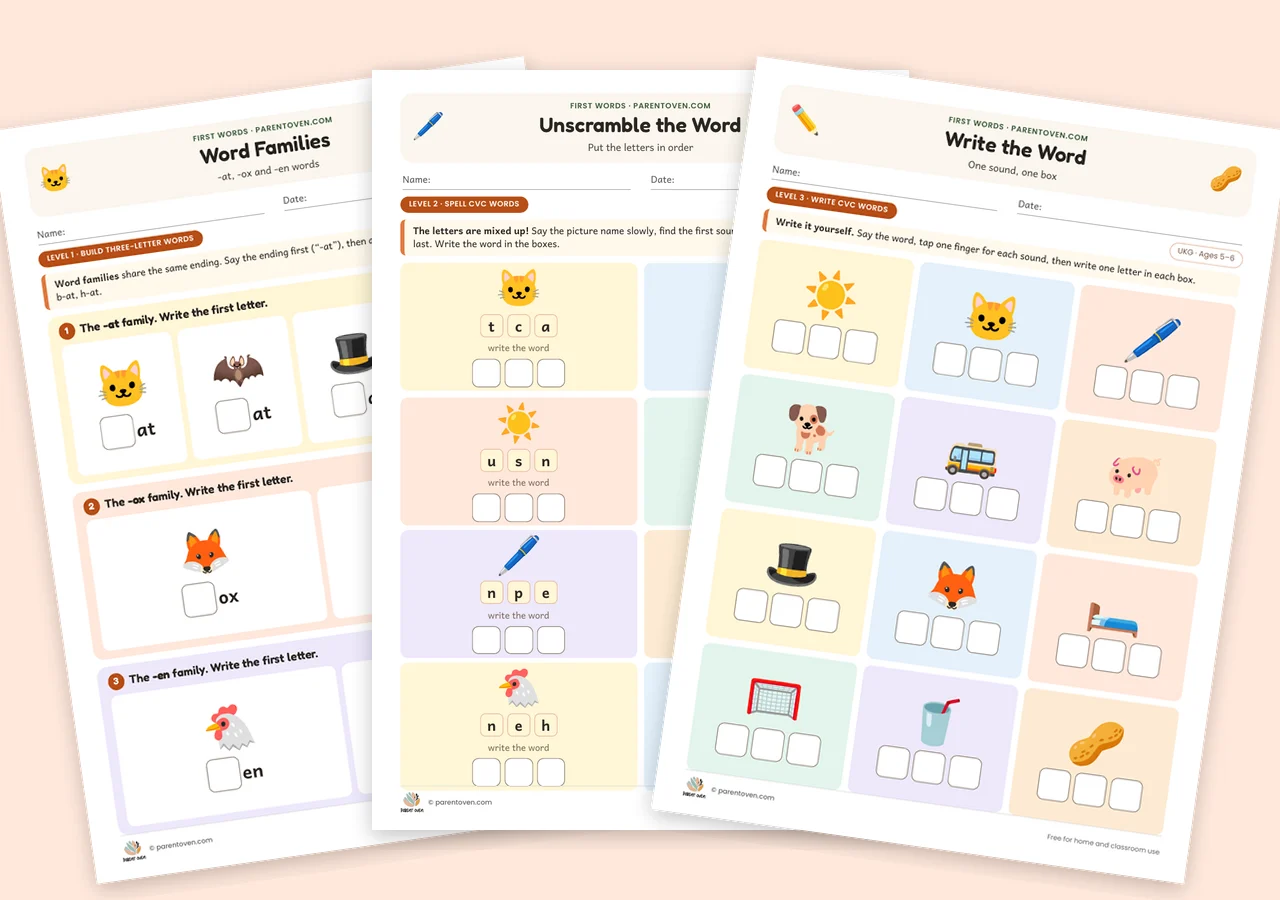
Six worksheets for the moment your child starts to read: tracing two-letter words like at, in, on and up, building -at, -ox and -en word families, matching three-letter words to pictures, unscrambling letters, choosing between words that differ only in the middle sound, and writing words alone.
Reading two- and three-letter words is a core literacy goal for age 5 to 6 in India’s NIPUN Bharat mission. These sheets keep every word decodable (no tricky spellings), so children succeed by sounding out, not guessing.
Free · A4 (prints on US Letter) · 6 sheets + answer key · colour and ink-saving black & white · no sign-up
Jump to: The six sheets · How to teach two and three letter words · Common mistakes · Games without paper · FAQs
The six sheets
The sheets go from easiest to hardest. Sheet 1 is tracing, Sheets 2 to 4 build and read words with support, and Sheets 5 and 6 ask children to read and spell on their own.
Level 1 · read and trace
Two-letter words
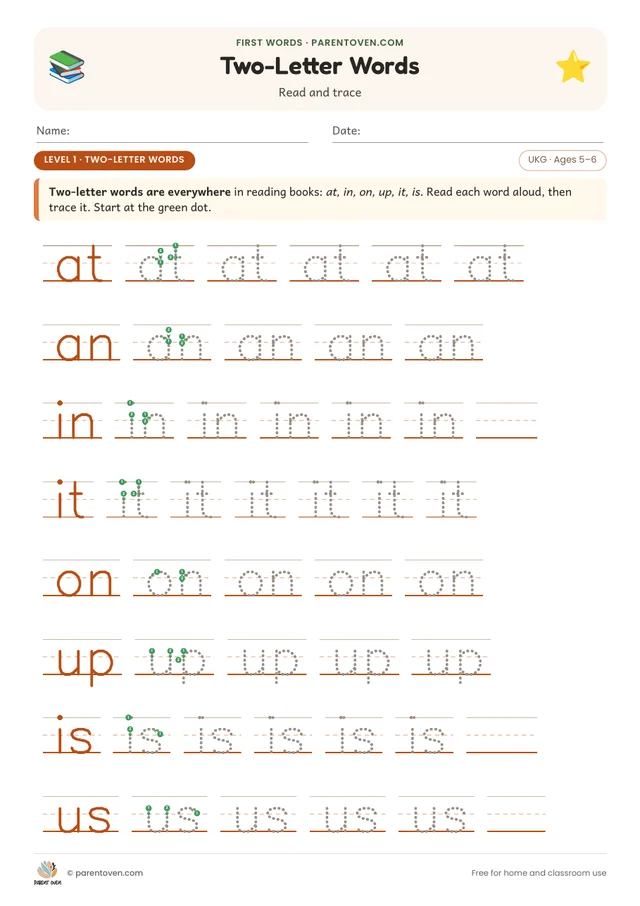
Eight common two-letter words (at, an, in, it, on, up, is, us), each with a solid model and single-stroke dotted copies with numbered green start dots.
Level 1 · build words
Word families
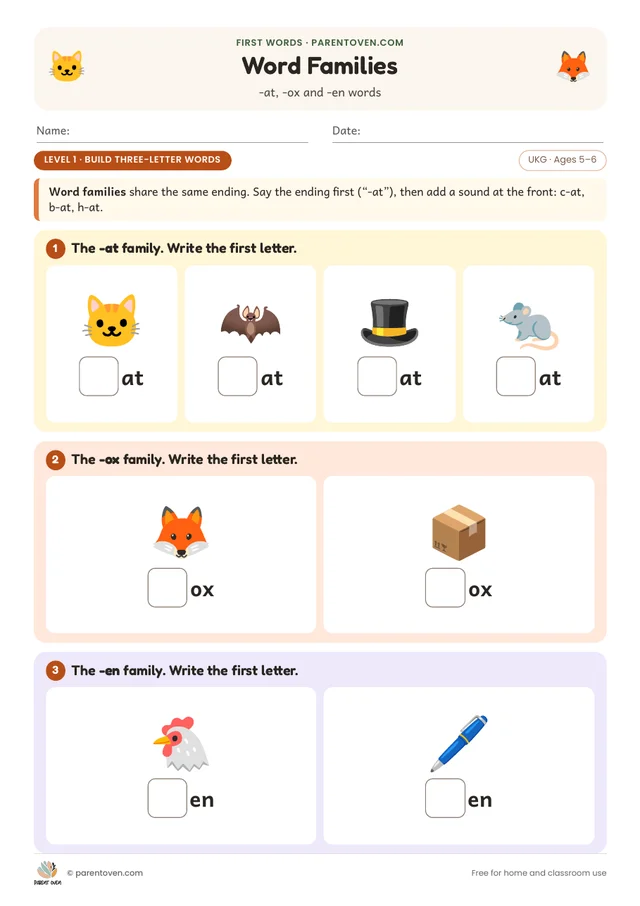
The -at, -ox and -en families with pictures. Children write the first letter to make cat, bat, hat, rat, fox, box, hen and pen. One ending, many words.
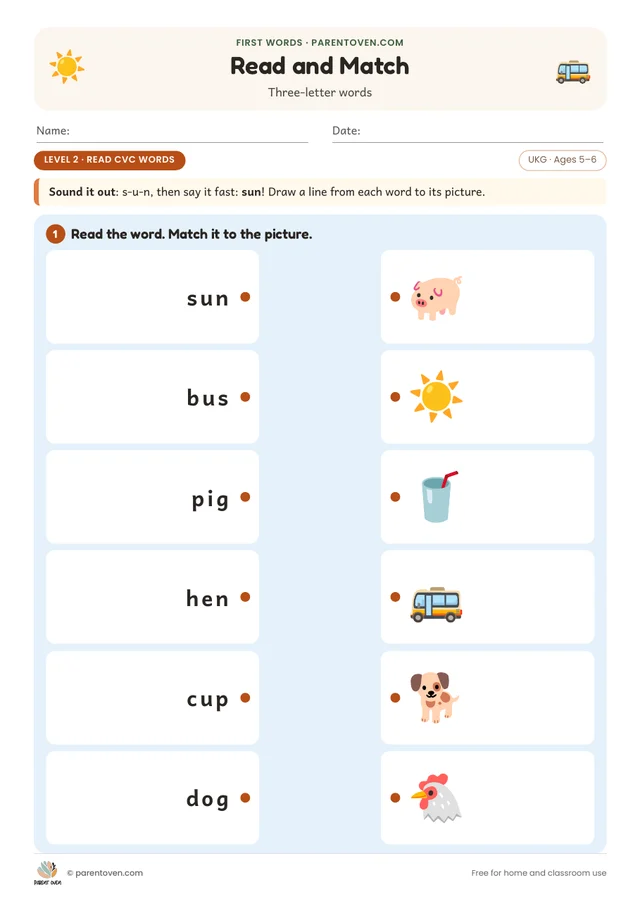
Level 2 · read CVC words
Read and match
Six words to sound out and match to pictures in a mixed order: sun, bus, pig, hen, cup and dog.
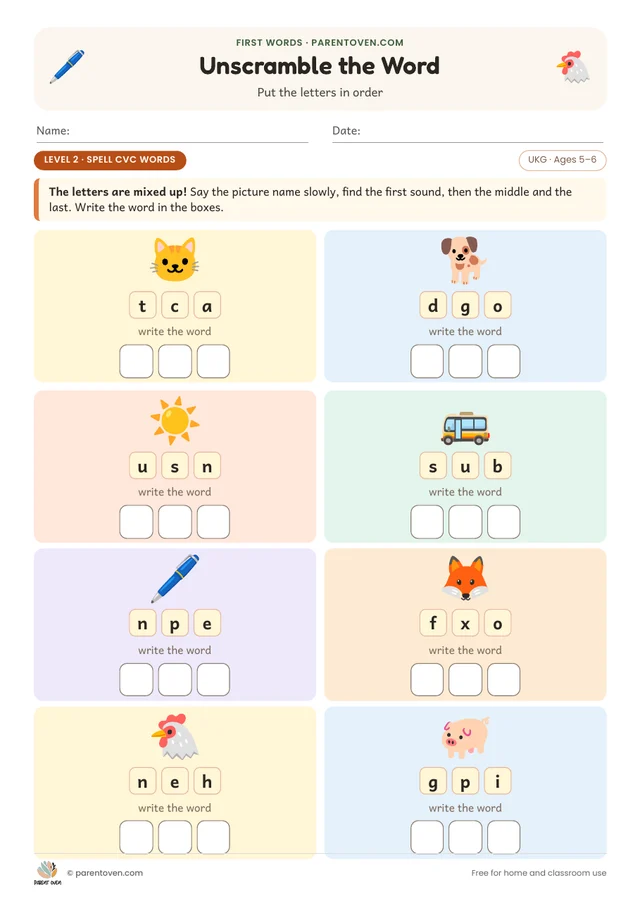
Level 2 · spell CVC words
Unscramble the word
Eight pictures with their letters mixed up (t c a). Children say the word slowly and write the letters in the right order.
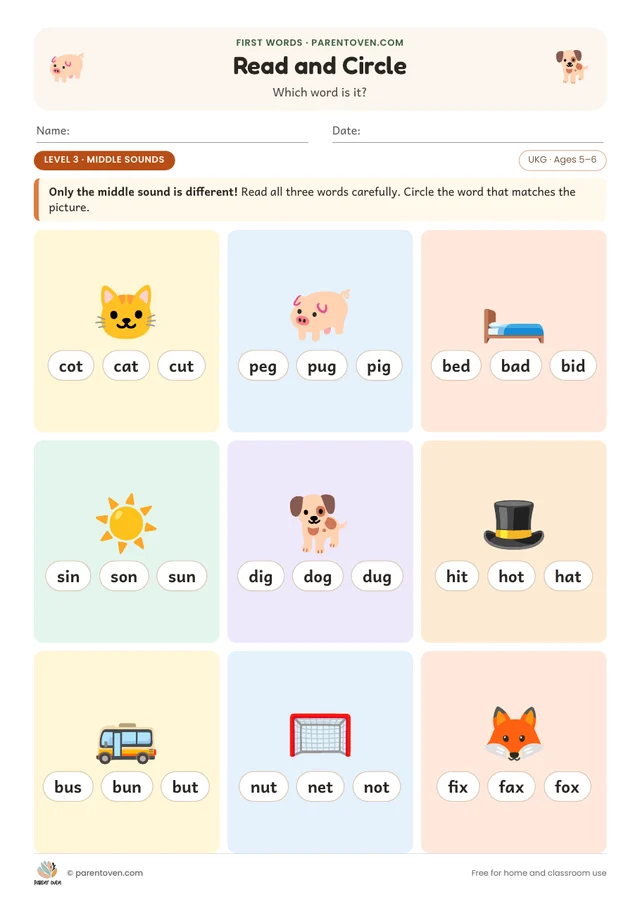
Level 3 · middle sounds
Read and circle
Nine pictures, each with three words that change only the vowel: cot, cat, cut. Children must read every word to find the right one.
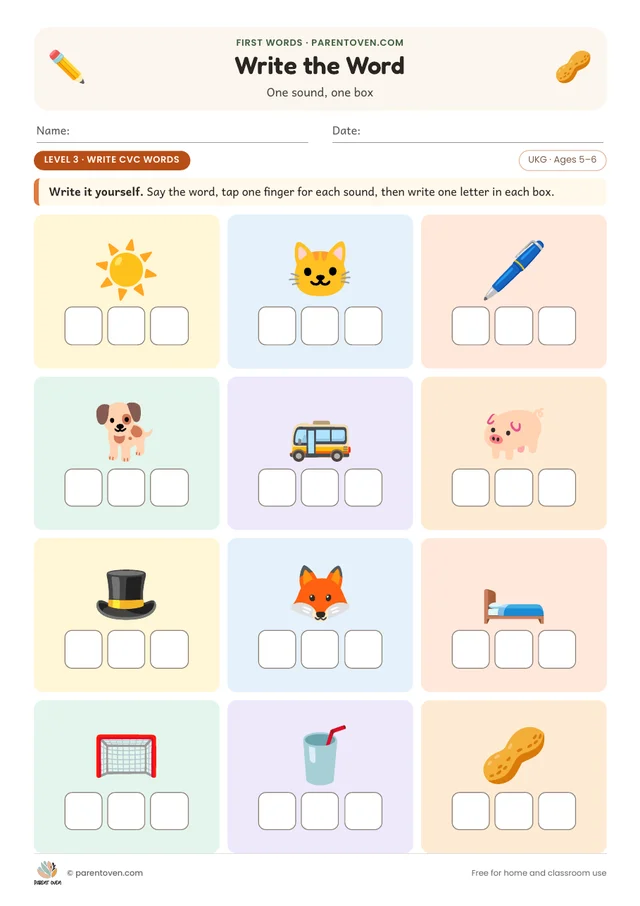
Level 3 · write CVC words
Write the word
Twelve pictures and three boxes each. One sound, one box. This is the real test of blending and spelling.
Saving ink? The black & white version has the same 6 sheets and answer key with white backgrounds and light grey pictures.
What your child will learn
Children read and write two-letter words, see how word families like -at, -en and -ox share an ending, match words to pictures, unscramble letters, and choose the right word for a picture.
These are the first words children can sound out on their own. Each success matters: let your child read a word to you before they write it, and praise the blending, not just the right answer.
A one-week plan
One sheet a day is plenty at this age. Stop while your child is still enjoying it, and save the answer key for the weekend so they can check their own work.
| Day | Sheet | Skill | Try this too |
|---|---|---|---|
| Monday | Two-letter words (Sheet 1) | Read and trace | Build words with letter tiles |
| Tuesday | Word families (Sheet 2) | Build words | Make a word-family house for -at |
| Wednesday | Read and match (Sheet 3) | Read cvc words | Read word cards around the room |
| Thursday | Unscramble the word (Sheet 4) | Spell cvc words | Unscramble magnetic letters |
| Friday | Read and circle (Sheet 5) | Middle sounds | Read a simple CVC storybook together |
| Saturday | Write the word (Sheet 6) | Write cvc words | Write three words from memory |
How to teach two and three letter words
- Check letter sounds first. A child needs to know most single letter sounds before blending. The vowels and consonants worksheets are a good warm-up.
- Blend two sounds. a-t, at. i-n, in. Two-letter words are the easiest blends and many are common reading words.
- Add one sound in front. Once “at” is easy, add c, b, h or r. Word families show children that one small change makes a new word.
- Sound, then say. Point under each letter and say its sound, then slide your finger and say the word fast.
- Listen for the middle. Many errors are in the vowel. Sheet 5 practises exactly this.
- Spell by sounds. For writing, say the word, tap a finger for each sound, then write one letter per sound.
- Read real books. Find simple readers with CVC words and celebrate each word your child reads alone.
Common mistakes and quick fixes
| What you see | What usually helps |
|---|---|
| Says each sound but cannot put them together | Say the sounds closer and closer: “c… a… t”, “c.a.t”, “cat”. Use stretchy sounds like m, s and f first. |
| Guesses from the picture | Cover the picture, read the word, then uncover the picture to check. |
| Reads “cat” as “cut” | Practise vowel pairs. Point to the vowel and ask “what sound does this make?” |
| Writes the letters in the wrong order | Use letter tiles first, then write. Say the first sound, then the next. |
| Adds an “uh” after sounds (cuh-a-tuh) | Keep consonant sounds short and clipped. Model them clearly. |
Games without paper
- Word family wheel. Write “-at” on paper and change the first letter with small cards: c, b, h, m, r, s.
- Robot talk. Say a word in robot sounds (d-o-g). Your child says the word. Then swap.
- Treasure hunt. Hide picture cards for three-letter words. Read a word card; your child finds the picture.
- Magnetic letters. Build a word, then change one letter: cat, cot, dot, dog.
- Sound game. The letter sounds game practises first sounds and middle vowels on a phone.
More reading practice
Go further with our CVC words worksheets, sight words and rhyming words. For neat letters, use lowercase letter tracing. The whole year is on the UKG worksheets page.
Frequently asked questions
What are three-letter words?
Usually CVC words: consonant, vowel, consonant, like cat, pen, sun and dog. They are the first words children learn to read by sounding out.
Which two-letter words should UKG children learn?
Common ones such as at, an, in, it, on, up, is, us, am, if, go, no and so. The first eight on Sheet 1 are fully decodable; go, no and so are best learned as sight words.
Is reading CVC words a UKG skill?
Yes. The NIPUN Bharat goal for age 5 to 6 is to read simple two- and three-letter words. Many Indian schools also teach word families and simple sentences in UKG.
My child reads the words but cannot spell them. Is that normal?
Yes. Reading usually comes before spelling. Keep practising with letter tiles and Sheet 6.
Can I print in black and white?
Yes. The ink-saving PDF has the same six sheets and the answer key.
Pictures are from Google’s Noto Emoji (Apache 2.0). Aligned with the NIPUN Bharat literacy goals for age 5 to 6 and NCERT’s NCF-FS 2022. Last reviewed: 21 November 2026 by the Parent Oven team.