Learning Worksheets Capital letters A to Z
Free printable PDF · LKG · ages 4–5 · 3 levels · answer key
Capital Letters Worksheets for LKG: Trace, Match and Find A to Z
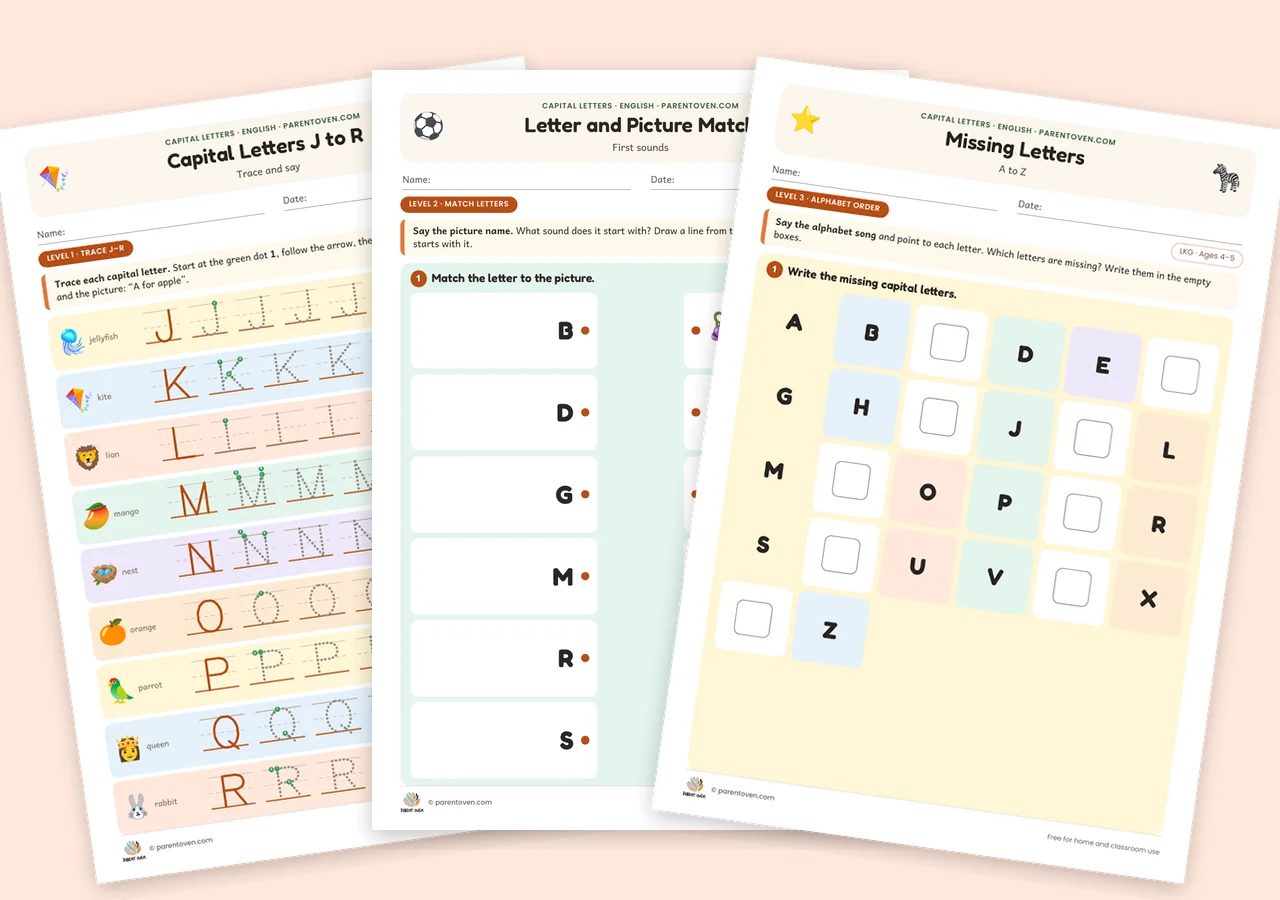
Six worksheets that take a four-year-old from tracing capital letters to finding them, matching them to first sounds and putting them in alphabet order. Every letter is traced on a single-stroke centreline with a numbered green start dot and an arrow, so children learn the right movement from the first day.
Capital letters are where most Indian schools begin in LKG. They are made of straight lines and simple curves, so they are easier for small hands than small letters. These sheets give each letter a picture word (“A for apple”) and build in looking games, so practice never turns into long rows of copying.
Free · A4 (prints on US Letter) · 6 sheets + answer key · colour and ink-saving black & white · no sign-up
Jump to: The six sheets · How to teach capital letters at home · Common mistakes · Games without paper · FAQs
The six sheets
Every sheet fills one A4 page, has a Name and Date line and stands on its own. The tracing sheets come first; the matching and order sheets work best once your child knows most letter names. The full PDF ends with a one-page answer key.
Level 1 · trace A–I
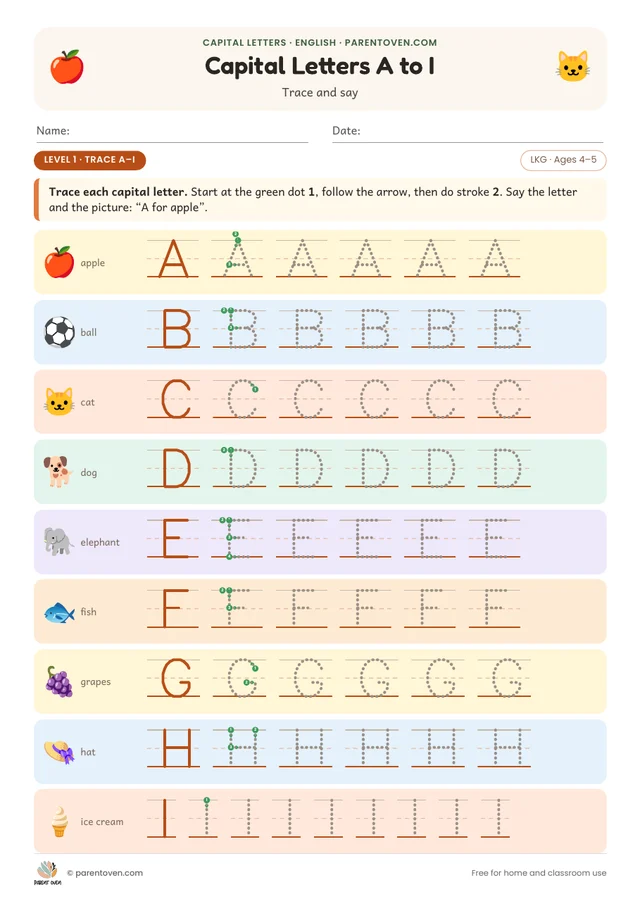
Trace capital letters A to I
Nine rows, one letter each, with a picture word on the left (apple, ball, cat, dog…). The first copy shows numbered start dots and arrows for every stroke; the next copies are dotted, and the row ends with space to try alone.

Level 1 · trace J–R
Trace capital letters J to R
The same calm layout for J to R, with pictures such as kite, lion, mango and queen. This half of the alphabet has the letters children mix up most (M and N, P and R), so say each stroke aloud as you trace.
Level 2 · trace S–Z
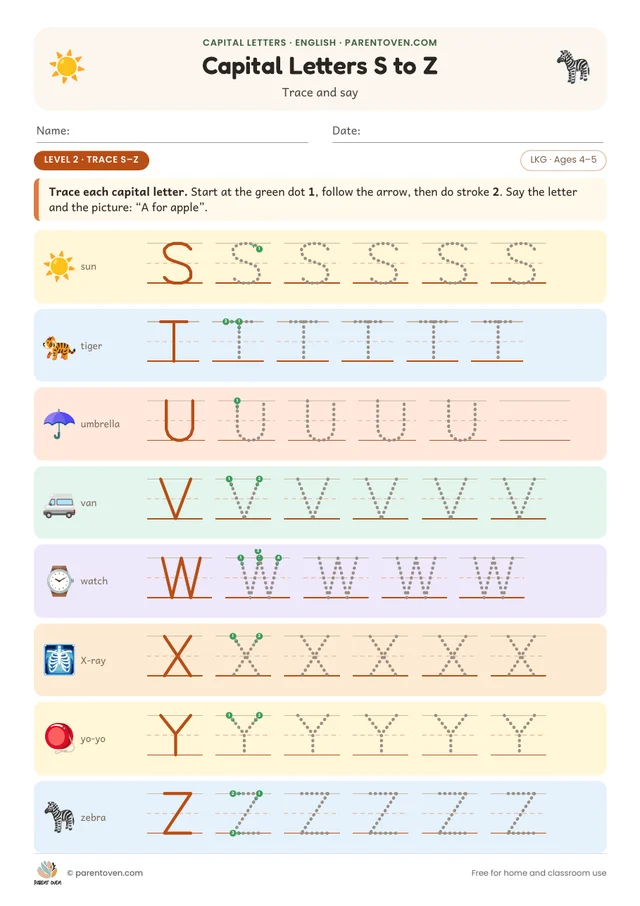
Trace capital letters S to Z
Eight rows from S for sun to Z for zebra. S and the slanting letters V, W, X, Y and Z need more control, which is why this sheet is marked Level 2.
Level 2 · first sounds
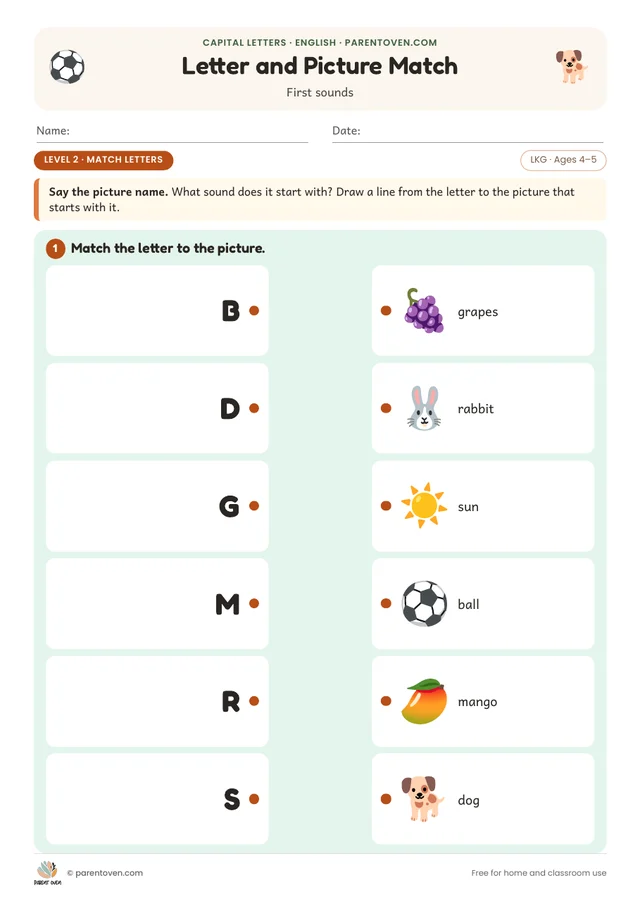
Letter and picture match
Six capital letters on the left and six pictures on the right, mixed up so that no letter sits next to its picture. Children say each picture name, listen for the first sound and draw a line to the right letter.
Level 2 · letter shapes
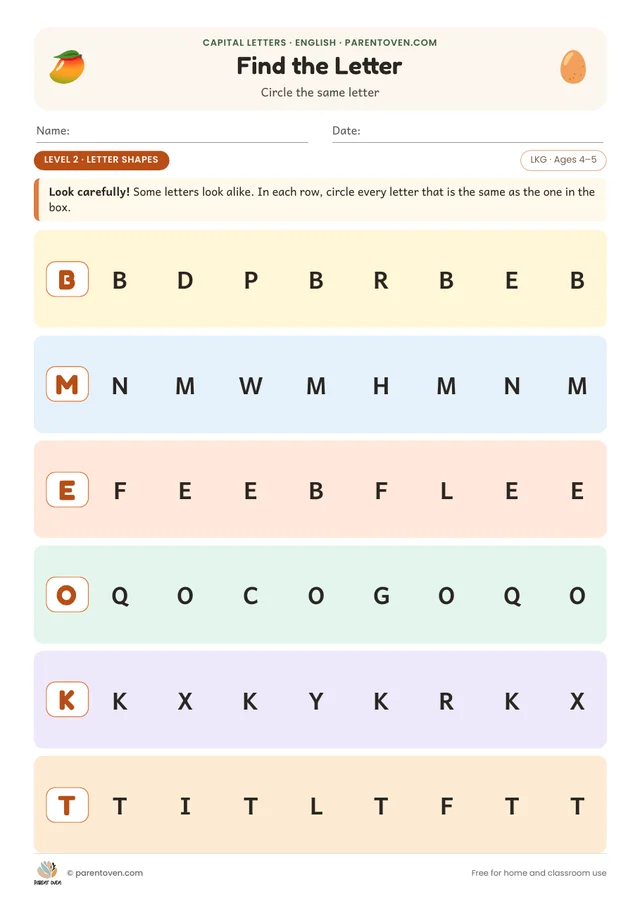
Find the letter
Six rows. Each row starts with a letter in a box, followed by look-alike letters such as B, P and R, or O, Q and C. Children circle every letter that matches. This trains careful looking, the skill behind reading.
Level 3 · alphabet order
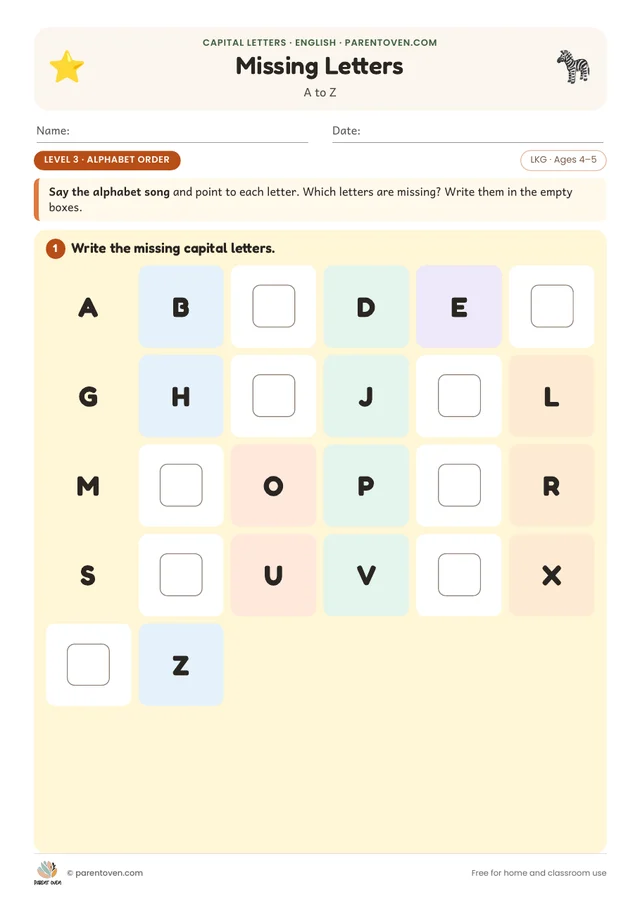
Missing letters A to Z
The whole alphabet in a grid with nine letters missing. Children sing or say the alphabet, point to each box and write the missing capitals.
Saving ink? The black & white version has the same 6 sheets and answer key with white backgrounds and light grey pictures.
What your child will learn
Children practise naming all 26 capital letters, writing each one with the right starting point and stroke order, hearing the first sound of a word, telling look-alike letters apart, and knowing the alphabet in order.
NCERT’s foundational stage goals for age 4 to 5 focus on recognising letters and making marks with control rather than neat handwriting. So expect wobbly letters for a while: a correct start and direction matter much more than straight lines.
A one-week plan
One sheet a day is plenty at this age. Stop while your child is still enjoying it, and save the answer key for the weekend so they can check their own work.
| Day | Sheet | Skill | Try this too |
|---|---|---|---|
| Monday | Trace capital letters A to I (Sheet 1) | Trace a–i | Make A, H and T with ice-cream sticks |
| Tuesday | Trace capital letters J to R (Sheet 2) | Trace j–r | Trace letters in a tray of rava or salt |
| Wednesday | Trace capital letters S to Z (Sheet 3) | Trace s–z | Find K, L and M on a cereal box |
| Thursday | Letter and picture match (Sheet 4) | First sounds | Play “I spy something starting with b” |
| Friday | Find the letter (Sheet 5) | Letter shapes | Hunt for letters on number plates on a walk |
| Saturday | Missing letters A to Z (Sheet 6) | Alphabet order | Sing the alphabet song while pointing to each letter |
How to teach capital letters at home
- Start big. Draw a giant A in the air with your whole arm, then on the floor with chalk, then with a finger in a tray of rava. Big movements teach the shape before the pencil does.
- Use the start dot. Every letter on these sheets starts at a green dot marked 1. Most capitals start at the top. Starting from the bottom works at first but makes writing slow and messy later.
- Say the strokes. “A: slide down, slide down, across.” “B: down, back to the top, round, round.” Saying it gives your child a little song to follow.
- Group letters by stroke. Teach straight-line letters together (L, T, I, E, F, H), then slanting ones (A, V, W, X, K), then curved ones (C, O, G, Q, S, D, P, B, R, U, J). Ours follow alphabet order, so pick the rows you want from each sheet.
- Link each letter to a sound. Say “B for ball, /b/ /b/ ball” rather than just “bee”. Children learn the letter name and its sound together without any extra effort.
- Little and often. Two or three letters a day is plenty at four. Stop while your child still wants to do more.
- Celebrate their name. Most children want to write their own name first. Use our name tracing maker so the letters they care about come early.
Common mistakes and quick fixes
| What you see | What usually helps |
|---|---|
| Starts letters from the bottom | Put a sticker or a green dot at the top of each letter and say “start at the top”. Practise big letters in the air first. |
| Writes letters back to front, like a reversed J or S | Completely normal at 4 and 5. Trace the letter with a finger while saying the strokes. It usually fades by age 7. |
| Mixes up M and N, or P and R | Put them side by side and count the strokes or “humps”. Use the Find the Letter sheet and talk about what is different. |
| Presses very hard or grips the pencil in a fist | Use a short, thick crayon, which encourages a tripod grip. Play with playdough and pegs to build finger strength. |
| Can sing the alphabet but not name a letter on its own | Point to letters out of order on packets and signs. Ask “which letter is this?” a few times a day, not as a test. |
Games without paper
- Letter hunt. Write five capital letters on sticky notes and hide them around the room. Your child finds each one and says its name and sound.
- Body letters. Make T, X, Y and I with your arms and legs. Can your child guess the letter you are making?
- Rava tray. Spread a thin layer of rava, salt or sand on a plate and trace letters with a finger. Shake to erase.
- Shop sign spotting. On a walk or a drive, find a capital A, then B, then C on signs and number plates.
- Colour the letters. Our alphabet colouring pages turn each letter into a picture to colour after tracing.
More letter practice
For one page per letter, use the alphabet tracing worksheets A to Z. When capitals are secure, move on to small letters with the lowercase letter tracing worksheets and then the capital and small letter matching worksheets. A finger-tracing version is on letter tracing online. All topics for this age are on the LKG worksheets page.
Frequently asked questions
Should LKG children learn capital or small letters first?
Most Indian schools start with capital letters in LKG because they use straight lines and simple curves. Small letters follow later in LKG or in UKG. Some phonics-based schools start with small letters instead; both work if letter sounds are taught alongside.
How many letters should a four-year-old learn in a week?
Two to four new letters a week is a comfortable pace, with lots of revision of old ones. Some children go faster; it is fine to slow down too.
My child writes some letters backwards. Is that a problem?
No. Reversals are very common at this age and usually disappear by about 7. Keep using the start dot and arrow, and praise a correct start.
Why do the tracing letters have numbers on them?
The numbers show the order of the strokes, and the green dot shows where to start. Learning the right order early makes writing faster and neater later.
Is there a black and white version?
Yes. The ink-saving black and white PDF has the same six sheets and answer key with white backgrounds and grey pictures.
Will these print on US Letter paper?
Yes. They are made for A4 with wide margins. Choose “Fit to page” in your print settings if an edge is cut off.
Pictures are from Google’s Noto Emoji (Apache 2.0). Skill levels follow NCERT’s NCF-FS 2022 and the NIPUN Bharat goals for the foundational stage. Last reviewed: 21 November 2026 by the Parent Oven team.