
Learning Worksheets Hindi words without matra
Free printable PDF · Hindi · UKG · ages 5–6 · answer key
बिना मात्रा वाले शब्द: Hindi Words Without Matra Worksheets for UKG
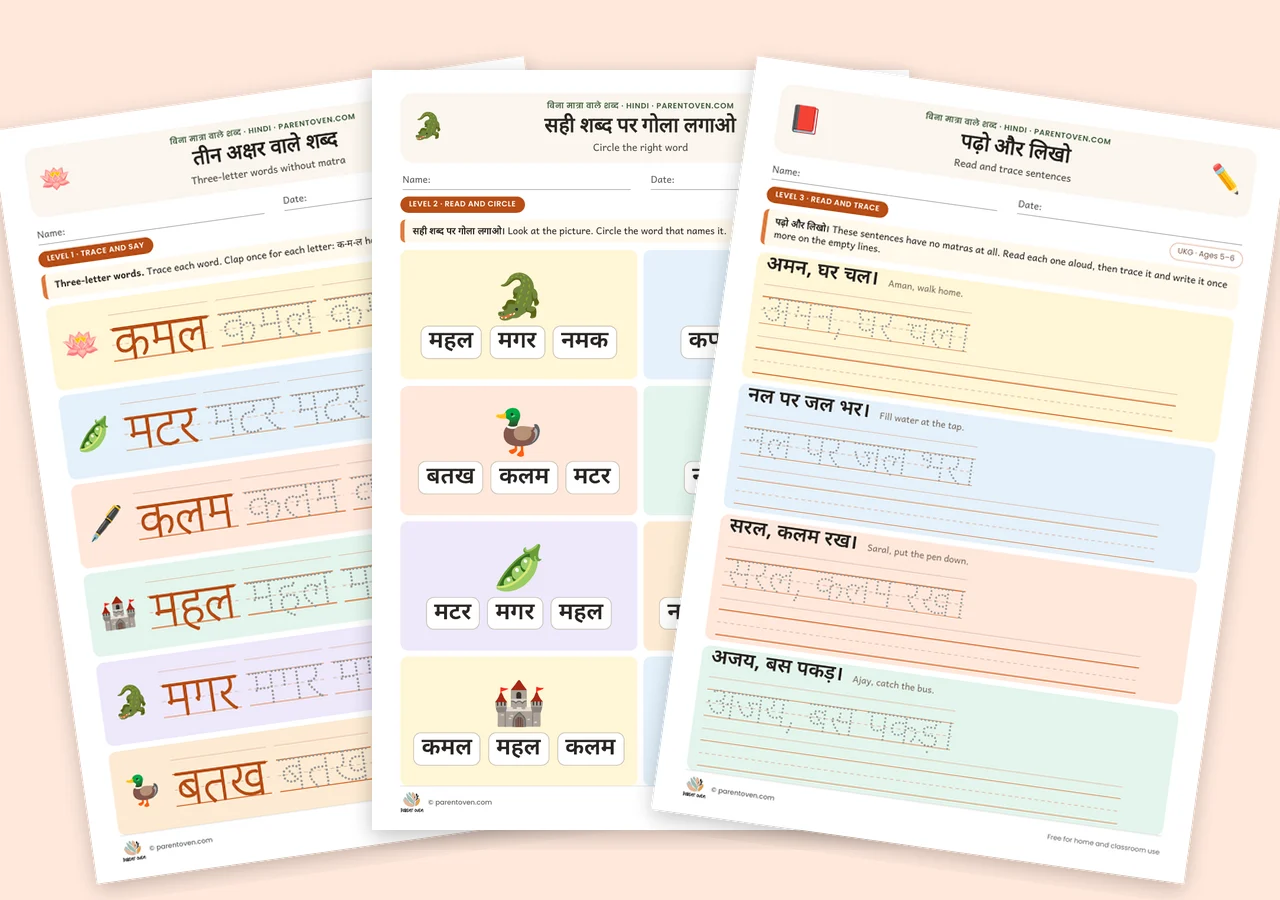
Six Hindi worksheets for the step after the varnamala: reading and writing words with no matras. Children trace दो अक्षर वाले शब्द (जल, फल, घर, नल, बस, कप) and तीन अक्षर वाले शब्द (कमल, मटर, कलम, महल, मगर, बतख), match pictures to words, circle the right word, join letters to make words, and read short sentences such as “नल पर जल भर।”
The tracing letters follow the real shape of each letter on a standard four-line Hindi copybook guide, with a clean शिरोरेखा. Every word is a common, natural school word with a clear picture. Answer key and black and white version included.
Free · A4 (prints on US Letter) · 6 sheets + answer key · colour and ink-saving black & white · no sign-up
Jump to: The six sheets · How to teach bina matra words · Common mistakes · Games without paper · FAQs
The six sheets
Each sheet is one A4 page. Sheets 1 and 2 are tracing, Sheets 3 and 4 are reading, and Sheets 5 and 6 combine reading and writing.
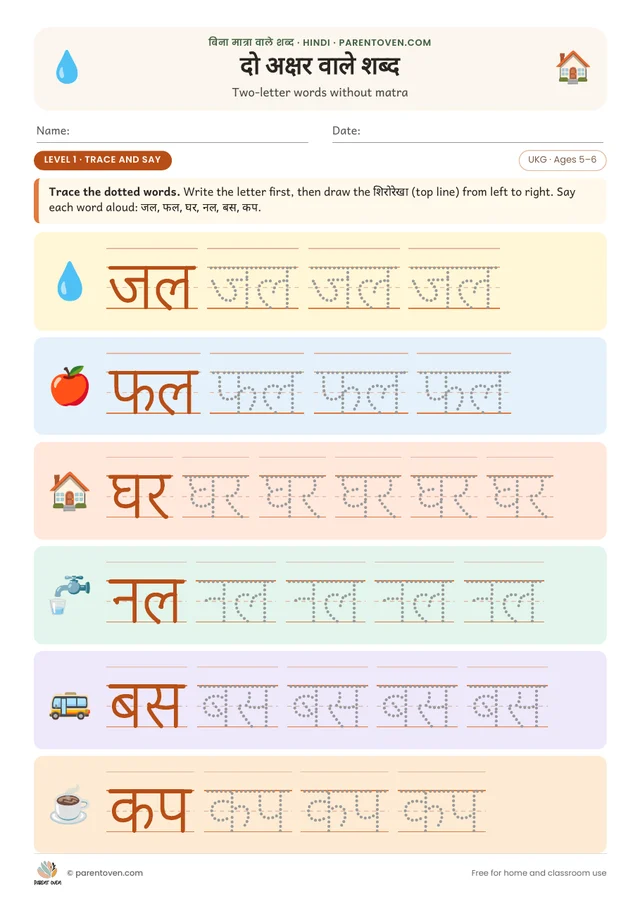
Level 1 · trace and say
दो अक्षर वाले शब्द
Six two-letter words with pictures: जल, फल, घर, नल, बस, कप. A solid model, then dotted copies to trace on the copybook lines.
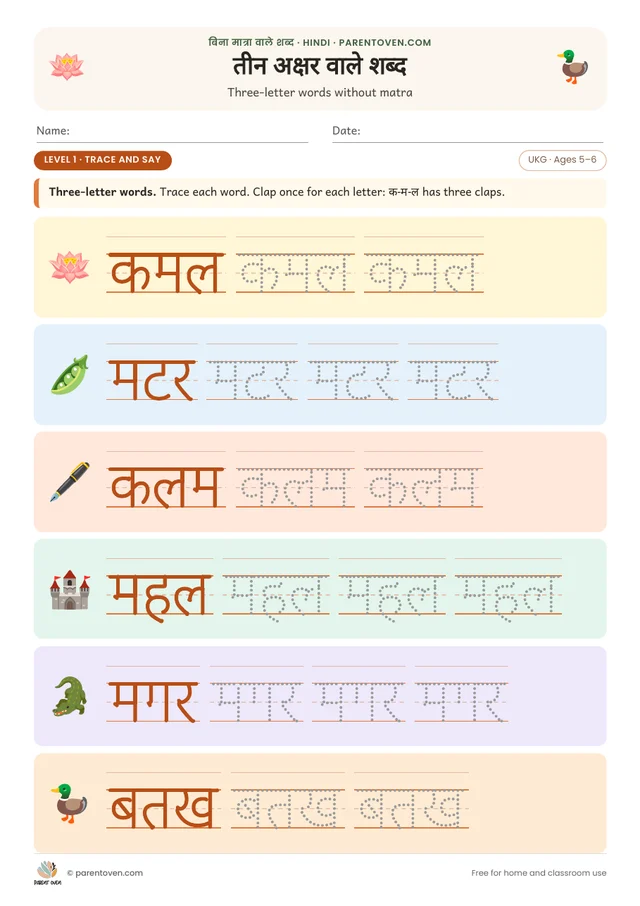
Level 1 · trace and say
तीन अक्षर वाले शब्द
Six three-letter words: कमल, मटर, कलम, महल, मगर, बतख. Children clap once for each letter before they trace.
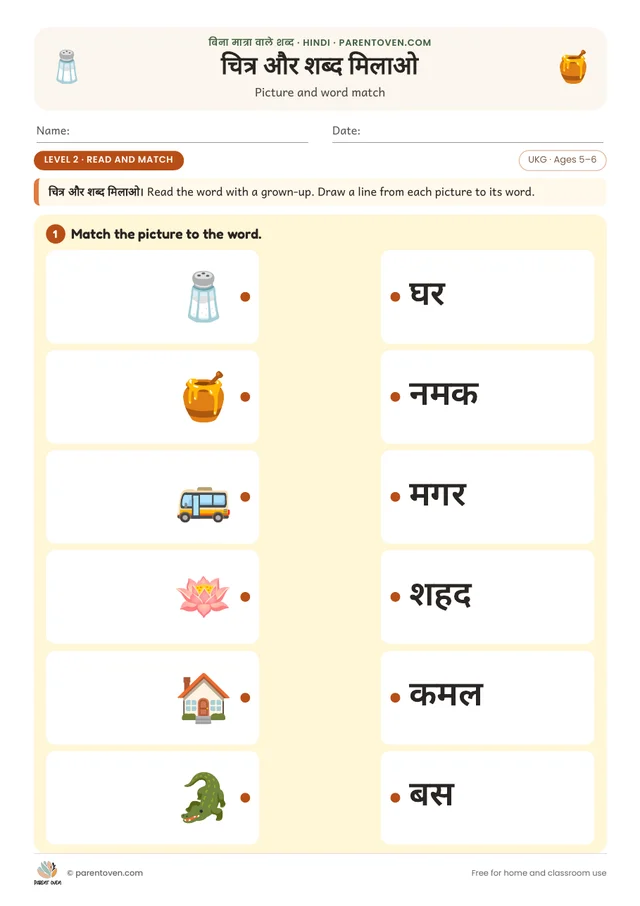
Level 2 · read and match
चित्र और शब्द मिलाओ
Six pictures (salt, honey, bus, lotus, house, crocodile) to match with नमक, शहद, बस, कमल, घर, मगर. The words are in a different order.

Level 2 · read and circle
सही शब्द पर गोला लगाओ
Eight pictures, each with three similar-looking words, such as मगर, महल, नमक. Children circle the word that names the picture.
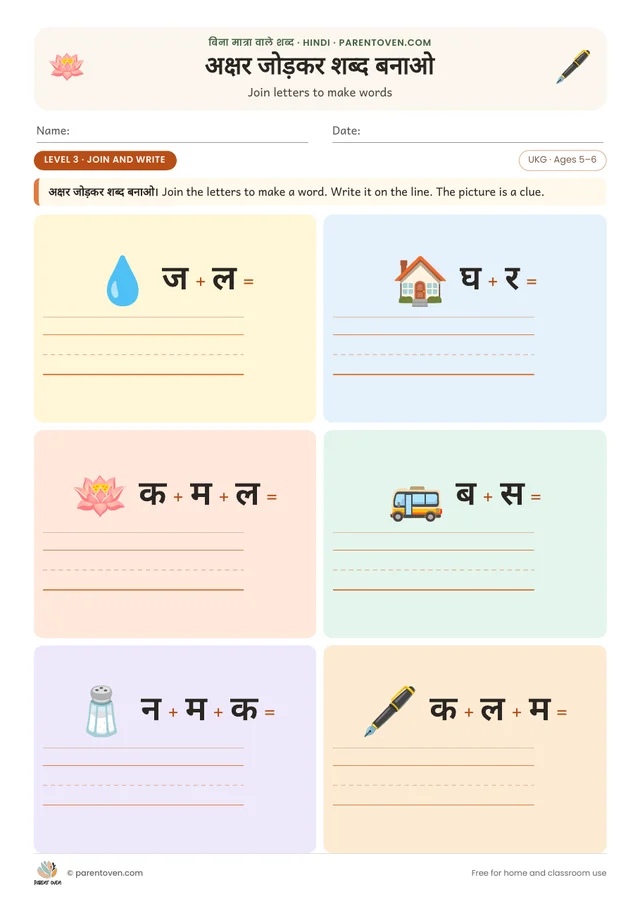
Level 3 · join and write
अक्षर जोड़कर शब्द बनाओ
ज + ल = ? Six letter sums with a picture clue. Children write the word on a Hindi copybook line.
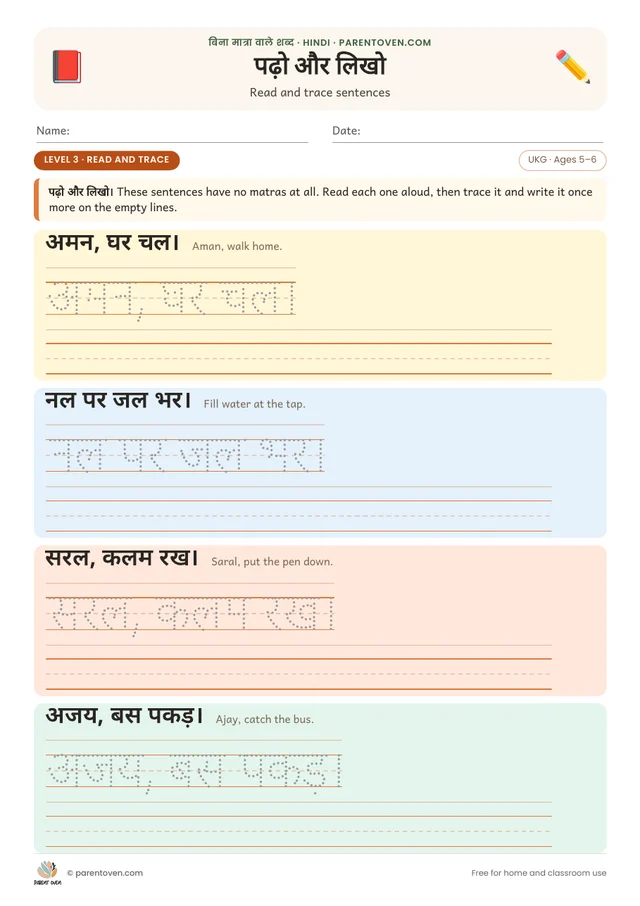
Level 3 · read and trace
पढ़ो और लिखो
Four short sentences with no matras: अमन, घर चल। नल पर जल भर। सरल, कलम रख। अजय, बस पकड़। Read, trace and write once more.
Saving ink? The black & white version has the same 6 sheets and answer key with white backgrounds and light grey pictures.
What your child will learn
Children read and write two- and three-letter Hindi words without matras, match words to pictures, build words from letters, and read their first short sentences in Hindi.
Blending is the key skill: क + म + ल = कमल. When your child can blend these words easily, they are ready for the आ matra and the barakhadi.
A one-week plan
One sheet a day is plenty at this age. Stop while your child is still enjoying it, and save the answer key for the weekend so they can check their own work.
| Day | Sheet | Skill | Try this too |
|---|---|---|---|
| Monday | दो अक्षर वाले शब्द (Sheet 1) | Trace and say | Make letter cards and build जल, घर |
| Tuesday | तीन अक्षर वाले शब्द (Sheet 2) | Trace and say | Clap the letters in each word |
| Wednesday | चित्र और शब्द मिलाओ (Sheet 3) | Read and match | Find words on signs and packets |
| Thursday | सही शब्द पर गोला लगाओ (Sheet 4) | Read and circle | Change one letter: जल, फल, नल |
| Friday | अक्षर जोड़कर शब्द बनाओ (Sheet 5) | Join and write | Read one sentence aloud at dinner |
| Saturday | पढ़ो और लिखो (Sheet 6) | Read and trace | Write two words from memory |
How to teach bina matra words
- Check the letters first. Children should know क to ज्ञ by sight and sound. If a letter is shaky, practise it on its own first.
- Blend slowly. Say each letter, then push them together: “क… म… ल… कमल!” Every letter here carries the inherent अ sound.
- Note the last letter. In spoken Hindi, the final अ is usually silent: we say “kamal”, not “kamala”. Model the natural way.
- Write the letter, then the line. Draw the letter body first and the शिरोरेखा last, joining the letters of the word into one line.
- Use real objects. Point to a real नल, कप or कलम while reading the word.
- Read sentences aloud together. Short no-matra sentences build confidence before matras arrive.
Common mistakes and quick fixes
| What you see | What usually helps |
|---|---|
| Reads कमल as “ka-ma-la” | Say the word naturally and ask your child to copy: kamal. The last अ is short and mostly silent. |
| Confuses ब and व, or म and भ | Point to the small difference (the cut in ब, the loop in भ) and trace both side by side. |
| Draws the शिरोरेखा first and the letters hang below it | Write the letters first, then draw one straight शिरोरेखा over the whole word. |
| Leaves gaps in the शिरोरेखा between letters | In one word, the top line joins all the letters. Between words, leave a gap. |
| Guesses the word from the picture | Cover the picture and read the letters first, then check with the picture. |
Games without paper
- अक्षर कार्ड. Write letters on cards and build words: ज + ल, घ + र, क + म + ल.
- Word hunt. Find बस, नल or घर on signs and packets when you go out.
- Clap the letters. Clap once for each letter in a word: बतख has three claps.
- Change one letter. जल → फल → नल. What new word do you get?
- Play the Hindi letter game. Our Hindi letter game practises letter sounds with read-aloud.
More Hindi practice
Before this set, practise the letters with our Hindi letter tracing worksheets (स्वर और व्यंजन). The full year is on the UKG worksheets page.
Frequently asked questions
बिना मात्रा वाले शब्द क्या होते हैं?
ये ऐसे शब्द हैं जिनमें कोई मात्रा नहीं लगती, जैसे जल, घर, कमल। हर अक्षर में “अ” की ध्वनि होती है।
When should children learn words without matra?
After they know the Hindi consonants by sight and sound, usually in UKG. Matras (आ, इ, ई…) come next, often in late UKG or Class 1.
Which are good two-letter words without matra?
जल, फल, घर, नल, बस, कप, हल, वन, दस, सब, थन and रथ are common examples.
Is this NCERT-aligned?
Yes. NCERT’s early Hindi books introduce simple no-matra words like these before matras, in line with NCF-FS 2022 goals for reading in the home language.
Why do some sheets have no numbered start dots?
Hindi letters are traced along the centre of the real letter shape. Show your child to write the letter body first and draw the शिरोरेखा last, from left to right, as Indian schools teach.
Is there a black and white version?
Yes. The ink-saving PDF has the same six sheets and answer key with light grey pictures.
Pictures are from Google’s Noto Emoji (Apache 2.0). Word lists follow NCERT early-grade Hindi practice and NCF-FS 2022 goals for literacy in the home language. Last reviewed: 21 November 2026 by the Parent Oven team.