
Learning Worksheets Transport worksheets
Free printable PDF · EVS · UKG · ages 5–6 · answer key
Transport Worksheets for UKG: Land, Water and Air
Six transport worksheets made for Indian children: auto rickshaws, scooters, buses and tractors sit next to ships, canoes, helicopters and rockets. Children sort vehicles into land, water and air, match helper vehicles to the people and places they serve, count wheels, trace transport words, learn traffic-light colours and safe road habits, and find the odd one out.
Transport is a favourite UKG EVS topic because children see it every day. The sheets use that: most tasks can be checked on the next trip to school. Answer key and black and white version included.
Free · A4 (prints on US Letter) · 6 sheets + answer key · colour and ink-saving black & white · no sign-up

Jump to: The six sheets · How to teach transport in UKG · Common mistakes · Games without paper · FAQs
The six sheets
Every sheet is one A4 page. Sheet 1 introduces the three kinds of transport, Sheets 2 to 4 build vocabulary, and Sheets 5 and 6 add road safety and reasoning.
Level 1 · kinds of transport
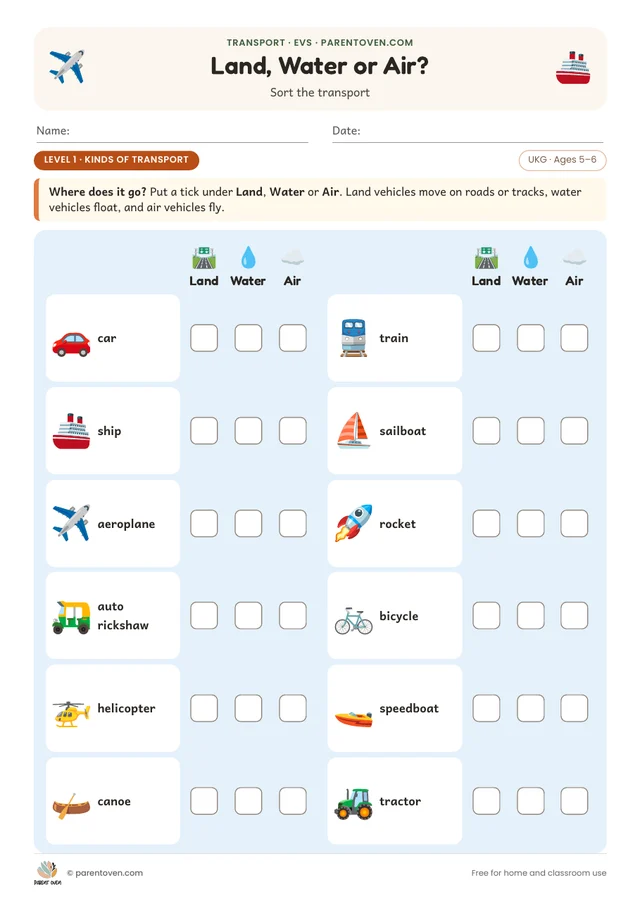
Land, water or air?
Twelve vehicles in two tables. Children tick Land, Water or Air for each one. The list mixes the familiar (car, train, bicycle) with a few new words (canoe, speedboat).
Level 1 · helper vehicles
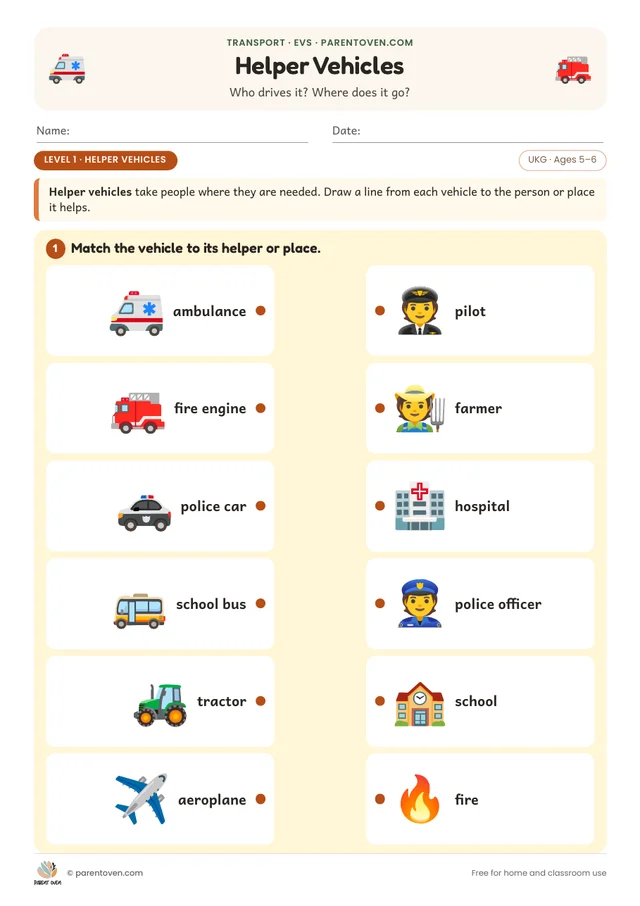
Helper vehicles
Match the ambulance, fire engine, police car, school bus, tractor and aeroplane to the place or person they help. The right-hand column is mixed up, so it is a real puzzle.

Level 2 · wheels and numbers
Count the wheels
Eight vehicles: how many wheels does each really have? The tip reminds children to think about the wheels they cannot see. Then: which has the most, and which has three?

Level 2 · write transport words
Trace transport words
Six rows with a picture: bus, car, van, ship, boat, train. A solid model, then single-stroke dotted words with numbered green start dots on the first copy.
Level 2 · road safety
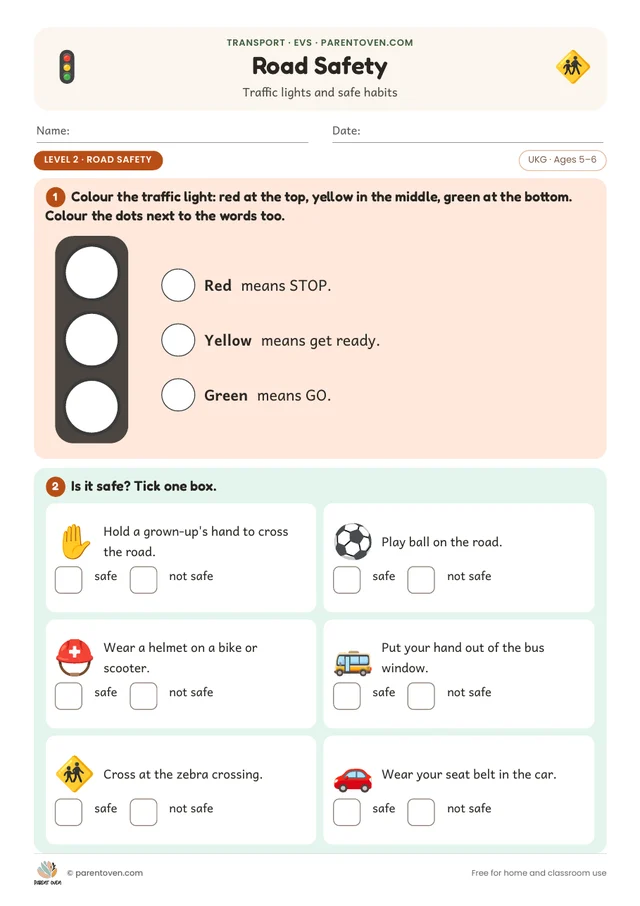
Road safety
Colour a traffic light and learn what red, yellow and green mean, then decide whether six habits are safe or not safe, from crossing at the zebra crossing to keeping hands inside the bus.

Level 3 · thinking about transport
Odd one out
Six rows of four vehicles. Circle the one that does not belong and say why: it floats, it flies, it is not a helper vehicle, or it has more than two wheels.
Saving ink? The black & white version has the same 6 sheets and answer key with white backgrounds and light grey pictures.
What your child will learn
Children sort vehicles by where they move, learn the names of helper vehicles, count wheels, write transport words, learn traffic-light colours and basic road rules, and give reasons in odd-one-out puzzles.
The road-safety sheet is the most practical page in the set. Practise its rules on every walk until they are habits: stop at the kerb, look both ways, hold a grown-up’s hand, and cross at the zebra crossing.
A one-week plan
One sheet a day is plenty at this age. Stop while your child is still enjoying it, and save the answer key for the weekend so they can check their own work.
| Day | Sheet | Skill | Try this too |
|---|---|---|---|
| Monday | Land, water or air? (Sheet 1) | Kinds of transport | Spot land, water and air vehicles from a window |
| Tuesday | Helper vehicles (Sheet 2) | Helper vehicles | Make siren sounds for helper vehicles |
| Wednesday | Count the wheels (Sheet 3) | Wheels and numbers | Count wheels in the parking area |
| Thursday | Trace transport words (Sheet 4) | Write transport words | Write a vehicle word on a chalkboard |
| Friday | Road safety (Sheet 5) | Road safety | Practise crossing at a zebra crossing |
| Saturday | Odd one out (Sheet 6) | Thinking about transport | Fold a paper boat |
How to teach transport in UKG
- Begin outside. Stand at the gate or a window for five minutes and name every vehicle you see. Count them. Which was the most common?
- Sort by where it moves. Land, water and air is the first big idea. Ask “does it have wheels? does it float? does it fly?”
- Talk about jobs. Helper vehicles help people: the ambulance takes sick people to hospital, the fire engine puts out fires. Children love the sirens.
- Count with meaning. Counting wheels is real maths. A car has four even if the picture shows two.
- Make safety a habit. Teach the traffic-light colours, holding hands, the zebra crossing and seat belts. Practise them on real walks.
- Ask “why?” Odd-one-out puzzles have reasons. Accept any sensible reason your child can explain.
Common mistakes and quick fixes
| What you see | What usually helps |
|---|---|
| Says a helicopter is a land vehicle because it lands | Ask “where does it spend most of its time moving?” It flies, so it is an air vehicle. |
| Counts only the wheels in the picture | Look at a real car or scooter. Count the wheels on both sides together. |
| Thinks yellow means “go fast” | Yellow means get ready to stop. Only green means go, and even then we look both ways. |
| Calls every boat a ship | Ships are very big and carry many people or goods; boats are smaller. Canoe and sailboat are kinds of boats. |
| Picks the odd one out by colour | Colour is a fair reason too! Then ask for a transport reason: where does it go, how many wheels? |
Games without paper
- Vehicle bingo. Draw six vehicles on paper before a trip. Tick them off as you spot them.
- Traffic-light game. Call out red, yellow or green: stop, get ready, or walk on the spot.
- Wheel count. In the parking area, count wheels on bikes, cars and autos. Which has the most?
- Paper boats. Fold a paper boat and float it in a bucket. Does it stay up? That is a water vehicle.
- Quiz time. Our vehicles quiz on the Play & Learn page is a fun picture review.
More EVS practice
Pair this set with community helpers worksheets and good habits and safety. For other EVS topics, try my body and five senses and animal worksheets. The full year is on the UKG worksheets page.
Frequently asked questions
What are the three types of transport?
Land transport moves on roads or tracks (car, bus, train, auto rickshaw). Water transport floats (ship, boat, canoe). Air transport flies (aeroplane, helicopter, rocket).
Is transport taught in UKG?
Yes. “Means of transport” is a common UKG EVS topic in Indian schools, usually with road safety and helper vehicles. NCF-FS 2022 includes the world around us and personal safety at this stage.
How many wheels does an auto rickshaw have?
Three: one at the front and two at the back. That is why it is sometimes called a three-wheeler.
How do I teach road safety to a 5-year-old?
Keep it to a few clear rules and practise them every time you go out: hold a grown-up’s hand, stop at the kerb, look both ways, cross at the zebra crossing, and wear a seat belt or helmet.
Is there a black and white version?
Yes. The ink-saving PDF has the same six sheets and answer key with light grey pictures.
Pictures are from Google’s Noto Emoji (Apache 2.0). Topics follow common Indian UKG EVS syllabuses and NCF-FS 2022 goals for safety and the world around us. Last reviewed: 21 November 2026 by the Parent Oven team.