
Learning Worksheets Family and helpers worksheets
Free printable PDF · EVS · UKG · ages 5–6 · answer key
My Family and Community Helpers Worksheets for UKG
Six worksheets that start at home and move out into the neighbourhood. Children match family words to pictures, draw their own family tree, match doctors, cooks, farmers, mechanics and firefighters to their tools, solve “Who am I?” riddles, trace helper words, and decide which jobs at home are helpful.
The set follows the way UKG EVS is taught in most Indian schools: me, my family, then the people who help us. Every puzzle has one right answer, the matching columns are mixed up, and the answer key is on the last page. A black and white version saves ink.
Free · A4 (prints on US Letter) · 6 sheets + answer key · colour and ink-saving black & white · no sign-up

Jump to: The six sheets · How to teach family and community helpers in UKG · Common mistakes · Games without paper · FAQs
The six sheets
Each sheet is one A4 page. Sheets 1 and 2 are about the child’s own family, Sheets 3 to 5 are about community helpers, and Sheet 6 brings it back home: children can be helpers too.
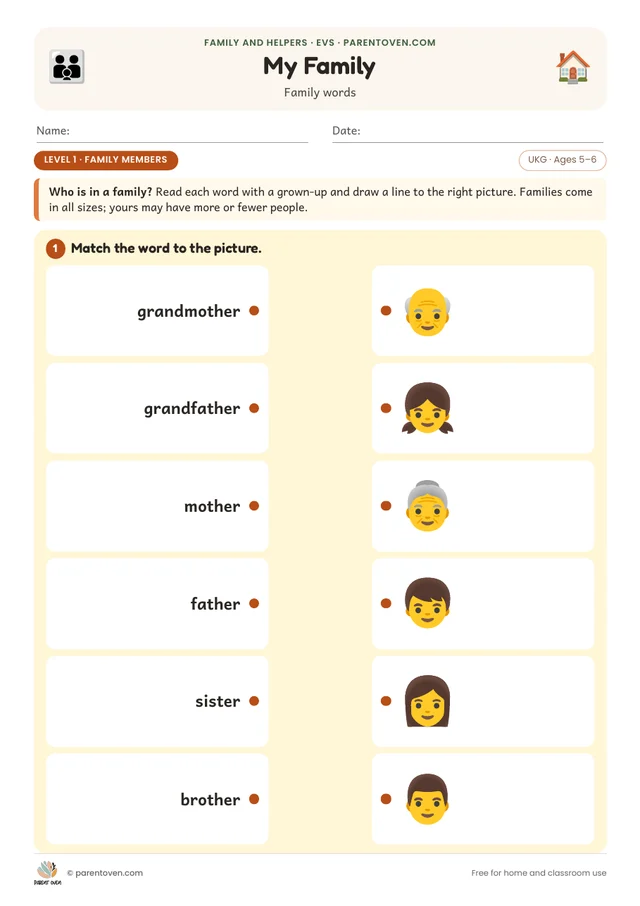
Level 1 · family members
My family
Six family words (grandmother, grandfather, mother, father, sister, brother) to match with pictures. The pictures are in a different order from the words, so children must read or listen, not just draw straight lines.
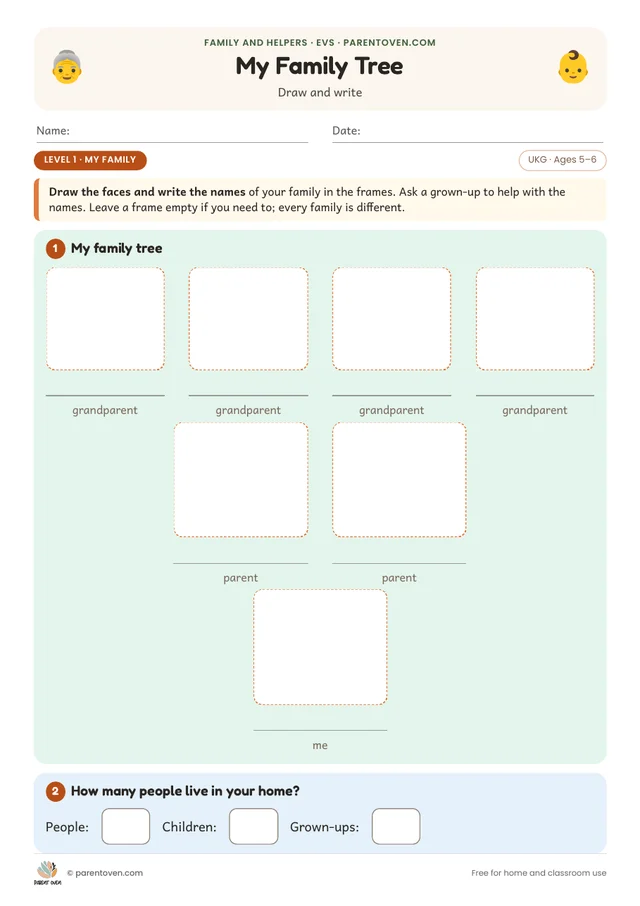
Level 1 · my family
My family tree
Frames for grandparents, parents and “me” to draw faces and write names, then three boxes to count the people, children and grown-ups at home. Any frame can stay empty: every family is different.
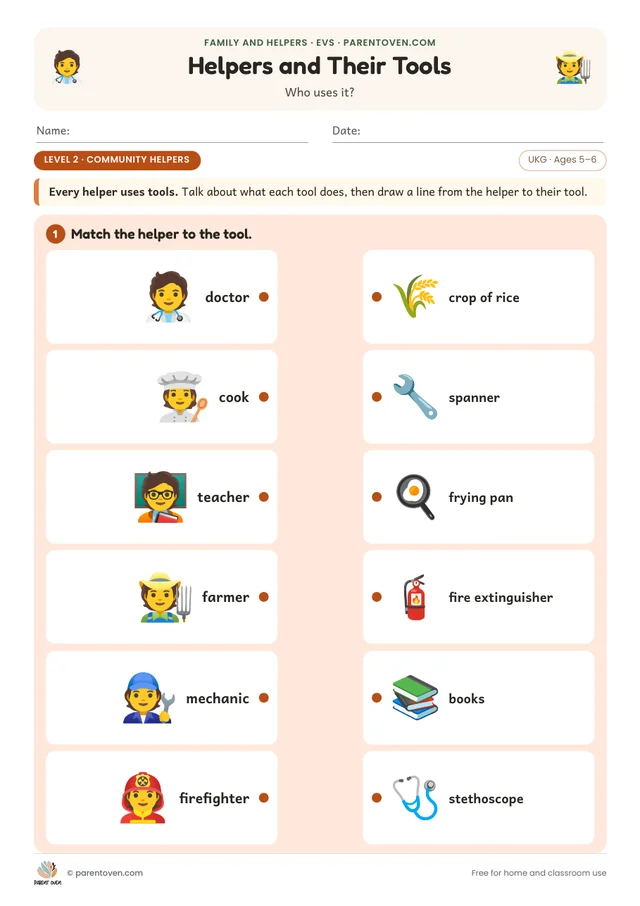
Level 2 · community helpers
Helpers and their tools
Match the doctor to the stethoscope, the cook to the frying pan, the teacher to books, the farmer to the rice crop, the mechanic to the spanner and the firefighter to the extinguisher.
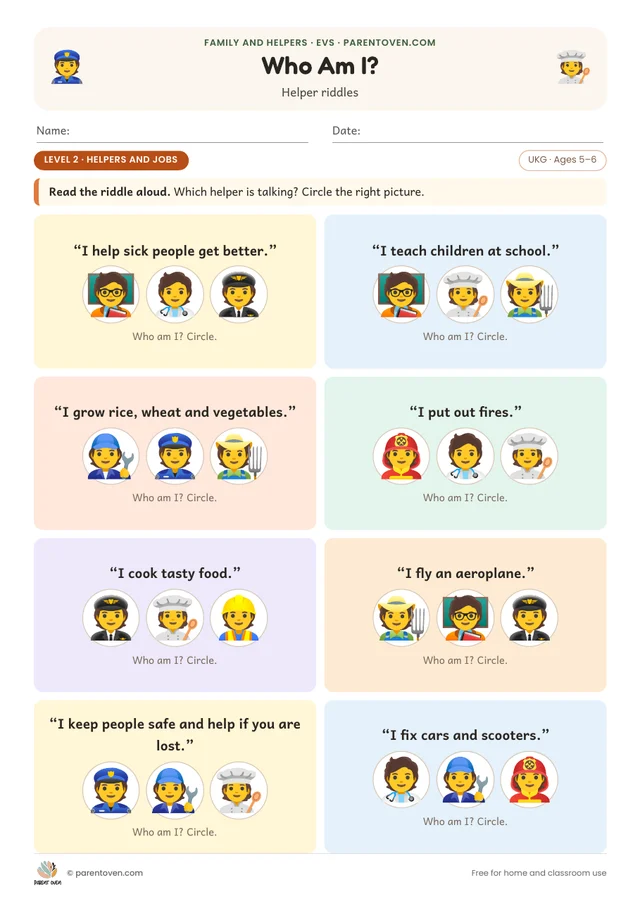
Level 2 · helpers and jobs
Who am I?
Eight short riddles, such as “I fix cars and scooters.” Under each riddle are three helpers; children circle the one who is talking. It builds listening and reasoning as well as vocabulary.
Level 2 · write helper words
Trace helper words
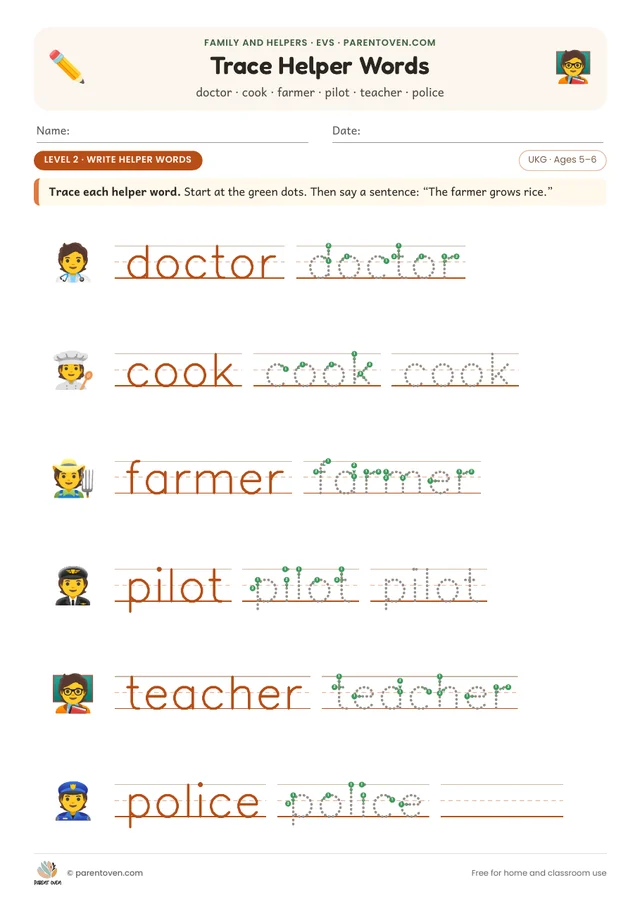
Six rows with a picture: doctor, cook, farmer, pilot, teacher, police. A solid model, then single-stroke dotted words with numbered green start dots on the first copy.
Level 3 · helping others
Helping at home
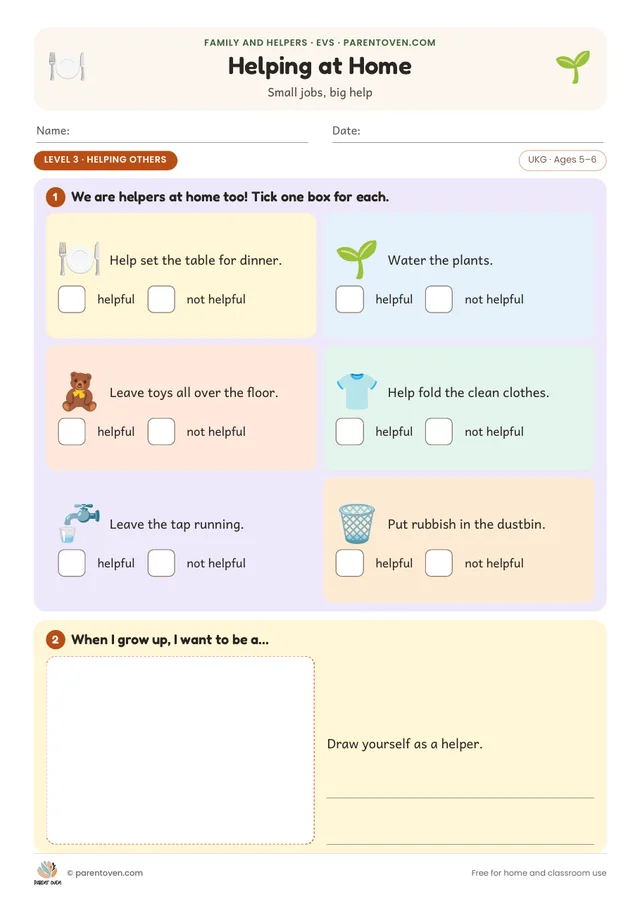
Six home jobs to tick as helpful or not helpful (set the table, water the plants, leave toys on the floor…), then a frame to draw “When I grow up, I want to be a…” with lines to write the job.
Saving ink? The black & white version has the same 6 sheets and answer key with white backgrounds and light grey pictures.
What your child will learn
Children learn family words, describe their own family, name eight community helpers and their tools, solve riddles about jobs, and see themselves as helpers at home.
The set also builds respect: every job, from the farmer to the sweeper, keeps the community going. Talk about the helpers your child meets every week and thank them together.
A one-week plan
One sheet a day is plenty at this age. Stop while your child is still enjoying it, and save the answer key for the weekend so they can check their own work.
| Day | Sheet | Skill | Try this too |
|---|---|---|---|
| Monday | My family (Sheet 1) | Family members | Look at family photos and name everyone |
| Tuesday | My family tree (Sheet 2) | My family | Count the people at the dinner table |
| Wednesday | Helpers and their tools (Sheet 3) | Community helpers | Play the tool basket game |
| Thursday | Who am I? (Sheet 4) | Helpers and jobs | Make up a new helper riddle |
| Friday | Trace helper words (Sheet 5) | Write helper words | Write a helper word on a card |
| Saturday | Helping at home (Sheet 6) | Helping others | Do one real job at home |
How to teach family and community helpers in UKG
- Start with photos. Look at a family album or phone photos. Name each person and how they are related: “Nani is Mummy’s mother.”
- Use the words your family uses. Dadi, Nani, Chacha, Mausi are all right. The sheet uses English words; say both.
- Walk the neighbourhood. Point out the vegetable seller, the guard, the postman, the sweeper. Ask what each one does for us.
- Link helpers to tools. A tool is a clue to the job. Hold up a spoon, a pen, a comb and ask “who uses this at work?”
- Play riddles out loud. Say “I wear a white coat and help when you are ill” and let your child guess before they see Sheet 4.
- Say thank you. Encourage your child to thank the helpers they meet. Respect for every job is the real lesson.
Common mistakes and quick fixes
| What you see | What usually helps |
|---|---|
| Calls every grown-up woman “aunty” on the family sheet | That is polite! Then teach the family words: mother’s sister, father’s mother, and so on. |
| Thinks only men are doctors, pilots or police | Show women in these jobs too. The pictures in the set mix men and women on purpose. |
| Mixes up the cook and the farmer | The farmer grows the food; the cook makes it into a meal. Talk about where rice comes from. |
| Worries about an empty frame on the family tree | Say every family is different. Children can draw anyone who looks after them, including a pet. |
| Ticks “helpful” for every job at home | Read the sentence again slowly. Leaving toys on the floor and letting the tap run are not helpful. |
Games without paper
- Helper charades. Act out a job (sweeping, driving, cooking) and guess who you are.
- Tool basket. Put a spoon, a toy stethoscope, a book and a small spanner in a bag. Pull one out and name the helper.
- Family phone. Teach your child the names of three family members and one phone number by heart.
- Thank-you cards. Draw a card for the school guard, the driver or the house help.
- Job of the day. Give your child one real helping job each day and praise it at bedtime.
More EVS practice
Next, try transport worksheets for helper vehicles, good habits and safety and living and non-living things. Earlier in the year: my body and five senses. The full year is on the UKG worksheets page.
Frequently asked questions
What are community helpers?
Community helpers are people whose work helps everyone around them: doctors, nurses, teachers, farmers, cooks, police officers, firefighters, postmen, drivers and cleaners.
Is “my family” taught in UKG?
Yes. My family and the people who help us are early EVS topics in most Indian UKG syllabuses, and NCF-FS 2022 includes knowing oneself, one’s family and the community.
My child lives with one parent or grandparents. Will the family tree work?
Yes. The frames are optional; children fill in the people who look after them. The answer key says there is no wrong family tree.
How many community helpers should a UKG child know?
Eight to ten common helpers is a good goal: doctor, nurse, teacher, farmer, cook, police officer, firefighter, postman, driver and shopkeeper.
Is there a black and white version?
Yes. The ink-saving PDF has the same six sheets and answer key with light grey pictures.
Pictures are from Google’s Noto Emoji (Apache 2.0). Topics follow common Indian UKG EVS syllabuses and NCF-FS 2022 goals for knowing oneself, family and community. Last reviewed: 21 November 2026 by the Parent Oven team.