Learning Worksheets Capital and small letters
Free printable PDF · LKG · ages 4–5 · 3 levels · answer key
Matching Capital and Small Letters Worksheets for LKG
Six worksheets that pair every capital letter with its small letter partner, from A and a to Z and z. Children draw lines between mixed-up columns, pick the right small letter out of tricky look-alikes, and finally write the small letter on their own.
Most books are printed in small letters, so knowing that A and a are the same letter is a big step towards reading. Some pairs look alike (C and c, O and o, S and s) and some do not (A and a, G and g, R and r). These sheets give extra time to the hard ones and to the famous mix-ups: b, d, p and q.
Free · A4 (prints on US Letter) · 6 sheets + answer key · colour and ink-saving black & white · no sign-up
Jump to: The six sheets · How to teach capital and small letters together · Common mistakes · Games without paper · FAQs
The six sheets
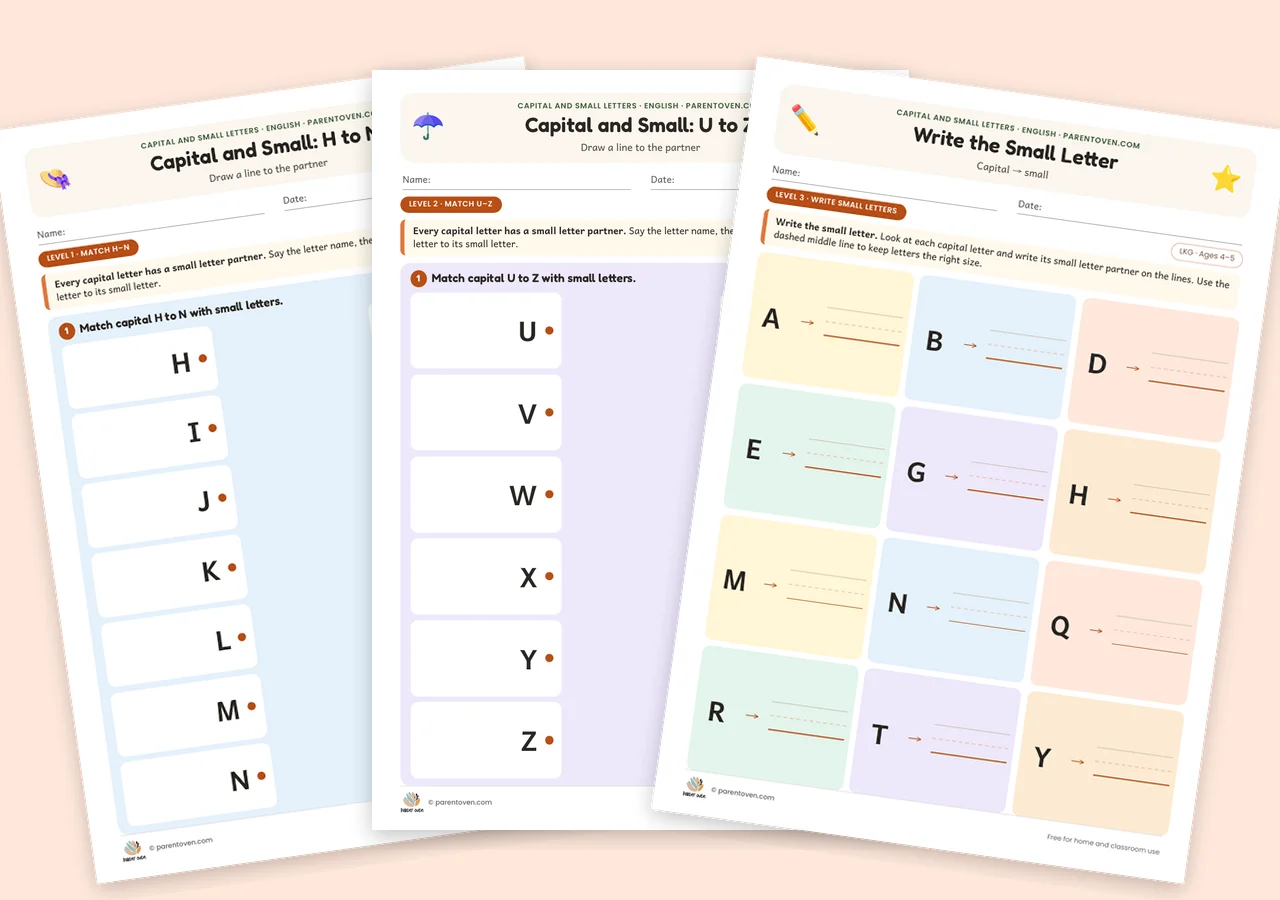
Every sheet fills one A4 page with a Name and Date line. The four matching sheets cover the whole alphabet in alphabet order; each column is shuffled so that no capital sits next to its partner. The full PDF ends with a one-page answer key.
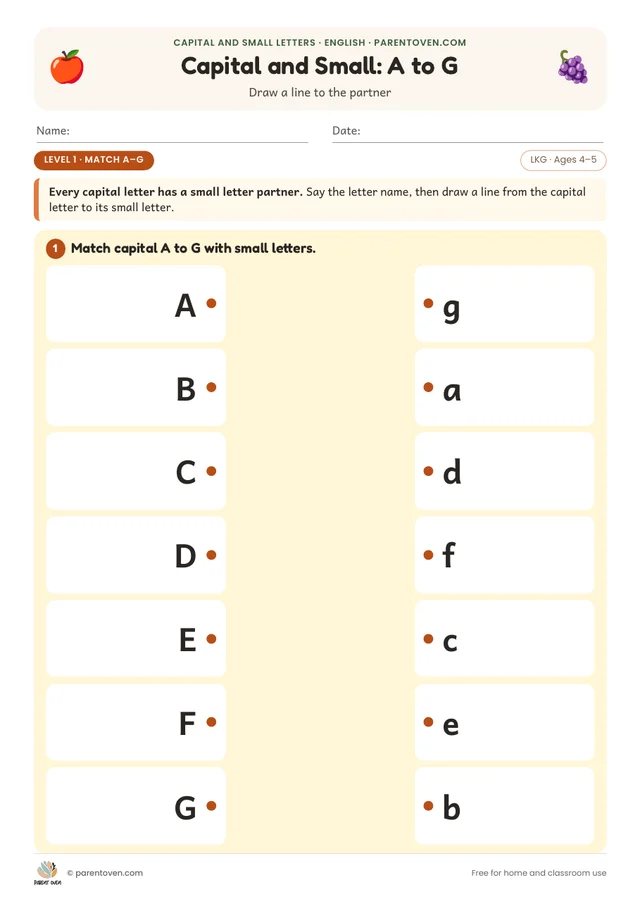
Level 1 · match A–G
Match A to G
Seven capital letters on the left and their small letters on the right, mixed up. Children say the letter name and draw a line from each capital to its partner. A and a, and G and g, look very different, so this is a good first challenge.

Level 1 · match H–N
Match H to N
Seven pairs from H to N. Watch for i and j, which both have a dot, and for h and n, which look alike.
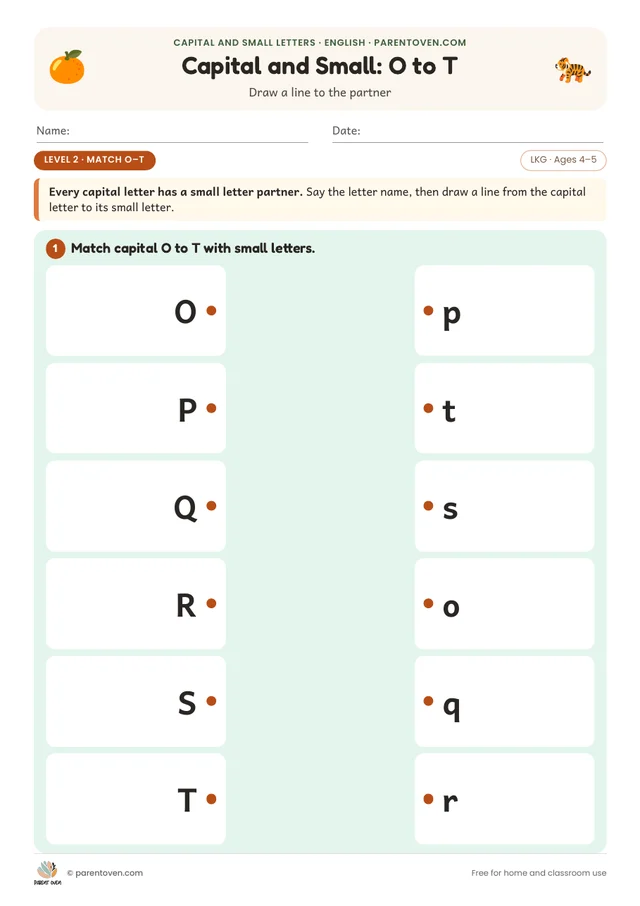
Level 2 · match O–T
Match O to T
Six pairs from O to T. O, S and P look almost the same in both sizes; Q, R and T do not, so children have to look closely.
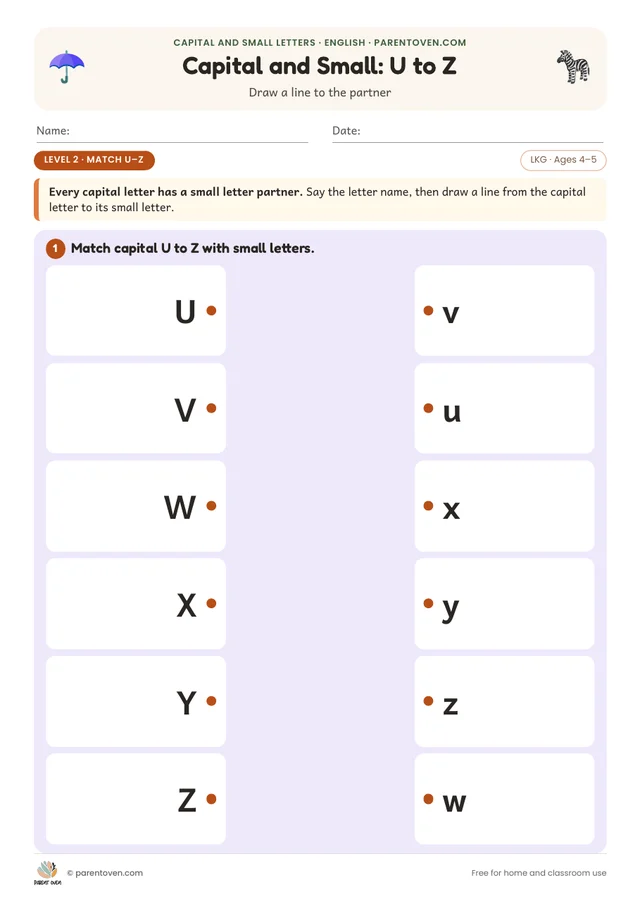
Level 2 · match U–Z
Match U to Z
The last six pairs. Most of these capitals and small letters share a shape (U and u, V and v, W and w, X and x, Z and z), which makes it a confident finish to the alphabet.
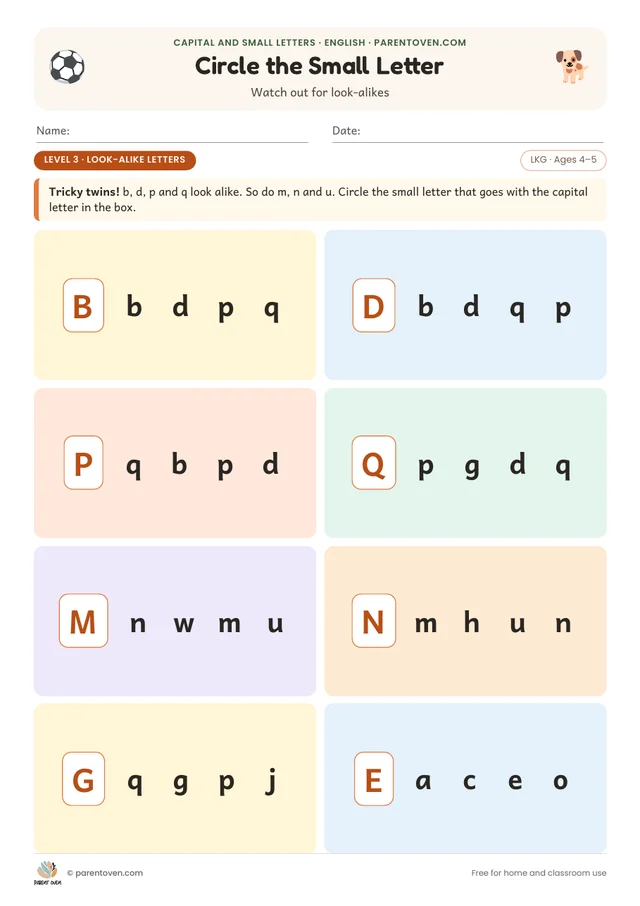
Level 3 · look-alike letters
Circle the small letter
Eight boxes. Each shows a capital letter and four small letters that look alike, such as b, d, p and q, or m, n, w and u. Children circle the small letter that goes with the capital.
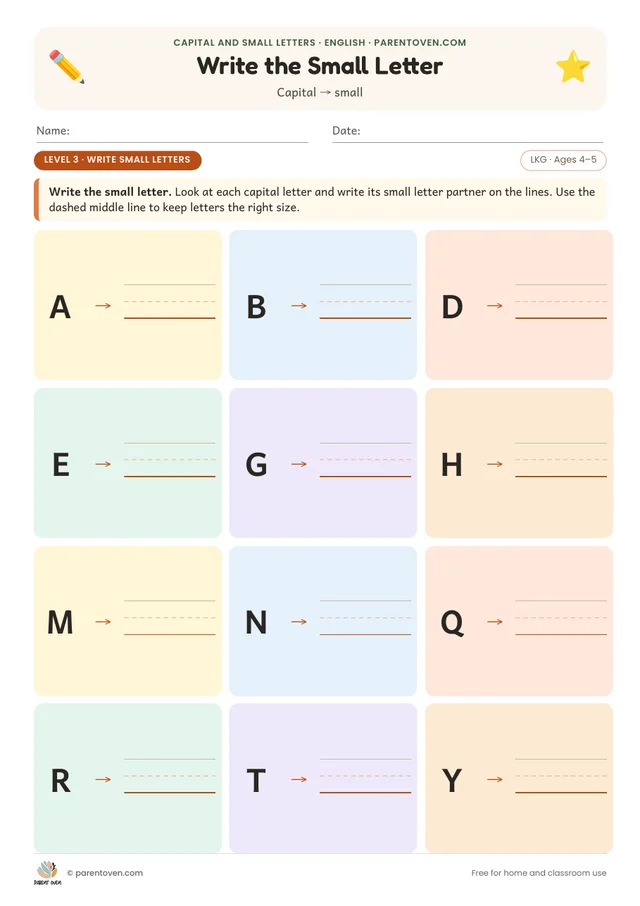
Level 3 · write small letters
Write the small letter
Twelve capitals, each with a short writing guide. Children write the small partner on the lines, using the dashed middle line to keep letters the right height.
Saving ink? The black & white version has the same 6 sheets and answer key with white backgrounds and light grey pictures.
What your child will learn
Children practise naming every letter in both its capital and small form, matching the two, telling apart small letters that look alike, and writing small letters on a guide with a middle line.
NCERT’s foundational stage goals ask children to recognise letters and connect them to sounds by the end of the preschool years. Knowing both forms of each letter lets a child find familiar letters in storybooks, on packets and on signs.
A one-week plan
One sheet a day is plenty at this age. Stop while your child is still enjoying it, and save the answer key for the weekend so they can check their own work.
| Day | Sheet | Skill | Try this too |
|---|---|---|---|
| Monday | Match A to G (Sheet 1) | Match a–g | Find capital and small letters on a cereal box |
| Tuesday | Match H to N (Sheet 2) | Match h–n | Play memory with letter cards |
| Wednesday | Match O to T (Sheet 3) | Match o–t | Write family names, capital first |
| Thursday | Match U to Z (Sheet 4) | Match u–z | Sort b, d, p and q fridge magnets |
| Friday | Circle the small letter (Sheet 5) | Look-alike letters | Spot small letters in a storybook |
| Saturday | Write the small letter (Sheet 6) | Write small letters | Match letter cards to a printed alphabet chart |
How to teach capital and small letters together
- Call them partners. “Every big letter has a small letter partner. Big A and small a are both called A and say /a/.” The word partner makes the idea easy to grasp.
- Start with the easy pairs. C c, O o, S s, U u, V v, W w, X x and Z z are the same shape in two sizes. Begin with those so your child sees the idea before meeting the tricky ones.
- Then the different ones. A a, B b, D d, E e, G g, H h, Q q and R r look quite different. Spend a little longer on these, one or two at a time.
- Use real print. Point to a big letter on a book cover and find its small partner in the story. Children are proud when they can find letters in “real” books.
- Tackle b and d with a trick. Make a “bed” with both fists, thumbs up: the left hand makes b, the right hand makes d. It is an old trick and it still works.
- Write on lines. When writing small letters, show that most sit between the middle and bottom line, some go up tall (b, d, h, k, l, t) and some hang down (g, j, p, q, y).
- A few at a time. Four to six pairs in a session is plenty for a four-year-old. Come back to the same pairs the next day.
Common mistakes and quick fixes
| What you see | What usually helps |
|---|---|
| Matches b with D, or d with B | Use the “bed” hand trick, and trace b and d with a finger: b starts with a tall line, d starts with a round belly. |
| Draws lines to the letter straight across | Remind your child that the columns are mixed up. Say the capital letter, then search down the other column for its partner. |
| Writes small letters as small capitals | Show the two forms side by side and trace the small one with a finger. Point out the shapes that change (A to a, G to g). |
| Makes all letters the same height | Use the dashed middle line. Show which letters stay short, which go up tall and which hang down. |
| Mixes up m and n, or u and n | Count the humps: n has one, m has two. Turn an n upside down to show it looks like a u: same shape, different direction. |
Games without paper
- Letter memory. Make cards for six capital and six small letters. Turn them face down and take turns finding matching pairs.
- Fridge partners. Put capital magnets on one side of the fridge and small ones on the other. Your child brings each pair together.
- Book hunt. Choose a letter, say R. Find a capital R on the cover and a small r inside the book.
- Name cards. Write each family member’s name with a capital first letter. Talk about why names start with a capital.
- Sock pairs. Write capital letters on one set of clothes pegs and small letters on another. Peg the partners together on a string.
More letter practice
If capitals are still new, start with the capital letters worksheets and alphabet tracing A to Z. For small letters one page at a time, use the lowercase letter tracing worksheets. When your child knows both forms, the UKG vowels and consonants worksheets move on to letter sounds and first words. All LKG topics are on the LKG worksheets page.
Frequently asked questions
When should children learn small letters?
Many Indian schools teach capital letters first in LKG and small letters from the middle of LKG or in UKG. Once a child knows most capitals, matching them to small letters is a natural next step.
Why are b, d, p and q so confusing?
They are the same shape turned in different directions. Children’s brains are used to objects staying the same when turned (a cup is a cup either way), so letters that change meaning when flipped take time. Most children sort them out by age 7.
Do children need to write small letters in LKG?
Recognising them matters more than writing them neatly. Writing small letters on lines can start in late LKG and becomes a main focus in UKG.
Why are the columns mixed up?
If capital and small letters were side by side, children could match them without looking at the letters at all. Mixing the columns makes every match a real choice.
Is there a black and white version?
Yes. The ink-saving black and white PDF has the same six sheets and answer key with white backgrounds.
Will these print on US Letter paper?
Yes. They are made for A4 with wide margins. Choose “Fit to page” if your printer cuts off an edge.
Pictures are from Google’s Noto Emoji (Apache 2.0). Skill levels follow NCERT’s NCF-FS 2022 and the NIPUN Bharat goals for the foundational stage. Last reviewed: 21 November 2026 by the Parent Oven team.