Learning Worksheets Maths Data handling for Class 1
Free printable PDF · Maths · Class 1 · NCERT Chapter 13 · answer key
Data Handling Worksheets for Class 1: Count, Compare and Read a Picture Graph
Six data handling worksheets for Class 1, made to sit next to Chapter 13 of the NCERT maths book, Joyful Mathematics: “So Many Toys”. Your child counts mixed-up toys and flowers, compares the groups with more than, less than and equal to, answers true-or-false questions, and then goes a step further with tally marks, a picture graph and a real name survey.
The pictures and numbers are new, not copied from the textbook, so your child practises the skill instead of remembering the book’s answers. Every counting picture has the toys spread out with nothing hidden or overlapping. Answer key and a black-and-white version are included.
Free · A4 (prints on US Letter) · 6 sheets + answer key · colour and ink-saving black & white · no sign-up
Jump to: The six sheets · How to teach data handling at home · Common mistakes · Games without paper · FAQs
The six sheets
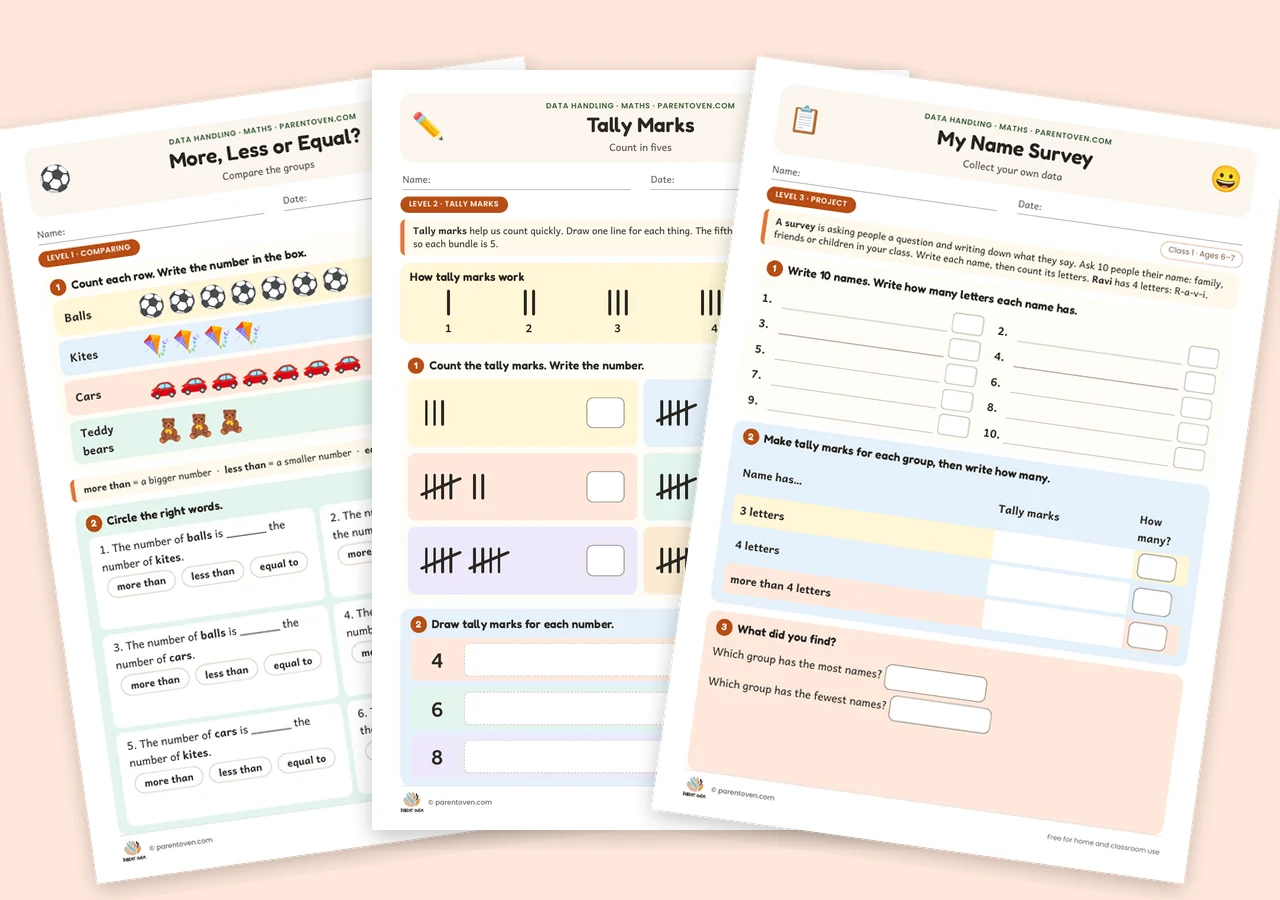
Each sheet is one A4 page. Sheets 1 to 3 follow the chapter (count, compare, most and least, true or false). Sheets 4 and 5 add tally marks and a picture graph, which most schools teach in Class 1 or early Class 2. Sheet 6 is the chapter’s survey project in a form you can do at home.
Level 1 · counting groups
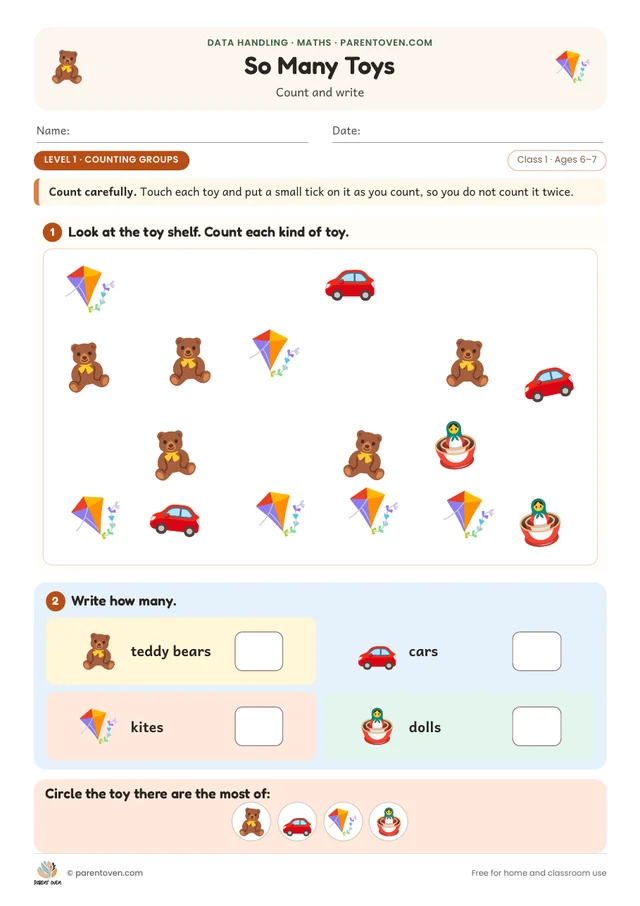
So many toys
A toy shelf with teddy bears, cars, kites and dolls all mixed up. Children count each kind, write the number and circle the toy there are the most of.
Level 1 · comparing
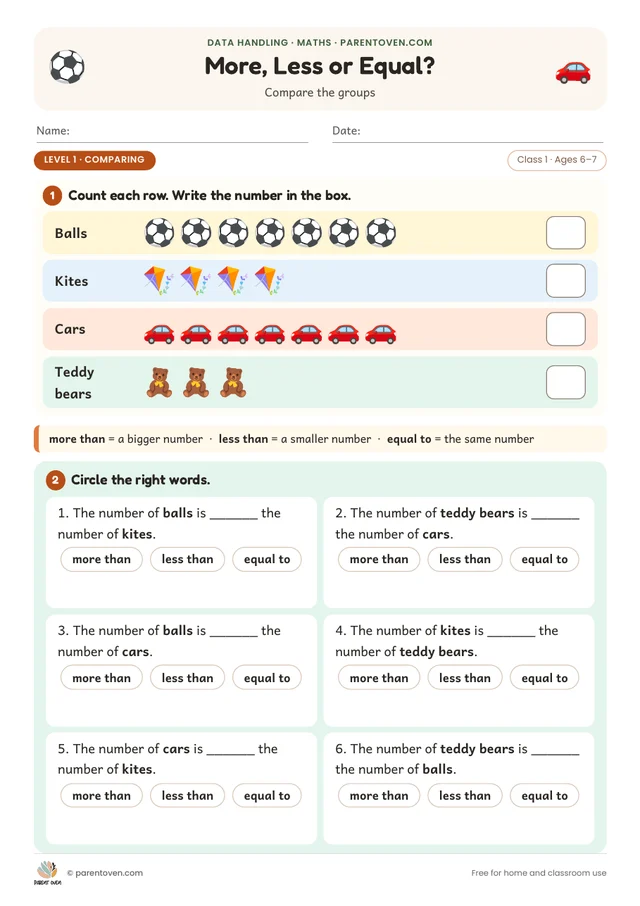
More, less or equal?
Four rows of balls, kites, cars and teddy bears. Children count each row, then finish six sentences such as “The number of balls is ___ the number of kites” by circling more than, less than or equal to. Two rows have the same number on purpose.
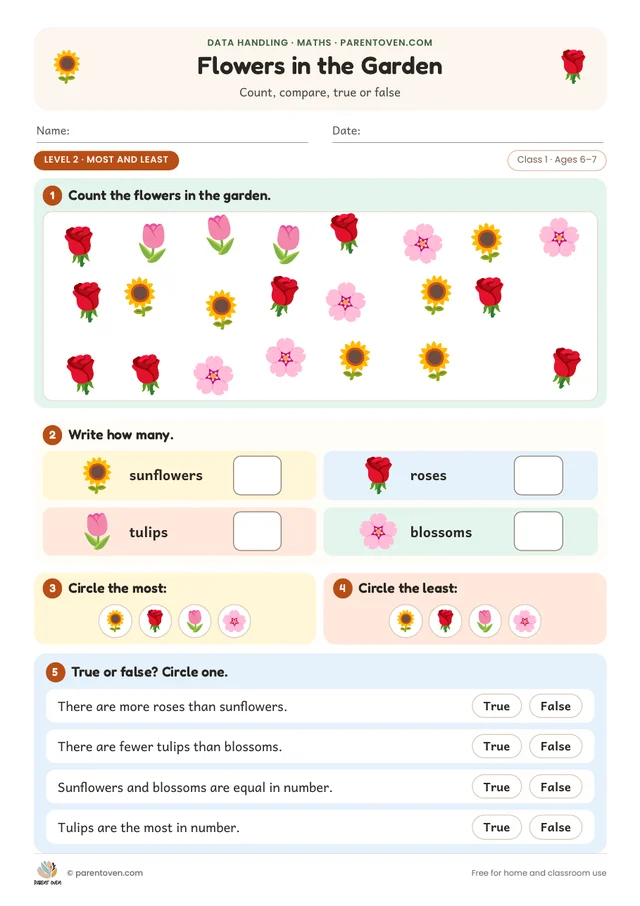
Level 2 · most and least
Flowers in the garden
Count sunflowers, roses, tulips and blossoms in a garden, circle the flower that is most and least in number, and mark four sentences true or false. The flowers differ in shape, so the sheet still works in black and white.
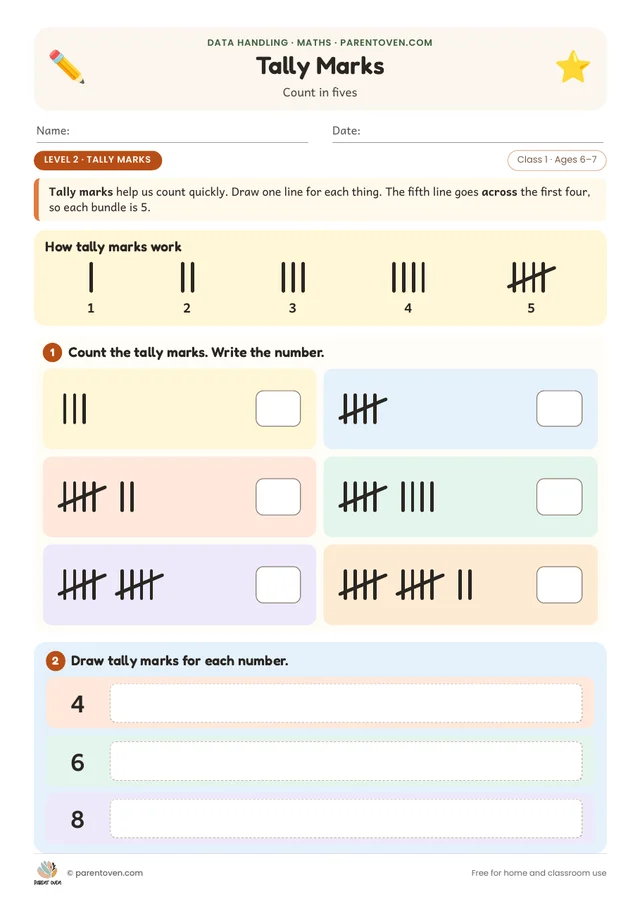
Level 2 · tally marks
Tally marks
A short “how it works” strip for 1 to 5, then six tallies to read (3 to 12) and three numbers to draw as tallies. The fifth line always goes across the first four.
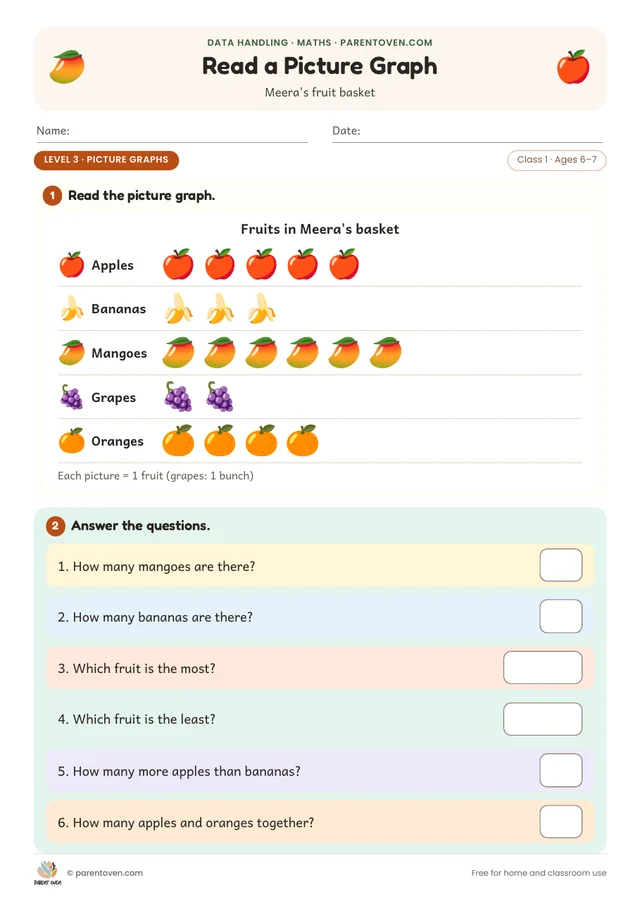
Level 3 · picture graphs
Read a picture graph
A picture graph of the fruit in Meera’s basket. Six questions: how many, which is most, which is least, how many more, and how many together.
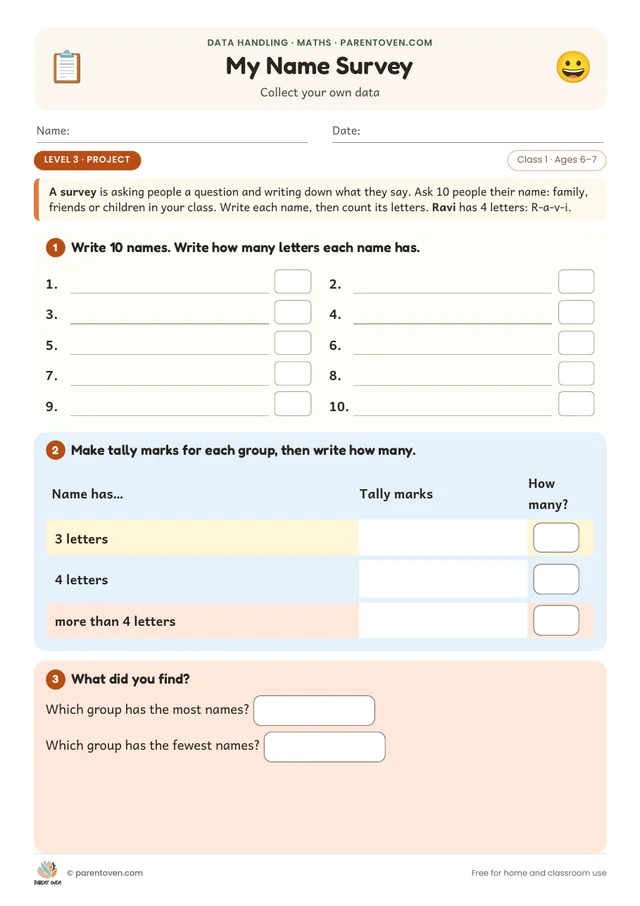
Level 3 · project
My name survey
The chapter’s project, done at home: ask 10 people their names, count the letters, sort them into 3 letters, 4 letters and more than 4, and use tally marks to find the biggest group.
Saving ink? The black & white version has the same 6 sheets and answer key with white backgrounds and light grey pictures.
What your child will learn
In NCERT’s Class 1 book, data handling means looking at a group of things, sorting them, counting each kind and saying which has more, which has less and which are equal. That is all the chapter asks, and it is enough. The hard part for six-year-olds is keeping track while counting a mixed-up picture, which is exactly what Sheets 1 and 3 practise.
Tally marks and picture graphs are the next step. They show the same counts in a neater way, and they come back in Class 2 (Joyful Mathematics Class 2, Chapter 11, Data Handling) and in every class after that.
A one-week plan
One sheet a day is plenty at this age. Stop while your child is still enjoying it, and save the answer key for the weekend so they can check their own work.
| Day | Sheet | Skill | Try this too |
|---|---|---|---|
| Monday | So many toys (Sheet 1) | Counting groups | Sort a box of toys into kinds and count each pile |
| Tuesday | More, less or equal? (Sheet 2) | Comparing | Line up two kinds of toys: which line is longer? |
| Wednesday | Flowers in the garden (Sheet 3) | Most and least | Count the flowers or leaves on one plant |
| Thursday | Tally marks (Sheet 4) | Tally marks | Tally cars that pass your window for 2 minutes |
| Friday | Read a picture graph (Sheet 5) | Picture graphs | Make a picture graph of fruit in your kitchen |
| Saturday | My name survey (Sheet 6) | Project | Do the name survey with family on a call |
How to teach data handling at home
- Start with real things. Tip a box of toys on the floor and ask, “How many cars? How many balls?” Sorting into piles first makes counting much easier.
- Teach one way to keep track. Touch each picture and put a small tick on it as you count. Children who do this make far fewer mistakes on Sheets 1 and 3.
- Say the full sentence. “The number of cars is more than the number of dolls.” The book uses these exact words, and children need to hear them often before they can write them.
- Show “equal to” with real things. Put 4 spoons and 4 cups in two lines, one under the other. Every spoon has a cup partner, so they are equal.
- Bundle in fives. Before tally marks, make bundles of 5 sticks or straws with a rubber band. A tally bundle is the same idea drawn on paper.
- Ask questions about a graph, not just numbers. “Which fruit did Meera have most of? How do you know?” Pointing to the longest row is a good answer.
Common mistakes and quick fixes
| What you see | What usually helps |
|---|---|
| Counts the same picture twice in a mixed-up scene | Tick each picture as you count it, or cover counted ones with a coin. |
| Circles “more than” when the numbers are the same | Line up both groups one under the other with real objects. If every one has a partner, they are equal. |
| Reads the comparison sentence the wrong way round | Point to the first group, then the second. Say: “Is the first group more or less than the second?” |
| Draws the fifth tally line upright like the others | Show a bundle of 5 sticks with a band. The band is the line that goes across. |
| Counts the empty space in a picture graph row | Run a finger along the row and count only the pictures. |
Games without paper
- Toy census. Sort a toy box and count each kind. Which kind is most? Write the numbers on a paper strip.
- Car tally. Sit at a window for two minutes. One tally mark for every car, another row for scooters.
- Snack graph. Lay out biscuits, grapes and peanuts in rows. Which row is longest? How many more?
- More or less cards. Show two dot cards for a second each. Your child says “more”, “less” or “equal”.
- Family survey. Ask everyone their favourite fruit and draw one picture per vote.
More Class 1 maths
For counting practice before these sheets, try counting objects 1 to 10 and the more or less worksheet. To see where data handling fits in the year, the NCERT and CBSE Class 1–2 map lists every chapter of Joyful Mathematics with a matching printable. More Class 1 practice is on the Grade 1 worksheets page, and every maths topic is on the maths worksheets page.
Frequently asked questions
Which NCERT chapter do these worksheets match?
Chapter 13, “So Many Toys”, in Joyful Mathematics for Class 1, the NCERT maths book written under NCF-FS 2022. The chapter is about counting groups, comparing them with more than, less than and equal to, and a small survey project.
Are tally marks in the Class 1 syllabus?
The NCERT Class 1 chapter focuses on counting and comparing groups. Tally marks and picture graphs are a common next step in Class 1 and are used in the Class 2 data handling chapter, so Sheets 4 and 5 are marked as Level 2 and 3.
My child counts correctly but writes the wrong number in the box. Why?
Usually it is a writing slip, not a counting problem. Ask your child to say the number aloud before writing it, and check that 6 and 9 are not reversed.
Can these be used in class?
Yes. They are free for home and classroom use. The name survey on Sheet 6 works well as a whole-class activity.
Is there a black and white version?
Yes. The ink-saving PDF has the same six sheets and answer key with white backgrounds and light grey pictures. The flowers on Sheet 3 differ in shape, not only colour, so they are still easy to tell apart.
Pictures are from Google’s Noto Emoji (Apache 2.0). Chapter names follow NCERT’s Joyful Mathematics Class 1 (Chapter 13, “So Many Toys”) and Class 2 (Chapter 11, “Data Handling”), written under NCF-FS 2022. Parent Oven is not affiliated with NCERT or CBSE. Last reviewed: 23 November 2026 by the Parent Oven team.