
Learning Worksheets Maths Greater than, less than
Free printable PDF · UKG · ages 5–6 · 3 levels · answer key
Greater Than, Less Than Worksheets for UKG: Compare and Order Numbers
Six worksheets that take children from “which group has more?” to comparing two-digit numbers and putting them in order. They start with counting real-looking pictures, introduce the >, < and = signs with tracing, then move to numbers up to 20 and up to 50, using tens and ones so the comparing makes sense instead of being guessed.
There is an answer key, an ink-saving black and white version, and a free online compare numbers game on the same skills for practice on a phone.
Free · A4 (prints on US Letter) · 6 sheets + answer key · colour and ink-saving black & white · no sign-up

Jump to: The six sheets · How to teach greater than and less than · Common mistakes · Games without paper · FAQs
The six sheets
Each sheet fills one A4 page and works on its own, so you can print only the level your child needs. The full PDF has all six sheets plus a one-page answer key.

Level 1 · numbers to 10
Count and compare
Six pairs of picture groups laid out in rows of five, so children can see “five and two more” at a glance. Count each group, write the number, then colour the star under the group with more. One pair is equal, so children learn that “same” is also an answer.
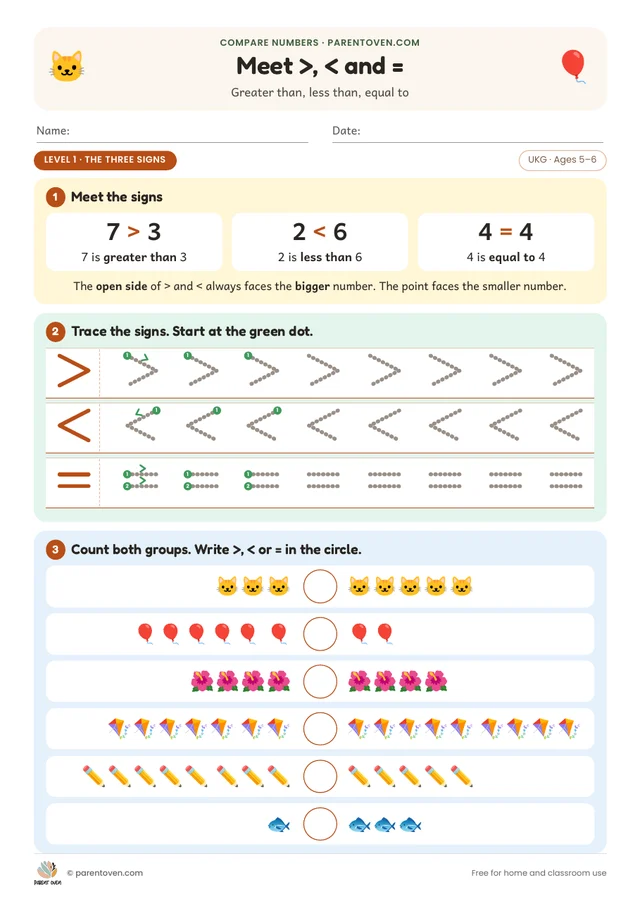
Level 1 · the three signs
Meet >, < and =
What each sign means, in words a five-year-old can say. Three rows of single-stroke tracing for >, < and = with a numbered green start dot and arrows, then six picture pairs to count and complete with the right sign.
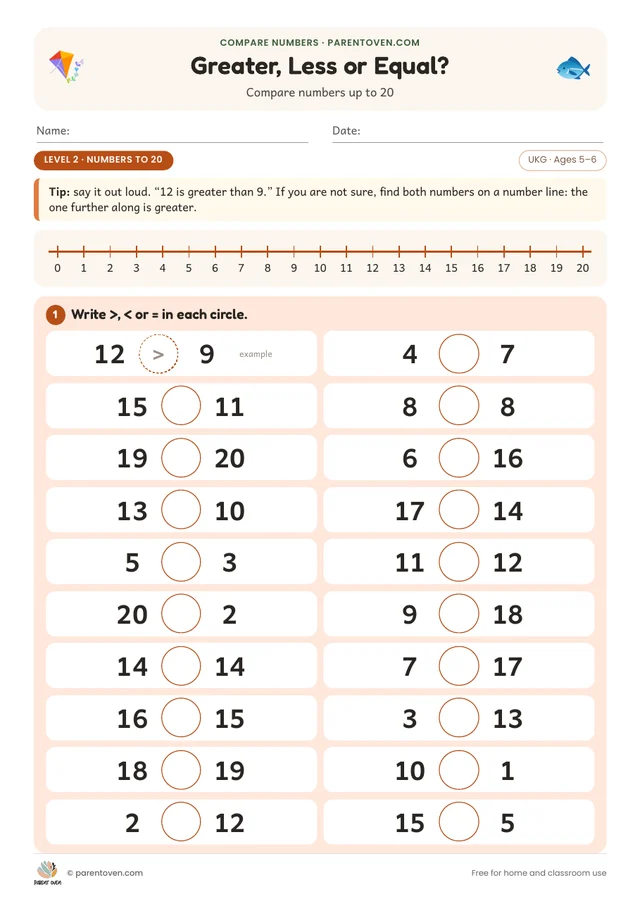
Level 2 · numbers to 20
Greater, less or equal? (to 20)
A number line from 0 to 20 at the top, then 20 pairs to compare. We mixed in look-alikes such as 6 and 16, 3 and 13, and 19 and 20 on purpose, because these are the pairs children most often get wrong.

Level 3 · tens and ones
Compare numbers to 50
Bundles of ten sticks and loose sticks show why 32 is bigger than 23. Children count tens and ones, write the numbers and the sign, then compare 12 more pairs and circle the biggest and smallest in a set of four.

Level 2–3 · ascending order
Number trains: small to big
Six trains to fill in ascending order, from numbers within 10 up to numbers within 50. The first train is done as an example. Crossing off each number as it is used keeps children from missing one.

Level 2–3 · descending order
Count down and big to small
A rocket countdown from 20 to 1 with seven missing numbers, four rows of balloons to write in descending order, and a counting-back strip from 50.
Saving ink? The black & white version has the same 6 sheets and answer key with white backgrounds and light grey pictures.
What your child will learn
By the end of the set your child should compare two numbers up to 20 (and later 50) and say which is greater or smaller, use the symbols >, < and = correctly, and put three or four numbers in order. These are the number-sense goals NIPUN Bharat sets for the end of the foundational stage.
Just as important, they learn to explain: “9 is more than 6 because it comes later when we count.” Ask for that reason often. A child who can say why is ready for addition.
A one-week plan
One sheet a day is plenty at this age. Stop while your child is still enjoying it, and save the answer key for the weekend so they can check their own work.
| Day | Sheet | Skill | Try this too |
|---|---|---|---|
| Monday | Count and compare (Sheet 1) | Numbers to 10 | Compare two piles of real blocks |
| Tuesday | Meet >, < and = (Sheet 2) | The three signs | Use the crocodile mouth with your hands |
| Wednesday | Greater, less or equal? (to 20) (Sheet 3) | Numbers to 20 | Line up number cards 1–20 |
| Thursday | Compare numbers to 50 (Sheet 4) | Tens and ones | Play the compare numbers game |
| Friday | Number trains: small to big (Sheet 5) | Ascending order | Order the ages of family members |
| Saturday | Count down and big to small (Sheet 6) | Descending order | Check answers with the key together |
How to teach greater than and less than
- Compare real things first. Put 6 spoons and 3 spoons on the table. Which has more? How do you know? Let your child line them up side by side to check.
- Count both groups, every time. Children often pick the group that is spread out more. Sheet 1 keeps pictures the same size in rows of five so counting, not guessing, wins.
- Say the whole sentence. “Six is greater than three.” “Two is less than five.” Reading from left to right is what makes the signs stick.
- Meet the signs. The open side of > and < faces the bigger number and the point faces the smaller one. Tracing the signs with a start dot (Sheet 2) helps children form them the right way round.
- Use a number line for teens. On Sheet 3, the number further along the line is greater. This is the easiest way to see why 16 is greater than 6.
- Tens first, then ones. For bigger numbers, compare the tens. If the tens are the same, compare the ones. The stick bundles on Sheet 4 make this visible.
- Finish with ordering. Putting four numbers in order (Sheets 5 and 6) is comparing many times over, and it shows whether the idea is really secure.
Common mistakes and quick fixes
| What you see | What usually helps |
|---|---|
| Picks the group that looks bigger, not the one with more | Count both groups aloud and write the numbers before deciding. Use real objects lined up in pairs. |
| Draws > when it should be < | Read the sentence aloud. If it sounds wrong (“3 is greater than 8”), turn the sign round. Mixing up the sign is normal; knowing which number is bigger matters most. |
| Thinks 19 is greater than 21 | Children compare the last digit. Show both on a number chart or with tens and ones: 2 tens beat 1 ten. |
| Says 6 and 16 are “nearly the same” | Build 16 as one bundle of ten and six loose sticks next to six sticks. The difference is a whole ten. |
| Forgets “equal” | Keep one or two equal pairs in every practice round, as these sheets do, so = feels like a normal answer. |
Games without paper
- Bada kaun? (Who is bigger?) Each player turns over a number card from 1 to 20. The bigger number wins both cards. Say the sentence each time.
- Dice duel. Roll two dice each and add the dots. Whoever has more scores a point. Great for counting on.
- Shop prices. In a shop, ask which costs more, the ₹20 biscuit or the ₹10 one. Pair this with our Indian money worksheets.
- Line up by height. Line up toys from shortest to tallest, then tallest to shortest. That is ascending and descending order in real life.
- Five-minute game. Our compare numbers game has three games and three levels with a read-aloud option.
More number practice
Before this set, try more or less and counting objects 1 to 10. Alongside it, use before, after and between, missing numbers and the number charts. For the full year, see all our UKG worksheets.
Frequently asked questions
How do I explain greater than and less than to a 5-year-old?
Start with real things: two piles of blocks, two plates of grapes. Ask which has more, then say the sentence together: “This plate has more. Seven is greater than four.” Bring in the signs only after the idea is clear, and read every sign as a full sentence from left to right.
What about the crocodile trick?
Many teachers draw > and < as a hungry crocodile that opens its mouth towards the bigger number. It works for many children. Some get muddled about which way the crocodile faces, so on these sheets we use one simple rule instead: the open side always faces the bigger number and the point faces the smaller one. Use whichever your child’s school uses.
Is comparing numbers taught in UKG?
Yes. Comparing groups and using words like more, less and equal is one of the NIPUN Bharat goals for age 5 to 6. Many Indian schools also teach the signs >, < and = and comparing numbers up to 50 in UKG, which is why the set goes up to Level 3.
Which sheet should my child start with?
Start with Sheet 1 even if your child can count well. It shows quickly whether they compare by counting carefully or by guessing which group looks bigger. Move to the signs on Sheet 2 when Sheet 1 is easy, and to the two-digit sheets only once numbers to 20 feel comfortable.
Is there a version that uses less ink?
Yes. The black and white PDF has the same sheets and answer key with white backgrounds and light grey pictures, so it prints well on a home printer and is easy to photocopy for a class.
Will these worksheets print on US Letter paper?
Yes. They are designed on A4 with wide margins, so they print well on US Letter too. Choose “Fit to page” in the print settings if your printer cuts off the edges.
Pictures are from Google’s Noto Emoji (Apache 2.0). Skill levels follow NCERT’s NCF-FS 2022 and the NIPUN Bharat targets for age 5 to 6. Last reviewed: 21 November 2026 by the Parent Oven team.