
Learning Worksheets Maths Number names 1 to 20
Free printable PDF · UKG · ages 5–6 · 3 levels · answer key
Number Names 1 to 20 Worksheets for UKG
Six worksheets for reading and writing number names from one to twenty. Children trace each name with single-stroke start dots, match numbers to their names, count pictures and circle the right word, and read number names both ways.
Number names are where reading meets maths, and the “teen” words trip up almost every child (fourteen or forty?). The sheets put look-alike words side by side on purpose, so children learn to read carefully. Answer key and black and white version included.
Free · A4 (prints on US Letter) · 6 sheets + answer key · colour and ink-saving black & white · no sign-up
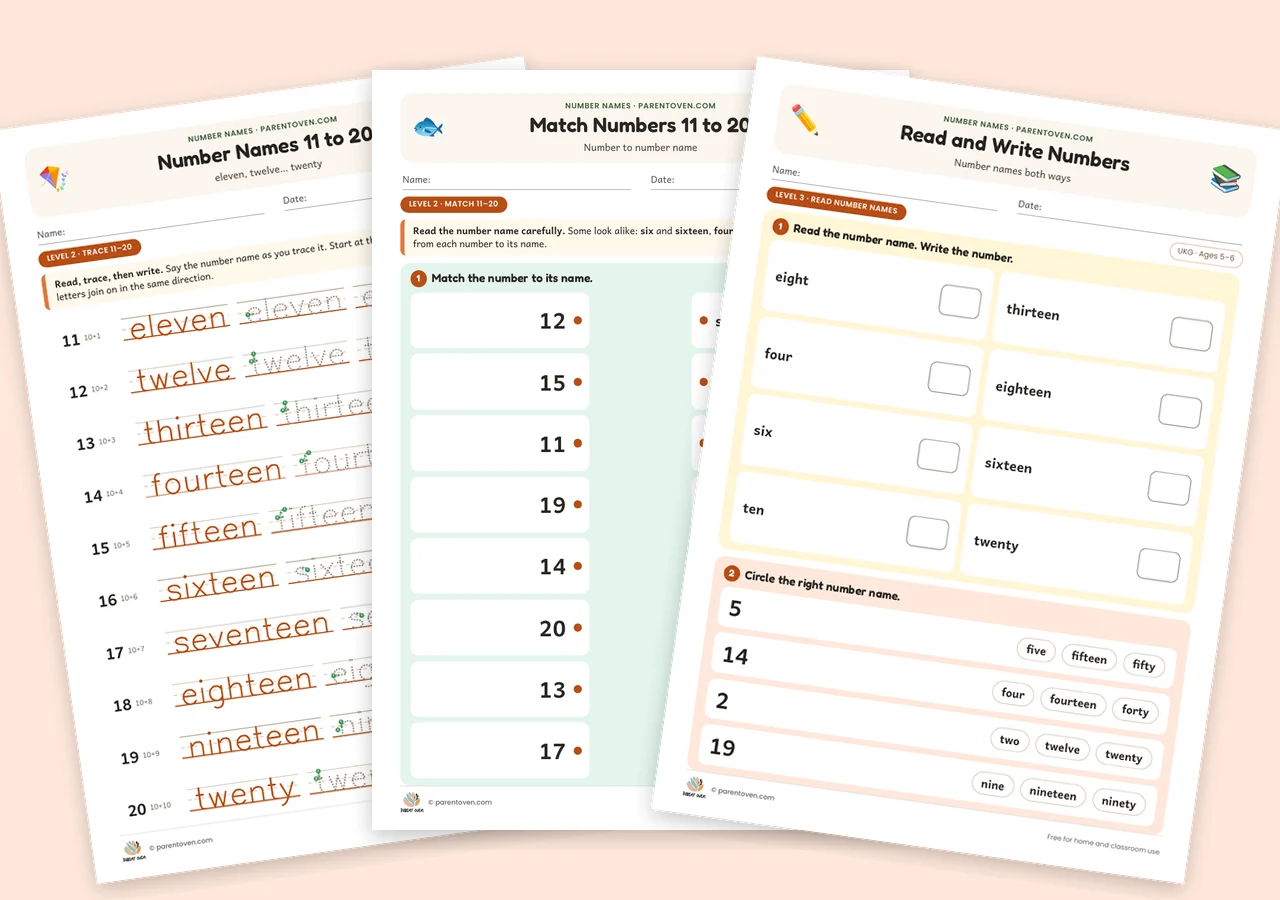
Jump to: The six sheets · How to teach number names · Common mistakes · Games without paper · FAQs
The six sheets
Sheets 1 and 2 are tracing, Sheets 3 and 4 are matching puzzles (the names are in a mixed order), and Sheets 5 and 6 check reading without help.
Level 1 · trace 1–10
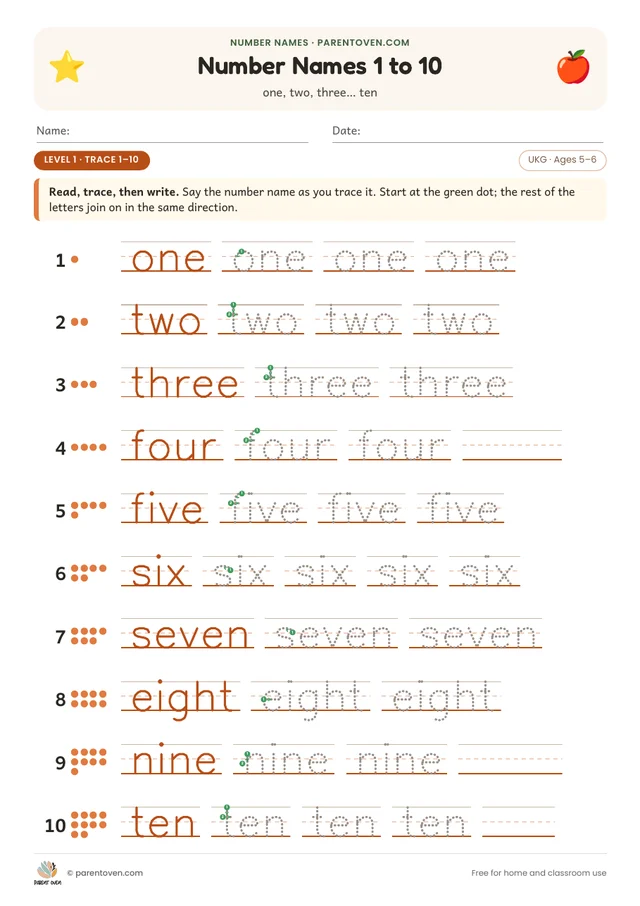
Number names 1 to 10
Ten rows from one to ten, each with the numeral and that many dots, a solid model and dotted copies. A green start dot shows where to begin each word.
Level 2 · trace 11–20
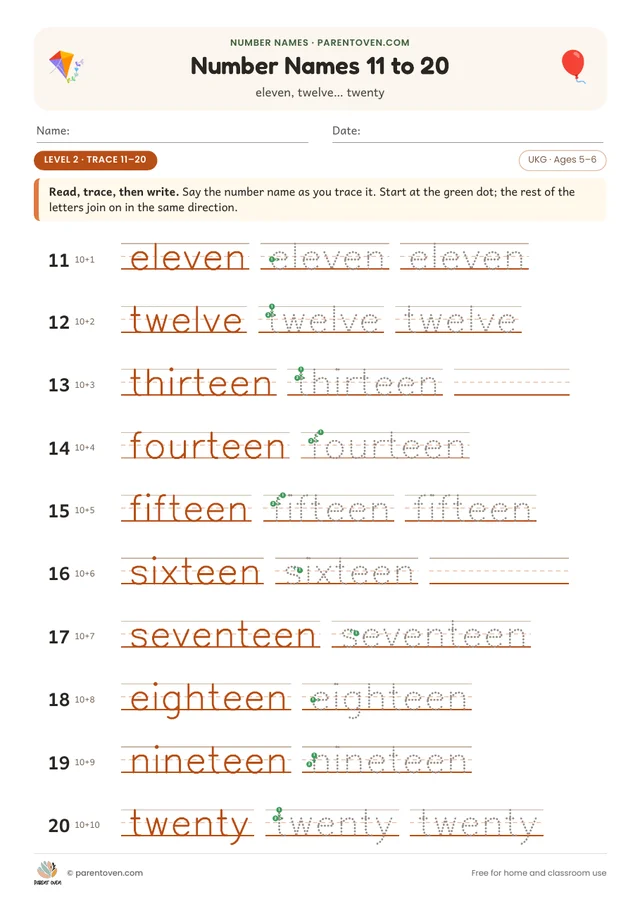
Number names 11 to 20
Ten rows from eleven to twenty, with a “10 + 4” style hint next to each number so children see that fourteen is ten and four.
Level 1 · match 1–10
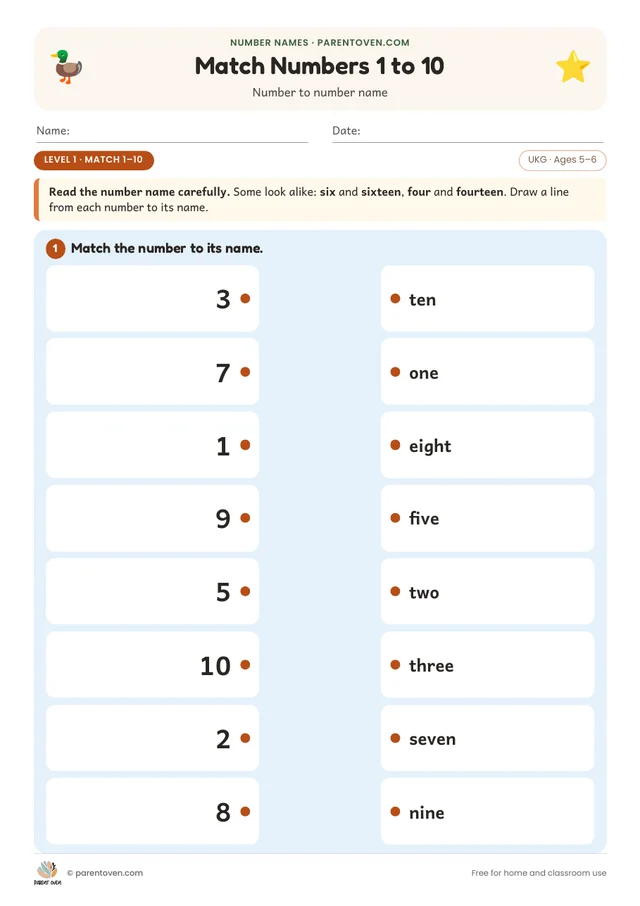
Match numbers 1 to 10
Eight numbers on the left, eight names on the right in a different order. Draw a line from each number to its name.
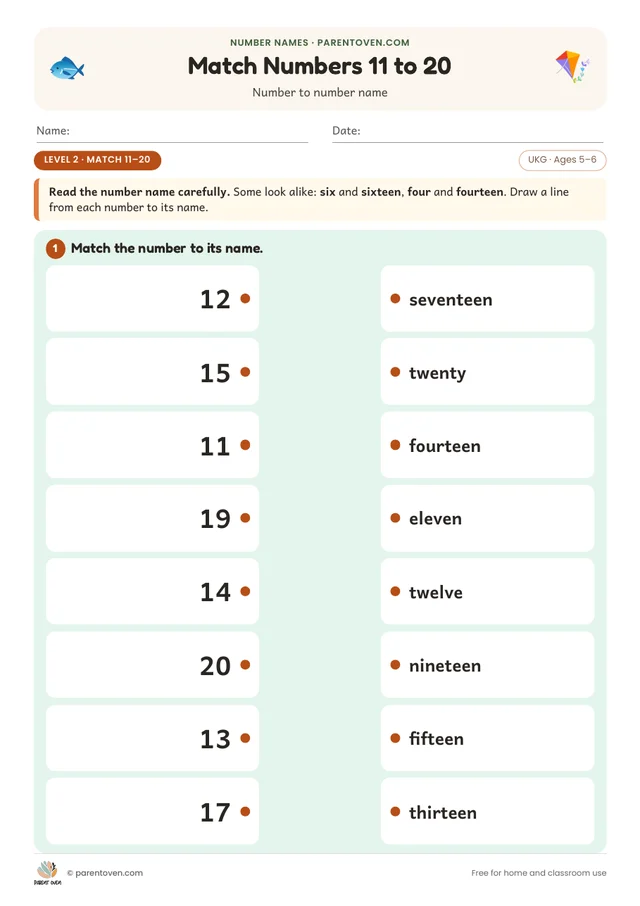
Level 2 · match 11–20
Match numbers 11 to 20
The same puzzle with teen numbers and twenty. Words like fifteen and fourteen look alike, so children must read every letter.
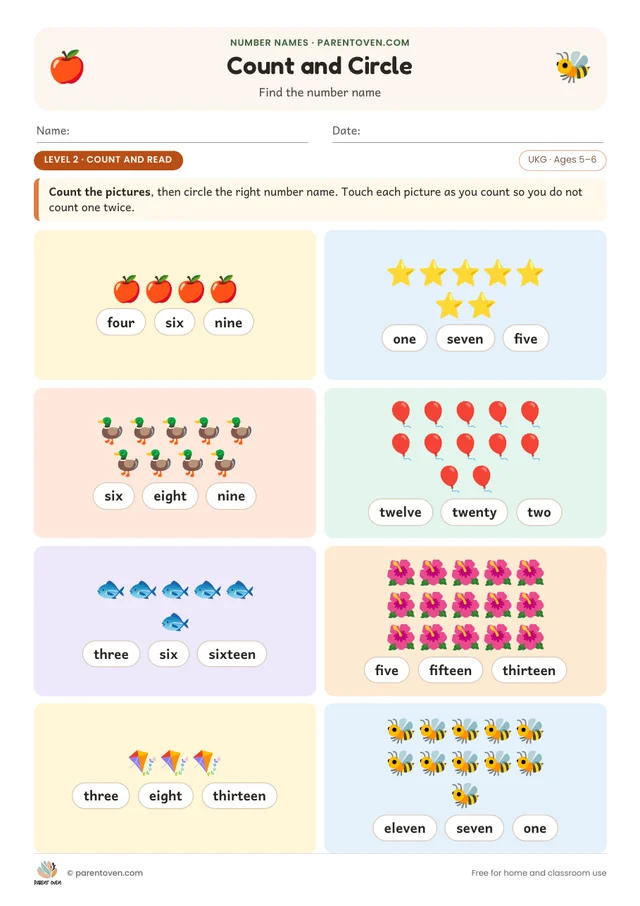
Level 2 · count and read
Count and circle
Eight groups of pictures from 3 to 15. Count, then circle the right name from three, such as five, fifteen or thirteen.
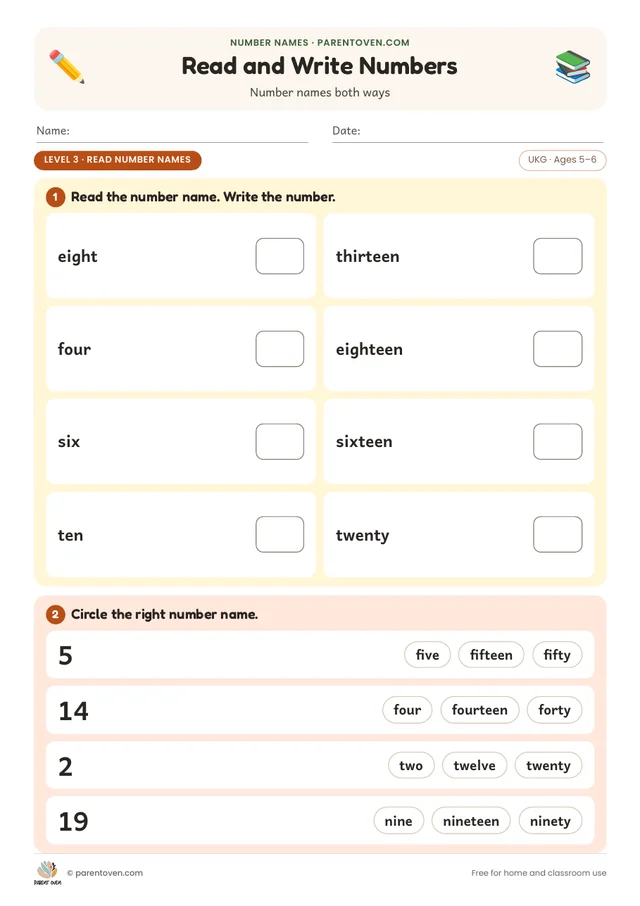
Level 3 · read number names
Read and write numbers
Read eight number names and write the numbers, then circle the right name for four numbers, choosing between pairs like four, fourteen and forty.
Saving ink? The black & white version has the same 6 sheets and answer key with white backgrounds and light grey pictures.
What your child will learn
Children read and write the number names one to twenty, match numerals to words, and count objects to choose the right number name.
The tricky words are eleven, twelve, thirteen and fifteen, and the spelling changes in forty and fifty later on. Reading number names is also a big help for word problems in Class 1.
A one-week plan
One sheet a day is plenty at this age. Stop while your child is still enjoying it, and save the answer key for the weekend so they can check their own work.
| Day | Sheet | Skill | Try this too |
|---|---|---|---|
| Monday | Number names 1 to 10 (Sheet 1) | Trace 1–10 | Make number-name flash cards |
| Tuesday | Number names 11 to 20 (Sheet 2) | Trace 11–20 | Match cards to numerals on the floor |
| Wednesday | Match numbers 1 to 10 (Sheet 3) | Match 1–10 | Count toys and say the name |
| Thursday | Match numbers 11 to 20 (Sheet 4) | Match 11–20 | Hunt for number words in a storybook |
| Friday | Count and circle (Sheet 5) | Count and read | Write the date in words |
| Saturday | Read and write numbers (Sheet 6) | Read number names | Spell one to ten aloud as a chant |
How to teach number names
- Know the numbers first. Children should recognise numerals to 20 before reading their names. If not, start with tracing numbers 11 to 20.
- Read one to ten as sight words. These short words come up all the time. Put them on cards and play snap or memory.
- Spot the “teen”. Thirteen to nineteen all end in -teen, which means “and ten”. Fourteen = four and ten.
- Point out the odd ones. Eleven, twelve, thirteen and fifteen do not follow the pattern neatly. Say them a few extra times.
- Trace, then write. Tracing builds the letter pattern; writing from memory shows it has stuck. Sheet 6 checks this.
- Read carefully. Matching puzzles with look-alike words (six and sixteen) train children to read the whole word, not just the start.
Common mistakes and quick fixes
| What you see | What usually helps |
|---|---|
| Reads fourteen as forty | Cover the end of the word and uncover it slowly: four… teen. Show 14 and 40 side by side on a number chart. |
| Spells “for” for four or “to” for two | Explain that number words have their own spelling. Make a small chart of number names to stick on the wall. |
| Writes 41 for fourteen | Fourteen starts with “four” but the ten comes first when we write. Build 14 with one ten and four ones. |
| Forgets the e in “three” or “nine” | Trace these words a few extra times; say the letters aloud. |
| Gets stuck at eleven and twelve | These have no pattern, so learn them like names of friends. Count 10, 11, 12 on the stairs. |
Games without paper
- Number name snap. Make cards with numerals and number names. Turn them over two at a time; a match is a pair.
- Shop labels. Write number names on price tags for toys: “nine rupees”. Your child reads and pays.
- Hop and read. Chalk number names on the floor. Call a number; your child hops to its name.
- Count and say. When counting objects, say the last number as a full sentence: “There are fifteen spoons.”
- Bigger numbers. Ready for more? The full number names 1 to 100 chart is in our maths section.
More number practice
Before this set, use number tracing 1 to 10 and 11 to 20. Alongside it, try counting 1 to 50 and the number charts. For the year plan, see the UKG worksheets page.
Frequently asked questions
What are number names?
Number names are numbers written as words, like “seven” for 7 and “fifteen” for 15. Reading and writing them is part of the UKG maths and English syllabus in most Indian schools.
Up to what number should a UKG child know number names?
Most schools ask for number names from one to ten or one to twenty in UKG. Some go up to fifty. Start with one to ten until they are easy.
Why are teen numbers so hard?
We say the ones first (six-teen) but write the tens first (16). Eleven and twelve do not follow any pattern. Showing tens and ones with objects helps a lot.
Should children trace or copy number names?
Both. Tracing teaches the letter order; copying and then writing from memory checks it. These sheets do one, then the other.
Is there an ink-saving version?
Yes. The black and white PDF has the same six sheets and answer key.
Pictures are from Google’s Noto Emoji (Apache 2.0). Skill levels follow NCERT’s NCF-FS 2022 and the NIPUN Bharat goals for the foundational stage. Last reviewed: 21 November 2026 by the Parent Oven team.