
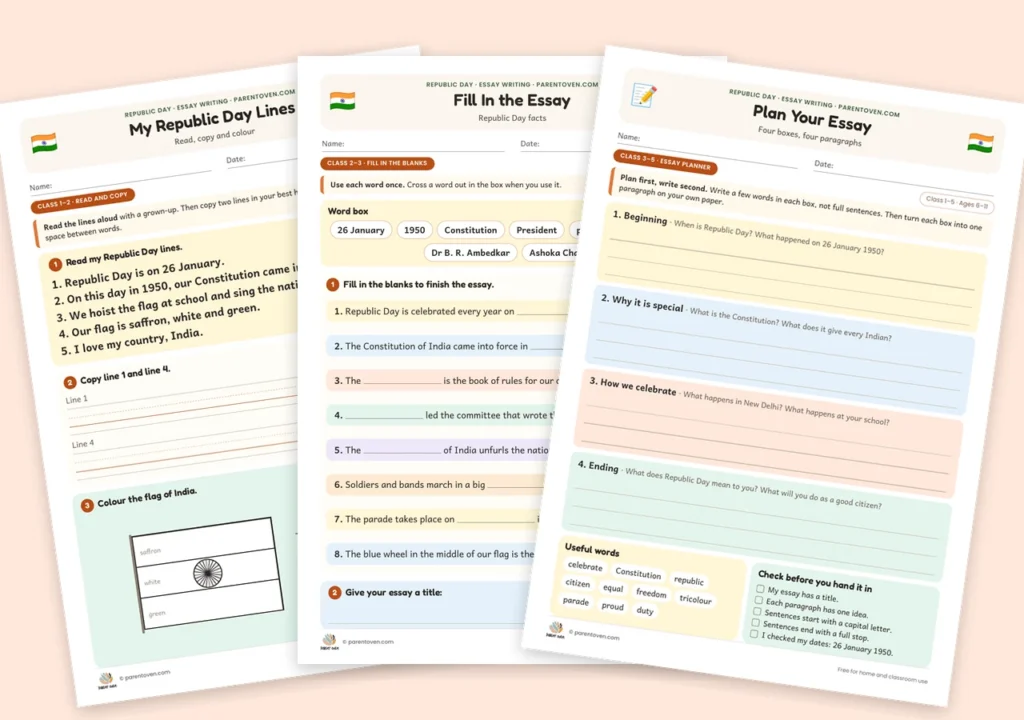
Every January the same note comes home in the school diary: “Write an essay on Republic Day.” Here are essays you can read with your child, sorted by class, from six simple lines for Class 1 to a five-paragraph essay for Class 5, plus 10 lines and a short essay in Hindi.
Each essay sticks to facts we checked against Government of India sources, listed at the end. Read one together, talk about it, and then let your child write their own version. Tap Copy on any essay to paste it into a document. The free printable pack below helps with that: a read-and-copy sheet, a fill-in-the-blanks essay, an essay planner and a Hindi sheet.
Jump to:
Republic Day Essay for Class 1 (6 Lines)
Short sentences with words a six-year-old can read. Good for copying into a notebook.
- Republic Day is on 26 January.
- It is a national festival of India.
- On this day in 1950, our Constitution came into force.
- At school, we hoist the flag and sing the national anthem.
- Our flag is saffron, white and green, with a blue wheel in the middle.
- I love my country, India.
Republic Day Essay for Class 2 (10 Lines)
Ten lines, about 120 words. Each line is one fact, so it is easy to remember.
- Republic Day is celebrated every year on 26 January.
- On 26 January 1950, the Constitution of India came into force.
- The Constitution is the book of rules that tells us how our country is run.
- Dr B. R. Ambedkar led the committee that wrote the draft of the Constitution.
- On this day, India became a republic. The people choose their leaders.
- The President of India unfurls the national flag in New Delhi.
- Soldiers, bands and colourful floats march in a big parade on Kartavya Path.
- In my school, we hoist the flag, sing the national anthem and say a pledge.
- Some children give speeches and sing songs about India.
- Republic Day makes me proud to be an Indian.
Republic Day Essay for Class 3 (About 120 Words)
Three short paragraphs: what the day is, how it is celebrated, and what it means to the child.
Every year on 26 January, India celebrates Republic Day. On this day in 1950, the Constitution of India came into force, and India became a republic. In a republic, the people choose their leaders, and no one is above the law.
In New Delhi, the President unfurls the national flag, and the national anthem is played. Then a long parade moves down Kartavya Path. Soldiers march in step, bands play, and floats from different states show their dances, crafts and festivals.
At my school, we gather in the morning to hoist the flag. We sing the national anthem, listen to speeches and watch a short programme. I like Republic Day because it reminds me that India belongs to all of us.
121 words
Republic Day Essay for Class 4 (About 180 Words)
Four paragraphs, with the history of the Constitution and the Beating Retreat ceremony.
Republic Day is one of India’s three national festivals, along with Independence Day and Gandhi Jayanti. We celebrate it every year on 26 January.
India became free on 15 August 1947, but it did not have its own Constitution yet. The Constituent Assembly worked on it for almost three years. Dr B. R. Ambedkar was the chairman of its Drafting Committee. The Constitution was adopted on 26 November 1949 and came into force on 26 January 1950. From that day, India was a republic.
The main celebration is in New Delhi. The President unfurls the flag, the national anthem is played, and the Republic Day parade moves along Kartavya Path. The parade shows the army, navy and air force, along with floats from the states. Three days later, on 29 January, the Beating Retreat ceremony at Vijay Chowk marks the end of the celebrations.
For me, Republic Day is a reminder that the Constitution gives every Indian equal rights. It also gives us duties, like respecting the flag and keeping our country clean. I want to be a citizen who does both.
182 words
Republic Day Essay for Class 5 (About 300 Words)
A full essay with a beginning, three middle paragraphs and an ending. The bold words at the start of each paragraph can become headings if the teacher asks for them.
Every year on 26 January, the whole of India celebrates Republic Day. It marks the day in 1950 when the Constitution of India came into force and India became a sovereign, democratic republic. Since then, the country has been run by the rules in its own Constitution, and the people elect the government.
Why 26 January? The date has a history. On 26 January 1930, the Indian National Congress called for Purna Swaraj, or complete independence, and people across the country celebrated it. When the new Constitution was ready, its leaders chose the same date to bring it into force. The Constitution had been adopted by the Constituent Assembly on 26 November 1949, after almost three years of discussion. Dr B. R. Ambedkar, the chairman of the Drafting Committee, played a leading part in writing it. Dr Rajendra Prasad became India’s first President.
How the day is celebrated. In New Delhi, the President of India unfurls the national flag and the national anthem is played. A grand parade then moves along Kartavya Path. Regiments of the army, navy and air force march past, and floats from different states and ministries show India’s culture and achievements. The celebrations end on 29 January with the Beating Retreat ceremony at Vijay Chowk. In schools, colonies and offices, people hoist the flag, sing patriotic songs and share sweets.
What it means today. The Constitution promises justice, liberty, equality and fraternity to every citizen. It gives us fundamental rights, such as the right to equality and the right to education, and it also lists fundamental duties. Republic Day is a good time to remember that a republic works only when its citizens do their part: obeying the law, respecting others and caring for the country.
I feel proud when I see the tricolour go up on 26 January. It reminds me that India belongs to all of us, and that each of us has a job in keeping it strong. Jai Hind!
327 words
गणतंत्र दिवस पर निबंध (Republic Day Essay in Hindi)
गणतंत्र दिवस पर 10 पंक्तियाँ (Class 1–2)
- गणतंत्र दिवस हर साल 26 जनवरी को मनाया जाता है।
- यह हमारा राष्ट्रीय पर्व है।
- 26 जनवरी 1950 को भारत का संविधान लागू हुआ था।
- उसी दिन भारत एक गणतंत्र बना।
- डॉ. भीमराव आंबेडकर संविधान की प्रारूप समिति के अध्यक्ष थे।
- नई दिल्ली में राष्ट्रपति राष्ट्रीय ध्वज फहराते हैं।
- कर्तव्य पथ पर सेना की भव्य परेड होती है।
- स्कूलों में झंडा फहराया जाता है और राष्ट्रगान गाया जाता है।
- हमारे तिरंगे में केसरिया, सफ़ेद और हरा रंग है, और बीच में नीला अशोक चक्र है।
- हमें अपने संविधान का सम्मान करना चाहिए। जय हिंद!
गणतंत्र दिवस पर छोटा निबंध (Class 3–5)
गणतंत्र दिवस भारत का राष्ट्रीय पर्व है। यह हर साल 26 जनवरी को मनाया जाता है। 26 जनवरी 1950 को हमारा संविधान लागू हुआ और भारत एक गणतंत्र बना। गणतंत्र का अर्थ है कि देश के लोग अपने नेता खुद चुनते हैं।
हमारा संविधान 26 नवंबर 1949 को अपनाया गया था। डॉ. भीमराव आंबेडकर इसकी प्रारूप समिति के अध्यक्ष थे। डॉ. राजेंद्र प्रसाद भारत के पहले राष्ट्रपति बने।
इस दिन नई दिल्ली में राष्ट्रपति तिरंगा फहराते हैं। कर्तव्य पथ पर थल सेना, नौसेना और वायु सेना की परेड होती है। अलग-अलग राज्यों की झाँकियाँ अपनी संस्कृति दिखाती हैं। स्कूलों में झंडा फहराया जाता है, राष्ट्रगान गाया जाता है और बच्चे भाषण देते हैं।
गणतंत्र दिवस हमें याद दिलाता है कि संविधान हर नागरिक को बराबर अधिकार देता है। साथ ही हमारे कुछ कर्तव्य भी हैं। हमें कानून का पालन करना चाहिए और अपने देश को साफ़ और सुंदर रखना चाहिए। जय हिंद!
Free Printable Republic Day Essay Worksheets
Four A4 sheets and an answer key. Print the one that matches your child’s class, or all of them if you have children in different classes. No sign-up.
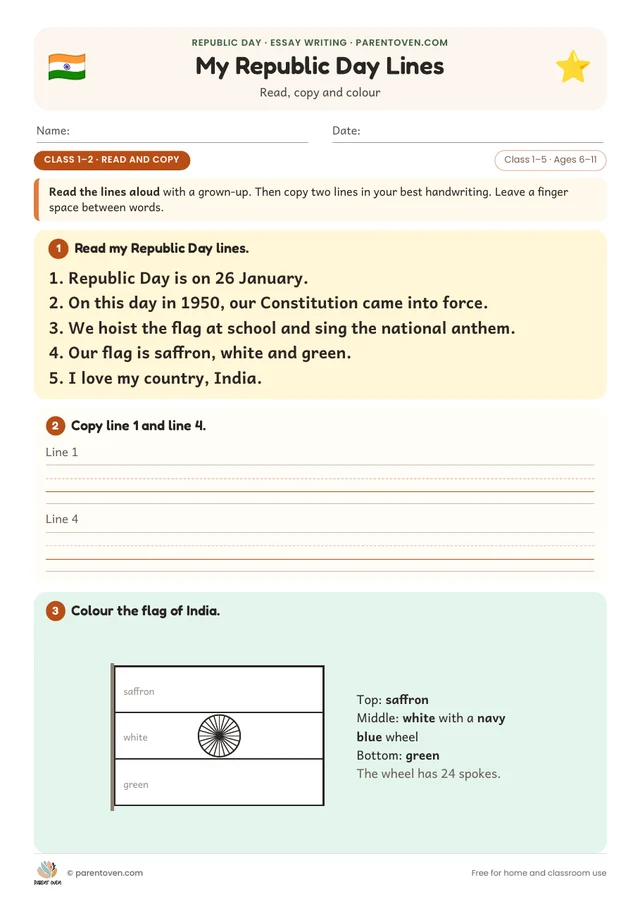
Class 1–2
Read, copy and colour
Five short Republic Day lines to read aloud, two of them to copy on four-line handwriting rows, and an outline of the national flag (with all 24 spokes in the wheel) to colour.
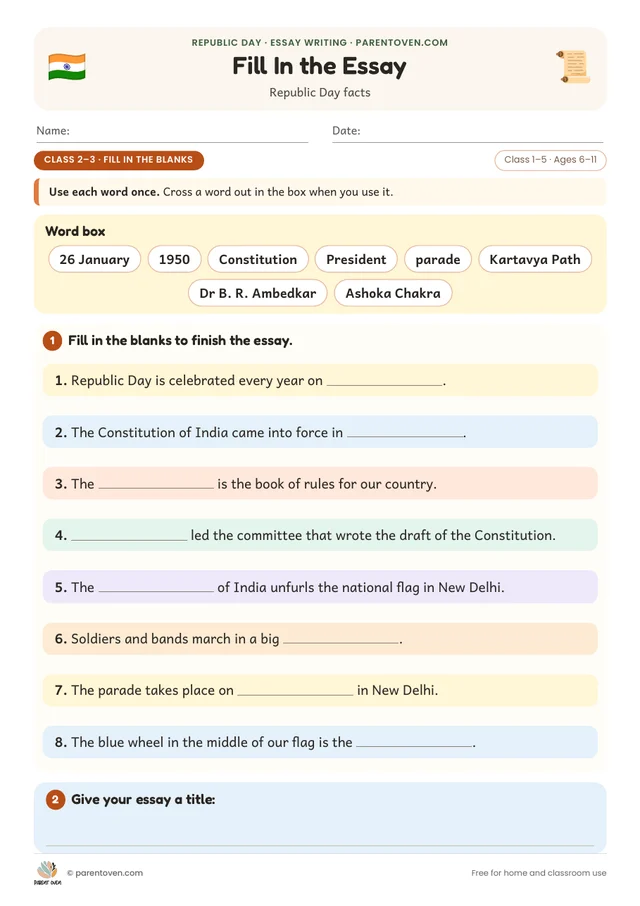
Class 2–3
Fill in the essay
Eight essay sentences with a blank in each and a word box: 26 January, 1950, Constitution, President, parade, Kartavya Path, Dr B. R. Ambedkar, Ashoka Chakra. Ends with a line to give the essay a title.
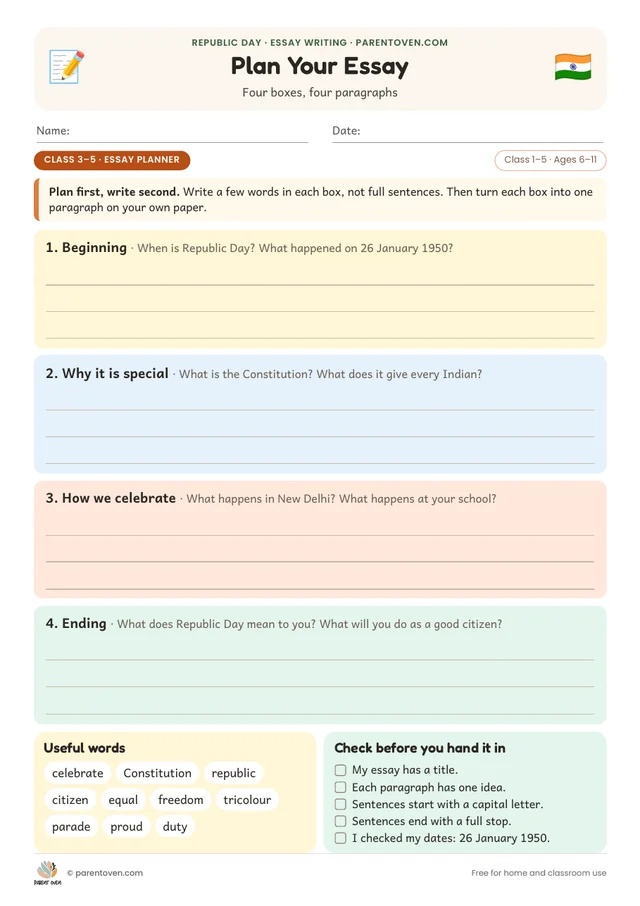
Class 3–5
Plan your essay
Four boxes that become four paragraphs: beginning, why the day is special, how it is celebrated, and what it means to you. Includes a box of useful words and a five-point check before handing it in.
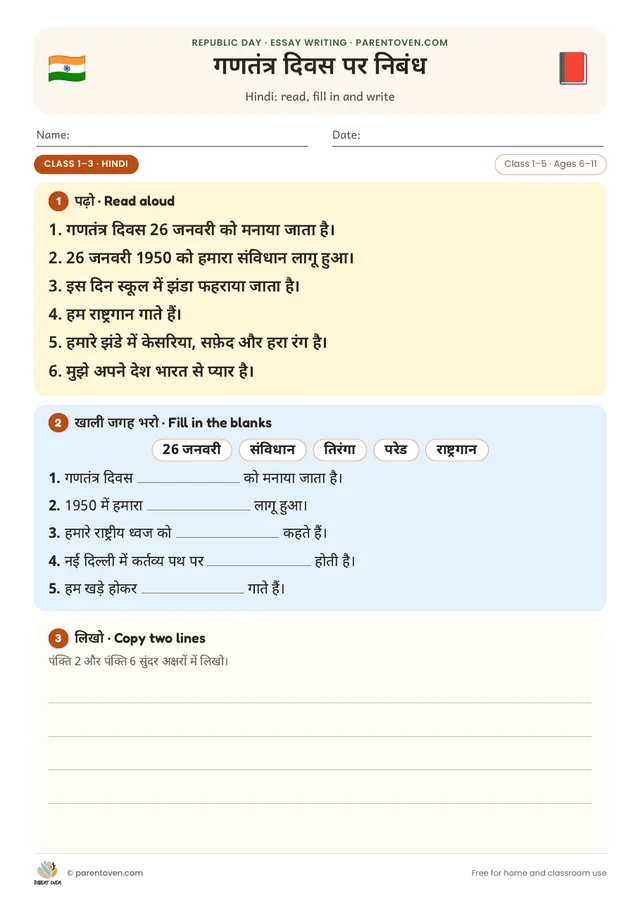
Class 1–3 · Hindi
गणतंत्र दिवस पर निबंध
Six simple Hindi lines to read aloud, five blanks to fill from a word box (26 जनवरी, संविधान, तिरंगा, परेड, राष्ट्रगान), and ruled lines to copy two sentences.
How to Help Your Child Write the Essay
- Talk before writing. Ask three questions: What happened on 26 January 1950? What did you see on TV or at school? What does the flag mean to you? Their answers are the essay.
- Use one paragraph for one idea. Beginning, history, celebration, feelings. The planner sheet has a box for each.
- Get the three dates right. 26 November 1949 (Constitution adopted), 26 January 1950 (came into force), 26 January 1930 (Purna Swaraj). These are the facts teachers check first.
- Keep sentences short. For Class 1 to 3, one fact per sentence is best. Long sentences are where spelling and grammar slip.
- End with the child’s own line. “I feel proud when…” or “I will…” makes the essay theirs, and teachers notice.
- Read it aloud. If a sentence sounds wrong when spoken, it usually is. Fix it together.
Republic Day Facts for an Essay (Checked)
- The Constituent Assembly adopted the Constitution on 26 November 1949. It came into force on 26 January 1950 (PIB, 2024).
- Dr B. R. Ambedkar was the chairman of the Drafting Committee (PIB, 2015).
- 26 November is observed as Constitution Day (Samvidhan Divas) since 2015 (PIB, 2015).
- The national flag has three equal bands of deep saffron, white and India green, with a navy blue Ashoka Chakra of 24 spokes in the centre (Ministry of Home Affairs).
- The Republic Day celebrations end with the Beating Retreat ceremony at Vijay Chowk, New Delhi, on 29 January (PIB).
Frequently Asked Questions
How long should a Republic Day essay be for Class 1 to 5?
As a rough guide: Class 1, five or six lines; Class 2, about ten lines; Class 3, about 120 words; Class 4, about 180 words; Class 5, 250 to 300 words. Always follow the word limit your child’s teacher gives.
Which Republic Day is it in 2027?
It is the 78th Republic Day. The first was on 26 January 1950.
Why is Republic Day celebrated on 26 January?
The Constitution of India came into force on 26 January 1950. The date was chosen because on 26 January 1930 the Indian National Congress had called for Purna Swaraj, or complete independence.
Who wrote the Constitution of India?
It was written and debated by the Constituent Assembly. Dr B. R. Ambedkar was the chairman of the Drafting Committee, so he is often called the chief architect of the Constitution.
Should my child learn the essay by heart?
For an exam, it is better to learn the four or five main facts and the order of the paragraphs, then write in their own words. Teachers give more marks to a clear essay the child understands than to a long one copied word for word.
Is there a Republic Day essay in Hindi?
Yes. This page has 10 lines and a short essay in Hindi, and Sheet 4 of the printable pack is a Hindi read, fill in and write sheet.
Sources
- Press Information Bureau (2024): 75th anniversary of the adoption of the Constitution
- Press Information Bureau (2015): 26 November to be observed as Constitution Day
- Press Information Bureau: Beating Retreat ceremony at Vijay Chowk
- Ministry of Home Affairs: National Flag of India
- Constitution of India, Preamble (Legislative Department, Ministry of Law and Justice)
We checked each source in November 2026. Pictures on the worksheets are from Google’s Noto Emoji (Apache 2.0). Last reviewed: 23 November 2026 by the Parent Oven team.
More for Republic Day
- Republic Day speech for kids: 1-minute and 2-minute speeches, opening and closing lines
- Republic Day worksheets: flag colouring, tracing, mazes for ages 3 to 7
- Republic Day colouring pages
- Republic Day quiz for kids: 12 questions with answers
- NCERT and CBSE Class 1–2 worksheet map