
Learning Worksheets My body worksheets
Free printable PDF · EVS · UKG · ages 5–6 · answer key
My Body Worksheets for UKG: Body Parts and the Five Senses
“My Body” is one of the first EVS topics in almost every Indian UKG syllabus. These six worksheets cover naming body parts, the five sense organs and what they do, which sense we use for everyday things, counting on our own body, writing body words, and which body part we use for actions like kicking or clapping.
The sheets are made for talking as much as writing: point, touch, act it out, then mark the answer. Each one fills an A4 page, there is an answer key, and you can print a black and white version to save ink.
Free · A4 (prints on US Letter) · 6 sheets + answer key · colour and ink-saving black & white · no sign-up

Jump to: The six sheets · How to teach “My Body” in UKG · Common mistakes · Games without paper · FAQs
The six sheets
Start with Sheets 1 and 2 for the words, then use Sheets 3 to 6 to think and apply. Matching sheets are real puzzles, with the pictures in a different order from the words.
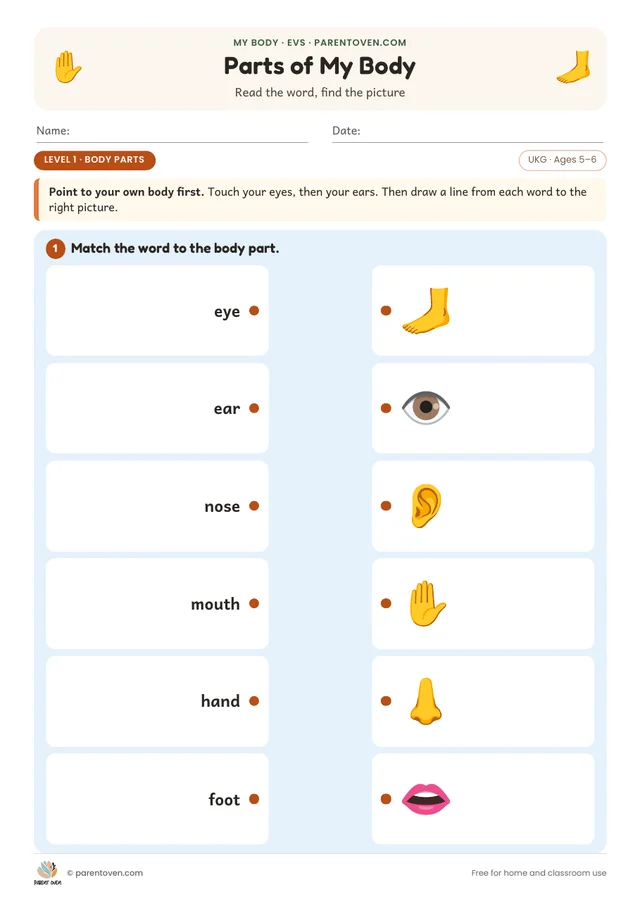
Level 1 · body parts
Parts of my body
Six words (eye, ear, nose, mouth, hand, foot) to match to clear pictures. A tip at the top asks children to touch each part on their own body first.
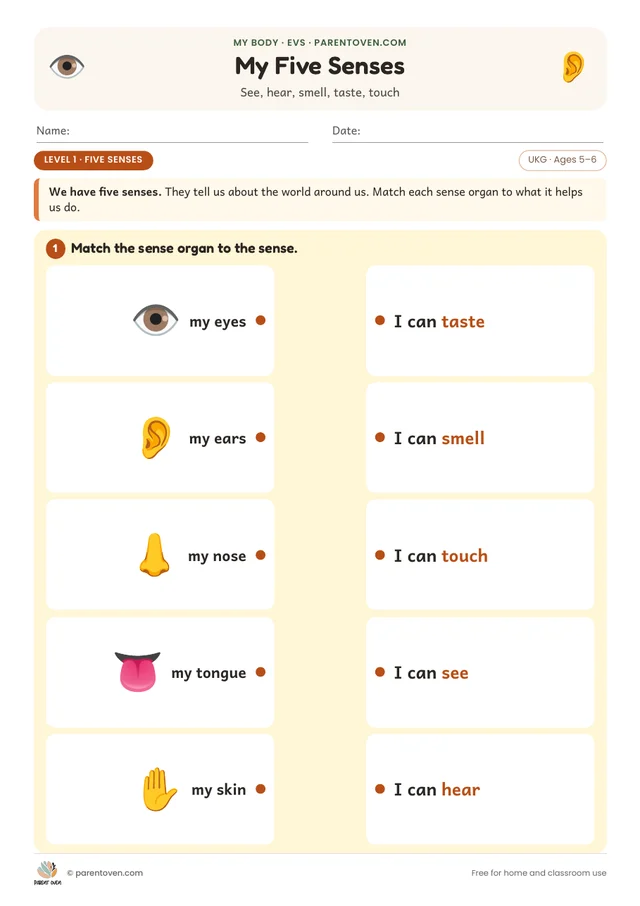
Level 1 · five senses
My five senses
Match each sense organ to what it does: eyes to see, ears to hear, nose to smell, tongue to taste and skin to touch. “I can…” sentences keep it personal.
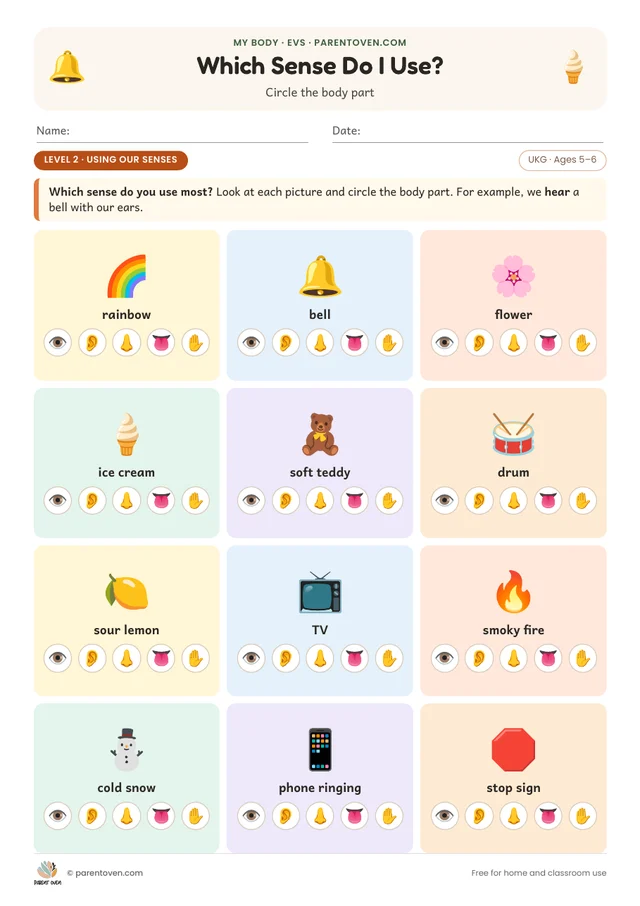
Level 2 · using our senses
Which sense do I use?
Twelve everyday pictures, from a rainbow to a ringing phone. Children circle the sense organ they use most. Some have more than one good answer, which makes a nice discussion.
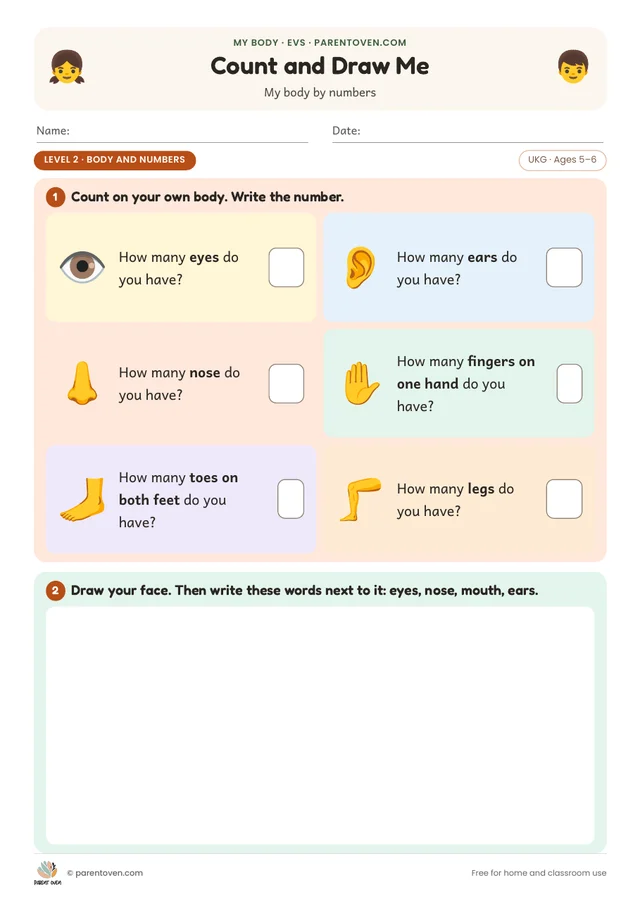
Level 2 · body and numbers
Count and draw me
How many eyes, ears, noses, fingers on one hand, toes and legs? Children count on their own body, then draw their face and write four body words next to it.
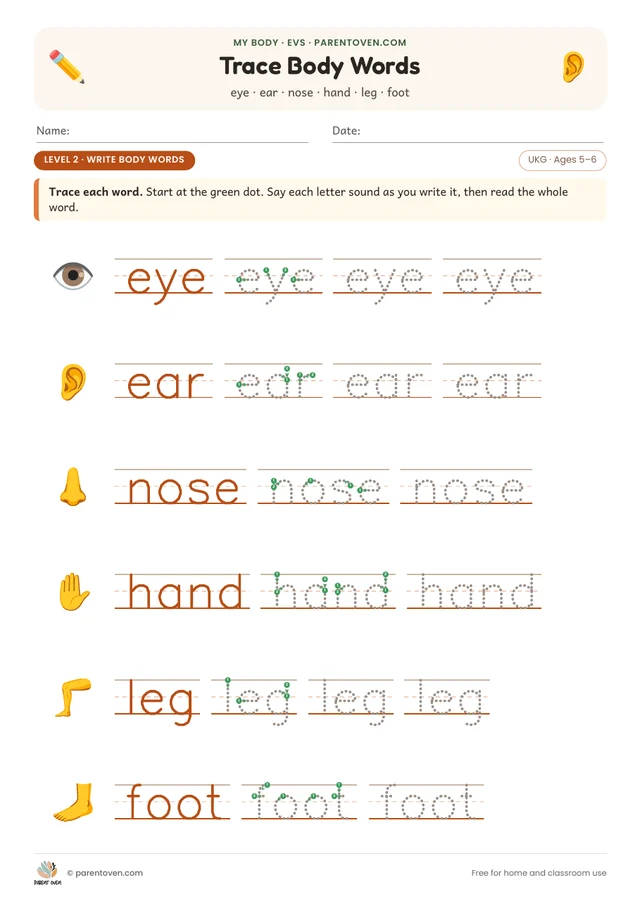
Level 2 · write body words
Trace body words
Six rows with a picture, a solid model and single-stroke dotted words: eye, ear, nose, hand, leg, foot. Green start dots on the first copy show where each letter begins.
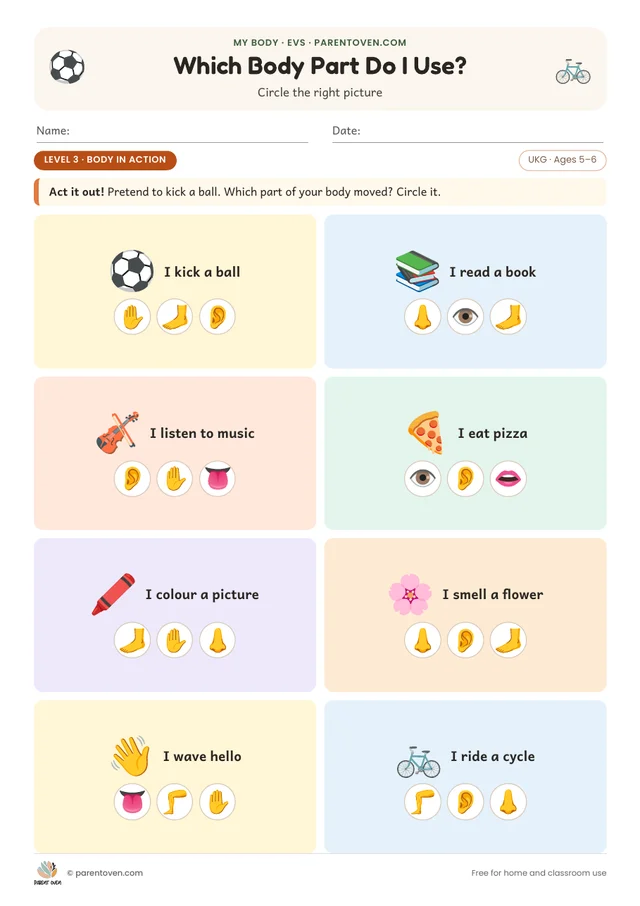
Level 3 · body in action
Which body part do I use?
Eight actions such as kick a ball, read a book and ride a cycle, each with three body parts to choose from. Acting it out first makes the answer obvious and fun.
Saving ink? The black & white version has the same 6 sheets and answer key with white backgrounds and light grey pictures.
What your child will learn
Children name the main body parts, link each sense to its organ, decide which sense they use for everyday things, count body parts, and trace body words.
The set also builds body awareness and care: we see with our eyes, so we protect them; we hear with our ears, so we keep them clean. NCF-FS 2022 links this knowledge to health and well-being goals at this age.
A one-week plan
One sheet a day is plenty at this age. Stop while your child is still enjoying it, and save the answer key for the weekend so they can check their own work.
| Day | Sheet | Skill | Try this too |
|---|---|---|---|
| Monday | Parts of my body (Sheet 1) | Body parts | Play Simon says with body parts |
| Tuesday | My five senses (Sheet 2) | Five senses | Blindfold taste test with three foods |
| Wednesday | Which sense do I use? (Sheet 3) | Using our senses | Mystery bag: guess by touch |
| Thursday | Count and draw me (Sheet 4) | Body and numbers | Count fingers and toes together |
| Friday | Trace body words (Sheet 5) | Write body words | Write body words with a finger on the back |
| Saturday | Which body part do I use? (Sheet 6) | Body in action | Dance and name the moving body parts |
How to teach “My Body” in UKG
- Start with songs and touch. “Head, shoulders, knees and toes” or a quick “touch your nose, touch your ears” game teaches the words faster than any sheet.
- Name, then use. First learn the names (Sheet 1), then what each part does (Sheets 2 and 6). “We see with our eyes” is a full sentence children can say.
- Do a senses walk. Walk around the house or park: what can you hear? smell? touch? Then do Sheet 3.
- Count on yourself. Fingers and toes are the first counters children own. Sheet 4 links EVS to maths in a natural way.
- Talk about care. Ask how we keep our eyes, ears and teeth safe. Our good habits sheets cover this in more depth.
- Accept good reasons. If your child says we “see” a lemon, agree, and ask which sense tells us it is sour.
Common mistakes and quick fixes
| What you see | What usually helps |
|---|---|
| Mixes up ear and eye when reading | Point to the picture and say the word slowly. The words look alike, so read them together, letter by letter. |
| Says we taste with our mouth | Mouth is fine at this age; then show the tongue in a mirror and say “the tongue does the tasting”. |
| Forgets that skin is a sense organ | Let your child touch something soft, rough, hot (warm cup) and cold (ice). “Your skin felt it!” |
| Counts 5 toes on both feet | Count one foot, then the other, and add: 5 and 5 make 10. Use the real feet! |
| Draws a face without ears | Very common. Look in a mirror together and ask what is on the sides of the head. |
Games without paper
- Simon says. “Simon says touch your elbow.” Add less common words like ankle, wrist and knee as your child gets better.
- Mystery bag. Put a few objects in a cloth bag. Your child feels one and guesses it: that is the sense of touch.
- Smell test. With eyes closed, sniff a lemon, a flower, and a spoon of coffee or haldi. Which is which?
- Sound walk. Sit quietly for one minute and list every sound you hear.
- Flash cards. Our body parts flash cards are a quick way to review the words.
More EVS practice
Next, try good habits and safety worksheets and my family and community helpers. For other EVS topics, see animal worksheets, bird worksheets and vegetable worksheets. All UKG topics are on the UKG worksheets page.
Frequently asked questions
What are the five senses for kids?
Sight (eyes), hearing (ears), smell (nose), taste (tongue) and touch (skin). Together they tell us what is around us and help keep us safe.
What body parts should a UKG child know?
Most UKG syllabuses include head, hair, eyes, ears, nose, mouth, teeth, tongue, neck, shoulders, arms, hands, fingers, legs, knees, feet and toes, plus the five sense organs.
Is “My Body” part of EVS in UKG?
Yes. NCF-FS 2022 includes knowing about one’s own body, health and safety in the foundational stage, and most Indian schools teach “My Body” and “Five Senses” as early EVS topics in UKG.
How can I make this topic fun?
Use action songs, a mirror, a senses walk and a mystery bag. Children remember what they do with their bodies far better than what they only write.
Can I print these in black and white?
Yes. The ink-saving PDF has the same six sheets and answer key with light grey pictures.
Pictures are from Google’s Noto Emoji (Apache 2.0). Topics follow NCERT’s NCF-FS 2022 (well-being and the world around us) and common Indian UKG EVS syllabuses. Last reviewed: 21 November 2026 by the Parent Oven team.