Learning Worksheets Fruit worksheets
Free printable PDF · LKG · ages 4–5 · 3 levels · answer key
Fruit Worksheets for LKG: Names, Colours, Counting and Sizes
Six worksheets about the fruits children eat and see at the market every day: apple, banana, mango, grapes, orange, pineapple, watermelon and more. Children match fruits to their names, pick their colours, count them, trace short fruit names, decide whether something is a fruit, and order fruits by their real size.
Fruits are a favourite LKG EVS topic because children already know them well. That makes them perfect for practising other skills too: colours, counting, first reading and comparing sizes. Every picture is clear and realistic, and each sheet works best with a real fruit or two on the table.
Free · A4 (prints on US Letter) · 6 sheets + answer key · colour and ink-saving black & white · no sign-up
Jump to: The six sheets · How to teach fruits at home · Common mistakes · Games without paper · FAQs
The six sheets
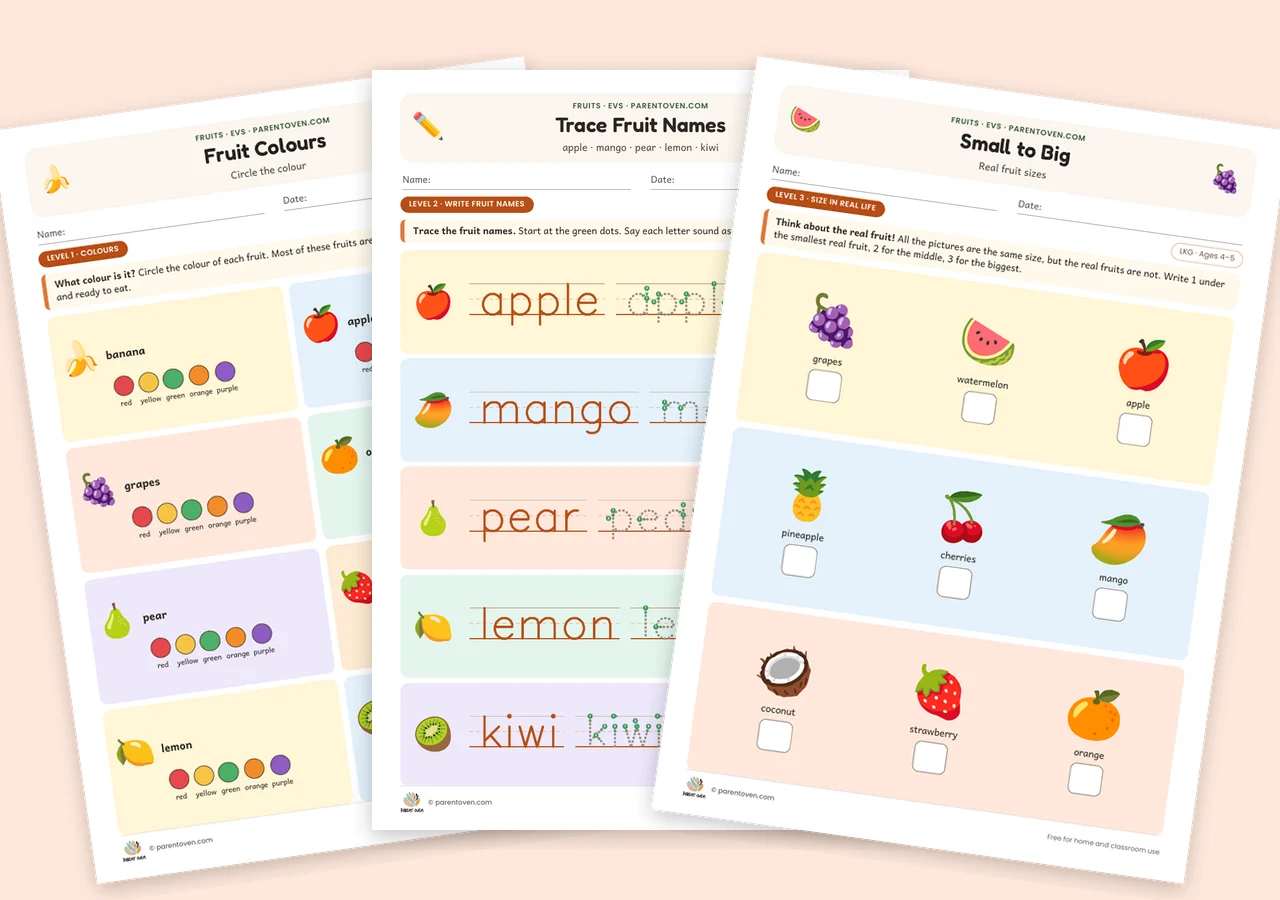
Each sheet fills one A4 page with a Name and Date line. The first sheets are about naming and colours, the middle ones add counting and writing, and the last two ask children to think. The full PDF ends with a one-page answer key.
Level 1 · fruit names
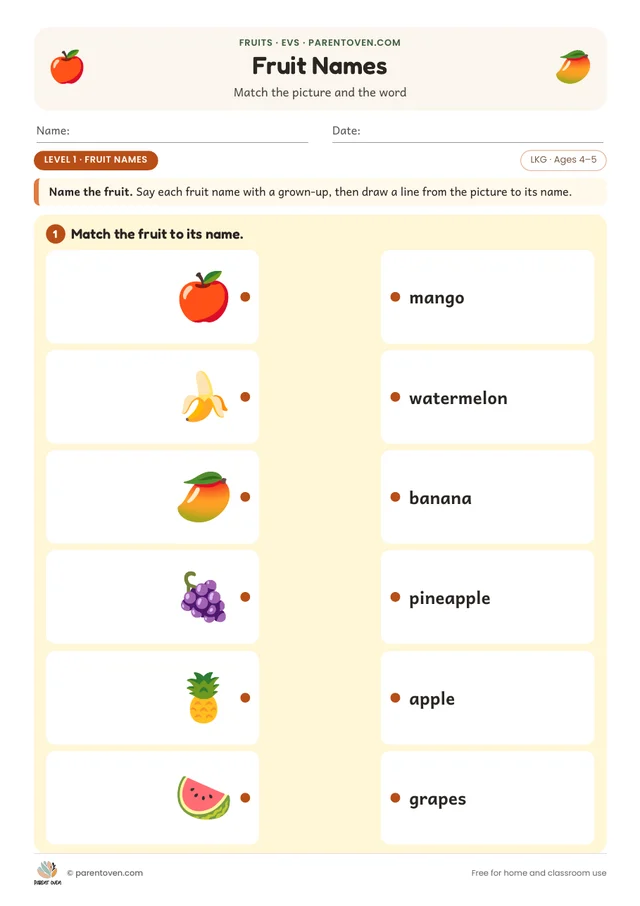
Fruit names
Six fruit pictures on the left and six names on the right, mixed up: apple, banana, mango, grapes, pineapple and watermelon. A grown-up reads the names with the child, who then draws a line from each fruit to its word.
Level 1 · colours
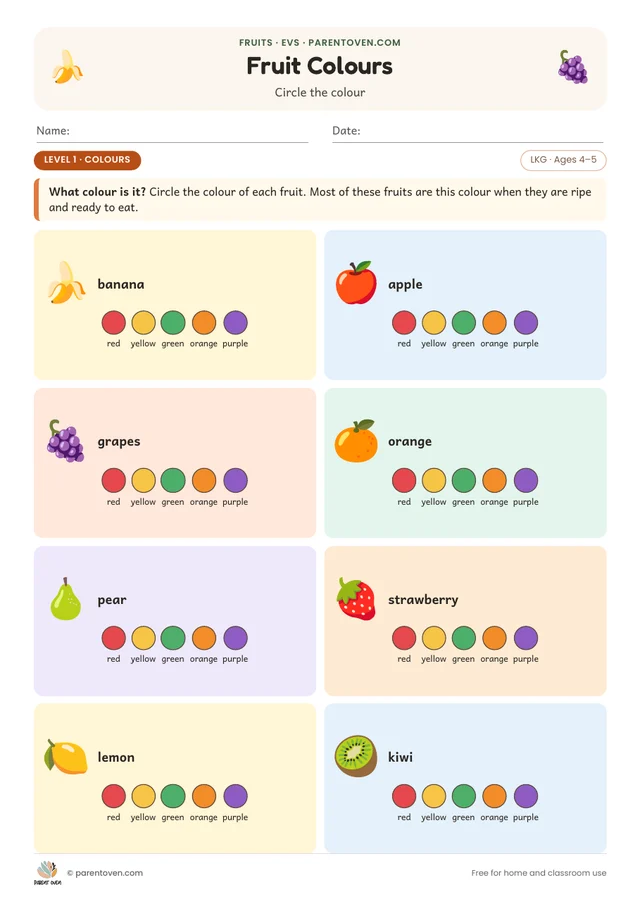
Fruit colours
Eight fruits, each with a row of five colour dots (red, yellow, green, orange and purple). Children circle the colour of the fruit when it is ripe. Two of them, the pear and the kiwi, are green, which surprises some children.
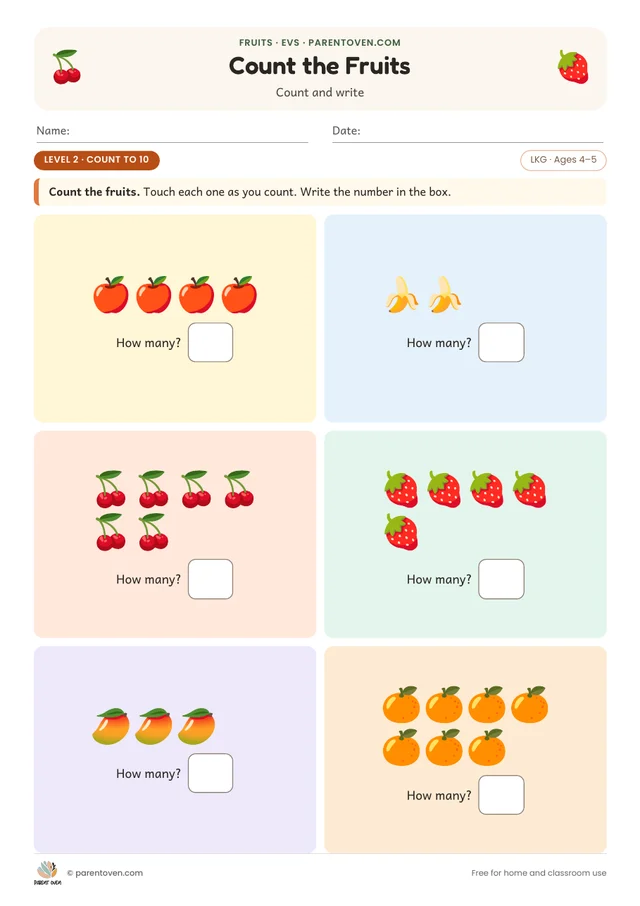
Level 2 · count to 10
Count the fruits
Six boxes with groups of fruit from two to seven, set out in neat rows. Children touch each fruit as they count and write the number in the box.

Level 2 · write fruit names
Trace fruit names
Five short words to trace: apple, mango, pear, lemon and kiwi. Each has a solid model, then dotted single-stroke letters with green start dots, on a writing guide with a middle line.

Level 3 · fruit or vegetable
Fruit or not?
Twelve pictures: fruits mixed with everyday vegetables such as carrot, potato, onion, broccoli and garlic. Children tick fruit or not a fruit for each one.
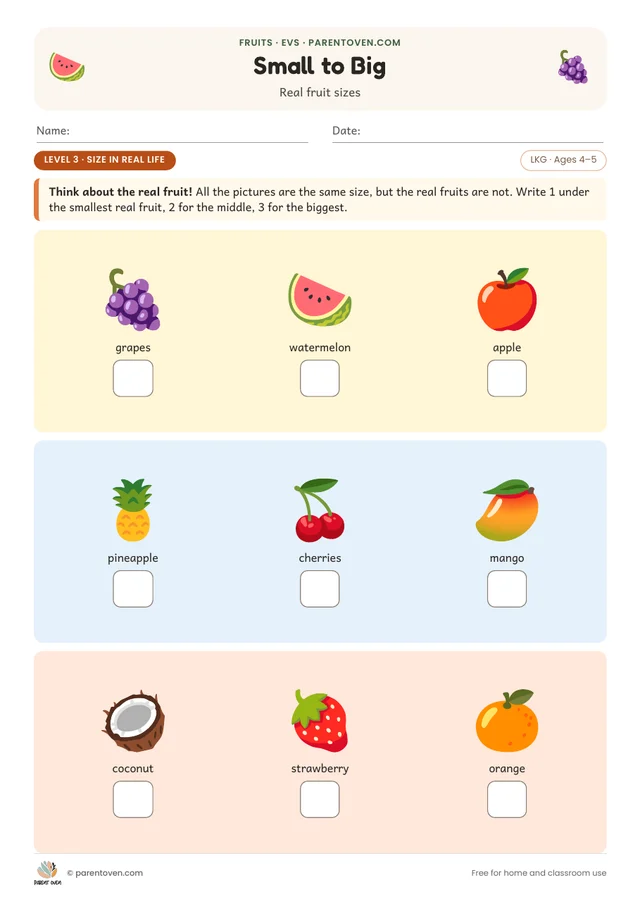
Level 3 · size in real life
Small to big
Three rows of three fruits, all drawn the same size. Children think about the real fruits and write 1 for the smallest, 2 for the middle and 3 for the biggest. A grape next to a watermelon makes the point clearly.
Saving ink? The black & white version has the same 6 sheets and answer key with white backgrounds and light grey pictures.
What your child will learn
Children learn the names of common fruits, their colours and real sizes, and how a fruit differs from a vegetable. Along the way they practise counting to 7, tracing short words with the correct letter formation, and reading a few simple words with help.
NCERT’s foundational stage goals for this age include knowing about food, plants and healthy habits through real experiences. Fruits are an easy way in: children can touch, smell, cut and taste them while they learn.
A one-week plan
One sheet a day is plenty at this age. Stop while your child is still enjoying it, and save the answer key for the weekend so they can check their own work.
| Day | Sheet | Skill | Try this too |
|---|---|---|---|
| Monday | Fruit names (Sheet 1) | Fruit names | Name every fruit in the fruit basket |
| Tuesday | Fruit colours (Sheet 2) | Colours | Sort fruits by colour on a plate |
| Wednesday | Count the fruits (Sheet 3) | Count to 10 | Count bananas in a bunch |
| Thursday | Trace fruit names (Sheet 4) | Write fruit names | Trace “apple” in rava, then eat one |
| Friday | Fruit or not? (Sheet 5) | Fruit or vegetable | Cut a fruit and a vegetable and look for seeds |
| Saturday | Small to big (Sheet 6) | Size in real life | Line up three fruits from small to big |
How to teach fruits at home
- Start with real fruit. Put three or four fruits on the table. Name them, hold them, smell them and talk about the colour, shape and size before opening a worksheet.
- Use both languages. Say the English name and the name you use at home: mango and aam, banana and kela, grapes and angoor. Children learn both easily, and it helps them link the picture with the word.
- Talk about colours carefully. A banana is green before it is ripe and yellow after. A mango can be green, yellow or orange. The sheets ask for the colour of the ripe fruit, but any colour your child has really seen is worth talking about.
- Fruit or vegetable? A simple rule for this age: a fruit grows from a flower and has seeds inside. Cut open an apple and a potato and look for seeds together.
- Count while you serve. “How many grapes are on your plate? Let us count.” Counting real fruit before the worksheet makes the count sheet easy.
- Think about size. Hold a grape and a watermelon slice, or a lemon and a coconut. Ask which is bigger in real life, then do the Small to Big sheet.
- Make it a market trip. At the fruit seller, ask your child to find a red fruit, a yellow fruit and the biggest fruit. Real shopping is the best revision.
Common mistakes and quick fixes
| What you see | What usually helps |
|---|---|
| Calls every round fruit an apple | Put an apple, an orange and a pomegranate side by side. Feel and smell each one and name it again. |
| Says a carrot is a fruit because it is sweet | Sweet is not the rule. Fruits grow from flowers and hold seeds. A carrot is a root, so it is a vegetable. |
| Circles the wrong colour for pear or kiwi | Show a real pear or kiwi, or a photo. Many children have not seen them, so this sheet is a chance to learn something new. |
| Traces letters from the bottom | Point to the green start dot and say “start at the dot”. Trace the word with a finger first. |
| Orders fruits by picture size, not real size | All the pictures are the same size on purpose. Ask “if you held a real watermelon, would it fit in your hand?” |
Games without paper
- Fruit feel bag. Put a fruit in a cloth bag. Your child feels it without looking and guesses what it is.
- Fruit chaat helper. Let your child wash and count the fruit pieces while you make a fruit chaat.
- Colour plate. Make a rainbow plate: something red, yellow, green, orange and purple.
- Seed hunt. Cut open an apple, an orange and a papaya and count or compare the seeds.
- Flash cards. Our fruits flash cards make a quick naming game, and the vegetable quiz helps with fruit or vegetable.
More EVS and early maths
For vegetables, see the vegetable worksheets. For colours, try the colour worksheets, and for sorting by colour, shape and kind, the sorting worksheets. The numbers 1 to 20 worksheets build on the counting here. All LKG topics are on the LKG worksheets page.
Frequently asked questions
Which fruits should an LKG child know?
The fruits your family eats and sees at the market are the best start: apple, banana, mango, orange, grapes, guava, papaya and watermelon. Learning five to ten common fruits well matters more than a long list.
How do I explain the difference between a fruit and a vegetable?
For young children: a fruit grows from a flower and has seeds inside. Vegetables are other parts of a plant, like roots (carrot), leaves (spinach), bulbs (onion) or flowers (broccoli). Some foods we cook as vegetables, like tomato and brinjal, are fruits to a scientist, so we left them out of the fruit or not sheet.
My child does not read yet. Can they do the names sheet?
Yes. Read the names aloud together first. Children often remember a word by its first letter, which is a good start to reading.
Why is there a counting sheet in a fruit set?
Children learn best when topics connect. Counting real fruit at snack time and then on paper helps both counting and talking about food.
Is there a black and white version?
Yes. The ink-saving black and white PDF has the same six sheets and answer key. For the colour sheet, use the word next to each fruit or show the real fruit.
Will these print on US Letter paper?
Yes. They are made for A4 with wide margins. Choose “Fit to page” if an edge is cut off.
Pictures are from Google’s Noto Emoji (Apache 2.0). Skill levels follow NCERT’s NCF-FS 2022 and the NIPUN Bharat goals for the foundational stage. Last reviewed: 21 November 2026 by the Parent Oven team.