
Learning Worksheets Maths Sorting
Free printable PDF · LKG · ages 4–5 · 3 levels · answer key
Sorting Worksheets for LKG: Colour, Shape, Kind and Place
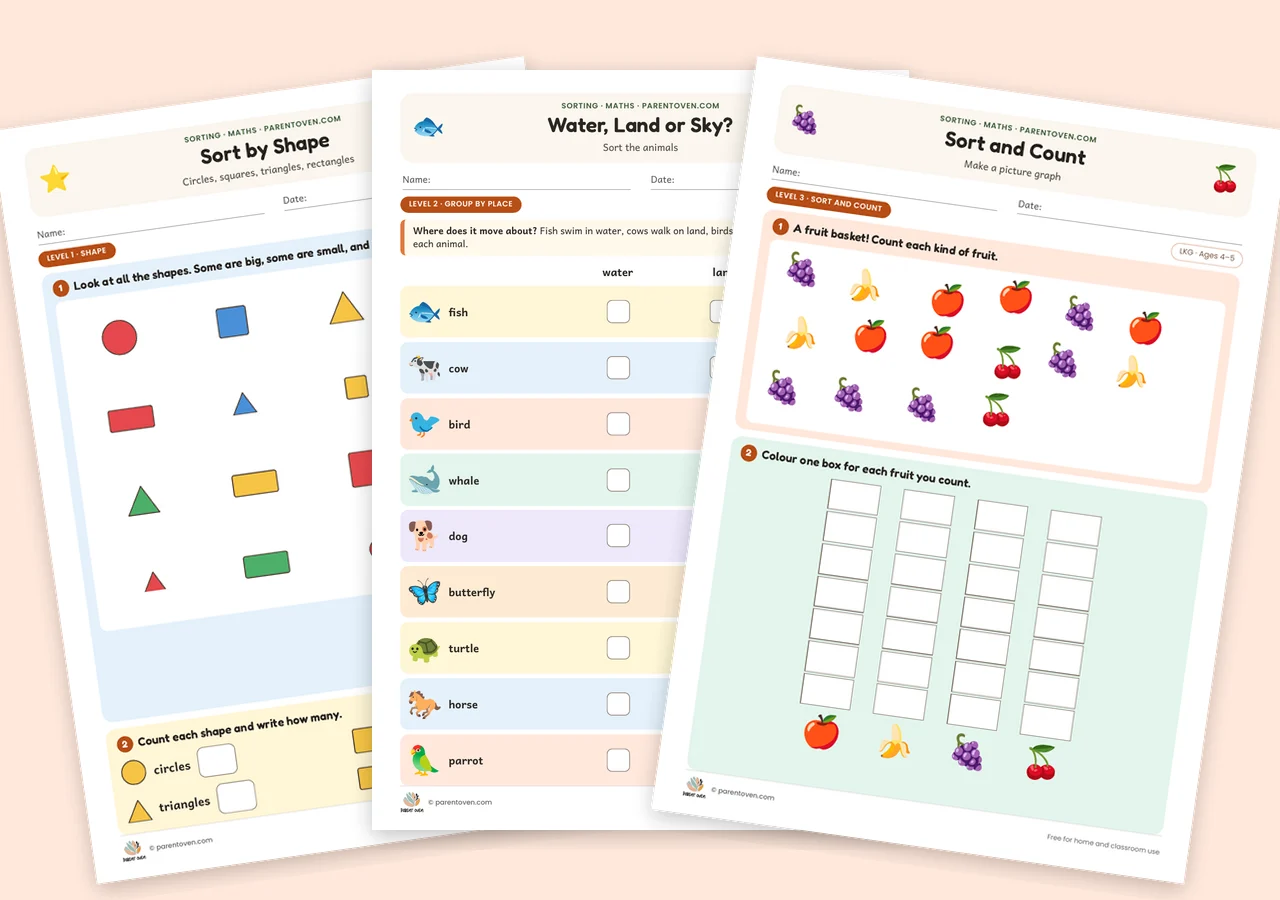
Six worksheets that teach children to group things by one rule at a time: colour, shape, kind and where an animal lives. The set ends with finding the odd one out and making a first picture graph by sorting and counting.
Sorting is one of the most useful thinking skills a four-year-old can build. It is how children make sense of the world, and it is the base of maths topics that come later, from patterns to data. Every sheet uses familiar things such as fruit, toys and animals, and none needs reading.
Free · A4 (prints on US Letter) · 6 sheets + answer key · colour and ink-saving black & white · no sign-up
Jump to: The six sheets · How to teach sorting at home · Common mistakes · Games without paper · FAQs
The six sheets
Each sheet fills one A4 page with a Name and Date line. Start with colour and shape, then move on to sorting by kind and place. The full PDF has a one-page answer key at the end.
Level 1 · colour
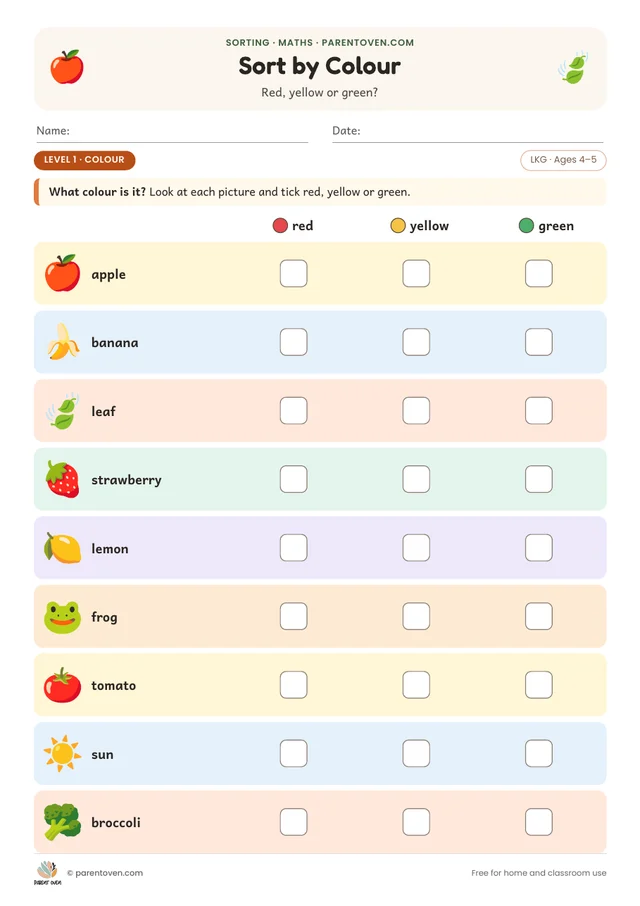
Sort by colour
Nine everyday things: apple, banana, leaf, strawberry, lemon, frog, tomato, sun and broccoli. Children tick red, yellow or green for each one. It works as a colour quiz and as a first sorting table.

Level 1 · shape
Sort by shape
A panel of circles, squares, triangles and rectangles in mixed sizes and colours. Children count each shape and write how many. Because the colours and sizes change, the only rule that works is shape.

Level 2 · sort by kind
Fruits or toys?
Eight things to tidy up: apple, teddy, grapes, ball, kite, mango, robot and banana. Children draw a line from each one to the fruit basket or the toy box.
Level 2 · group by place
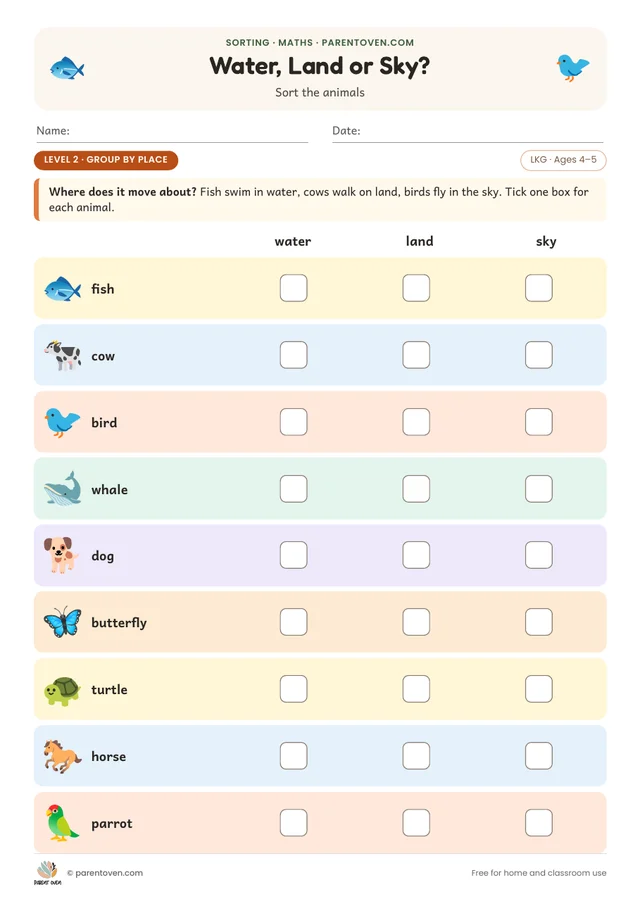
Water, land or sky?
Nine animals, including a fish, a cow, a whale, a butterfly and a parrot. Children tick where each one mostly moves about: in water, on land or in the sky.
Level 3 · sorting rules
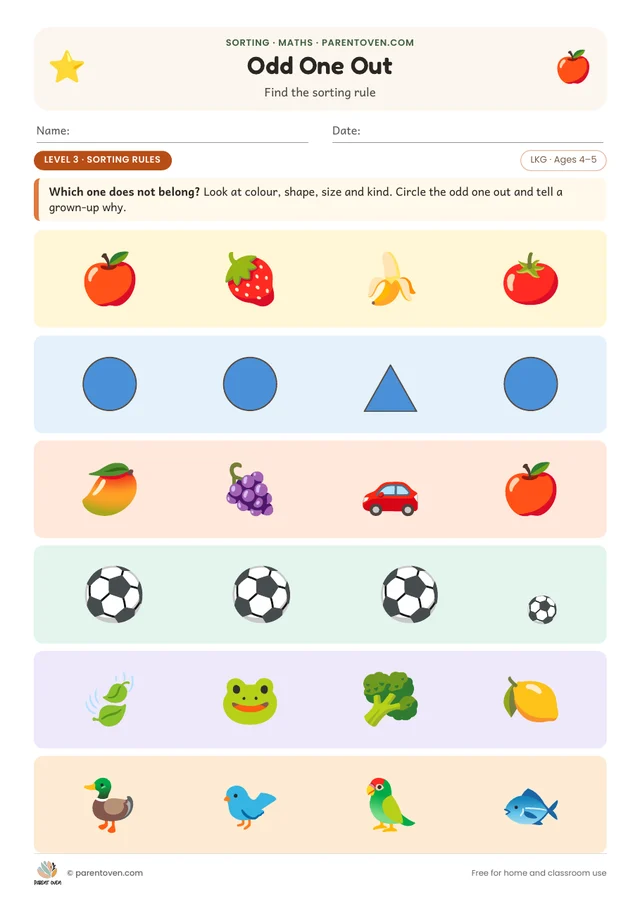
Odd one out
Six rows of four pictures. In each row one does not belong, because of its kind, colour, shape or size. Children circle it and tell a grown-up why. Hearing the reason is the real goal.
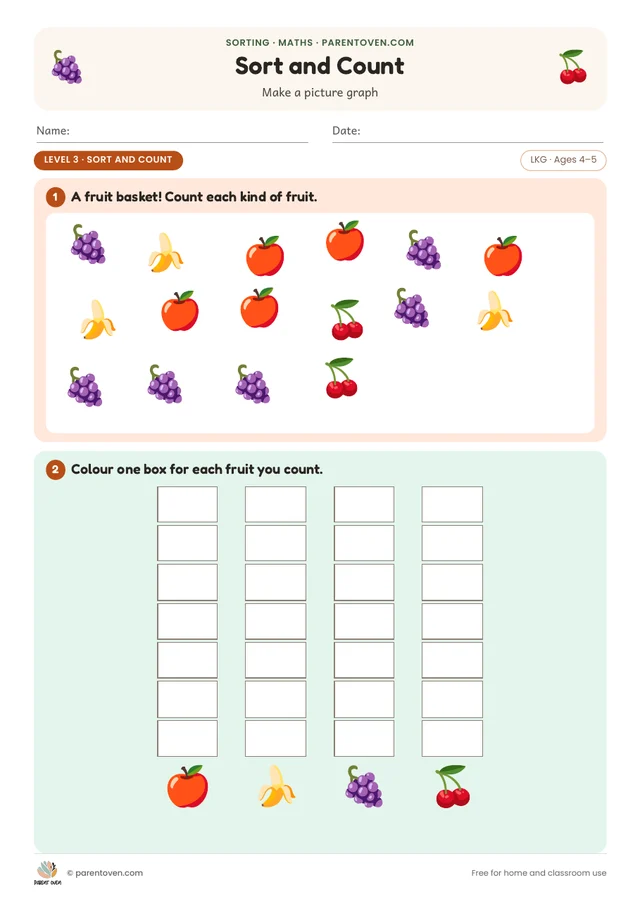
Level 3 · picture graph
Sort and count
A basket of mixed fruit. Children count each kind, then colour one box per fruit in a simple column graph, so they can see which fruit there is most of.
Saving ink? The black & white version has the same 6 sheets and answer key with white backgrounds and light grey pictures.
What your child will learn
Children practise sorting by one feature (colour, shape, kind or place), explaining the rule they used, finding the one that does not fit, and counting sorted groups to make a picture graph.
NCERT’s foundational stage framework lists sorting and classifying objects by one feature among the maths goals for ages 3 to 6. The best sorting happens with real things, so each sheet comes with an idea to try at home.
A one-week plan
One sheet a day is plenty at this age. Stop while your child is still enjoying it, and save the answer key for the weekend so they can check their own work.
| Day | Sheet | Skill | Try this too |
|---|---|---|---|
| Monday | Sort by colour (Sheet 1) | Colour | Sort the washing by colour |
| Tuesday | Sort by shape (Sheet 2) | Shape | Sort blocks into circles, squares and triangles |
| Wednesday | Fruits or toys? (Sheet 3) | Sort by kind | Tidy up: fruit in the basket, toys in the box |
| Thursday | Water, land or sky? (Sheet 4) | Group by place | Name animals that live in water, on land and in the sky |
| Friday | Odd one out (Sheet 5) | Sorting rules | Find the odd one out on the dinner table |
| Saturday | Sort and count (Sheet 6) | Picture graph | Sort and count buttons by colour |
How to teach sorting at home
- Begin with real things. Give your child a mixed pile of red and yellow blocks and two bowls. “Put all the red ones here and all the yellow ones there.”
- One rule at a time. Sort by colour first. Later, sort the same pile by size or shape. Showing that one pile can be sorted in different ways is a powerful idea.
- Say the rule. Ask “how did you sort them?” and help your child say it: “These are all red. These are all yellow.” Putting the rule into words is the heart of the skill.
- Let your child choose. Give a box of mixed buttons and ask your child to sort them any way they like. Then ask them to explain. Any rule they can explain is good thinking.
- Talk about tricky ones. Is a duck a land animal or a water animal? It walks, swims and flies! Let your child pick and explain; there is room for more than one answer.
- Count the groups. After sorting, count each pile. Which has the most? The Sort and Count sheet turns this into a simple picture graph.
- Make tidy-up time a sorting game. Books on the shelf, blocks in the box, clothes in the drawer. Children practise sorting every day without noticing.
Common mistakes and quick fixes
| What you see | What usually helps |
|---|---|
| Changes the rule halfway, sorting by colour then by shape | Name the rule before starting and say it again in the middle: “We are sorting by colour.” |
| Calls a green apple a vegetable because it is green | Talk about what makes a fruit: it grows on a plant from a flower and has seeds inside. Colour does not decide. |
| Struggles with the odd one out | Ask your child to name all four pictures first, then ask “which three go together?” |
| Counts shapes twice on the shape sheet | Tick each shape lightly as it is counted, or count one shape type at a time and colour it in. |
| Says a whale is a fish | A whale lives in water, so it goes in the water group, which is correct for this sheet. You can add that it breathes air like us. |
Games without paper
- Laundry sort. Let your child sort socks, shirts and towels into piles before folding.
- Kitchen sort. Sort spoons, forks and bowls into groups. Then try sorting by size.
- Animal homes. Name an animal and your child says water, land or sky. Take turns.
- Button jar. Sort a jar of old buttons by colour, then by number of holes.
- Colour walk. Find five green things outside. Next walk, try five round things.
More early maths
For colours, try the colour worksheets and colours flash cards. For shapes, see the shapes worksheets and the shapes quiz. The big and small worksheets practise size, same and different, and the fruit worksheets include fruit or not. All LKG topics are on the LKG worksheets page.
Frequently asked questions
What sorting skills should an LKG child have?
By the end of LKG most children can sort objects by one feature such as colour, shape, size or kind, and say what the groups have in common. Sorting by two features at once usually comes later.
Why is sorting important in maths?
Sorting teaches children to notice features and group by a rule. This is the base of patterns, counting groups, comparing and, later, data and graphs.
My child sorted differently from the answer key. Is it wrong?
Not if they can explain the rule. On the odd one out sheet especially, some rows can have more than one sensible answer.
Will the colour sheet work in black and white?
Each picture shows a well-known thing, like a banana or a leaf, so children can still answer from what they know. For the first time, the colour PDF is best.
Is there a black and white version?
Yes. The ink-saving black and white PDF has the same six sheets and answer key with white backgrounds and grey pictures.
Will these print on US Letter paper?
Yes. They are made for A4 with wide margins. Choose “Fit to page” if an edge is cut off.
Pictures are from Google’s Noto Emoji (Apache 2.0). Skill levels follow NCERT’s NCF-FS 2022 and the NIPUN Bharat goals for the foundational stage. Last reviewed: 21 November 2026 by the Parent Oven team.