Learning Worksheets Maths Big and small
Free printable PDF · LKG · ages 4–5 · 3 levels · answer key
Big and Small Worksheets for LKG, with Same and Different
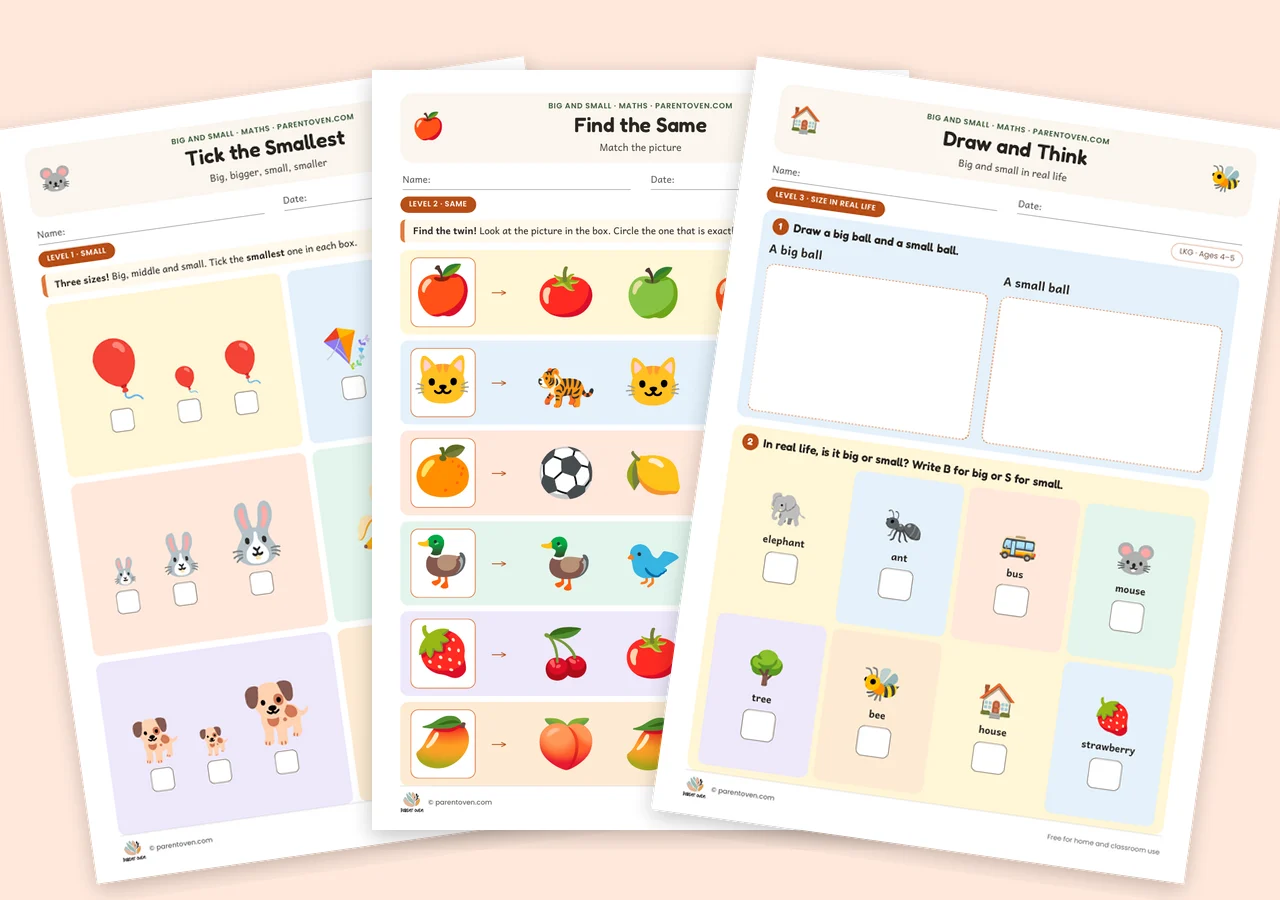
Six worksheets on two of the first maths ideas children meet: size and sameness. Children tick the big one, find the smallest of three, decide whether two pictures are the same, find a twin, spot the odd one out and think about the real size of things.
Comparing is at the heart of early maths. Before children can say that 7 is more than 4, they need words like big, small, same and different, and the habit of looking closely. These sheets use clear, colourful pictures and no reading, so a four-year-old can do most of them alone after one example.
Free · A4 (prints on US Letter) · 6 sheets + answer key · colour and ink-saving black & white · no sign-up
Jump to: The six sheets · How to teach big and small, same and different · Common mistakes · Games without paper · FAQs
The six sheets
Each sheet fills one A4 page with a Name and Date line. The first two sheets are about size, the next three about same and different, and the last one brings both together. The full PDF ends with an answer key.

Level 1 · big
Tick the big one
Eight pairs of the same thing in two sizes: a football, a duck, a star, an apple, a car, a fish, a teddy and a flower. Children tick the big one. The big picture is on the left in some boxes and on the right in others, so they really have to look.
Level 1 · small
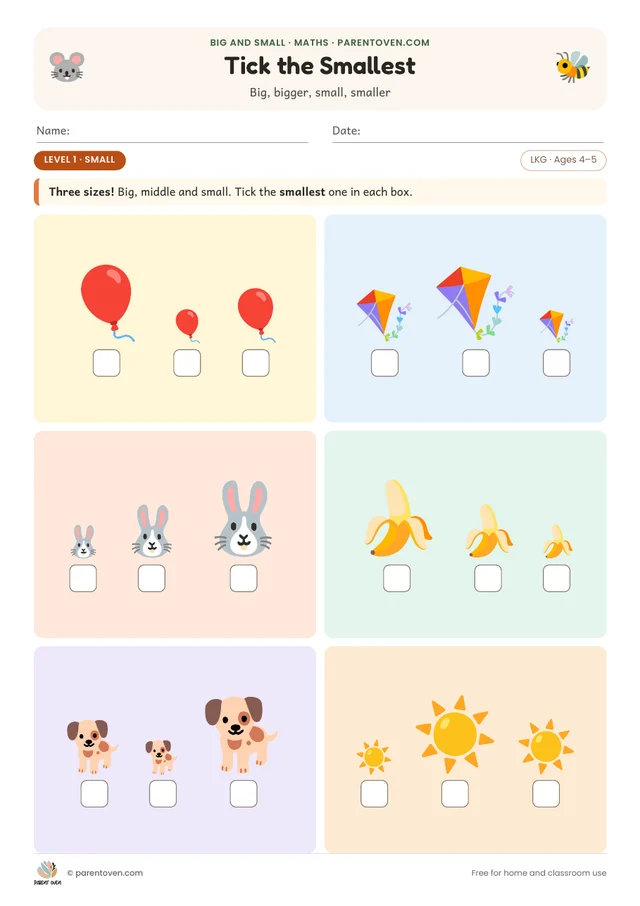
Tick the smallest
Six boxes with three sizes of the same thing. Children tick the smallest one. Three sizes bring in the words bigger and smaller, and the order changes from box to box.

Level 2 · same and different
Same or different?
Eight pairs. Some are exactly the same; others look alike but are not (an apple and a tomato, a cat and a tiger, a lemon and a banana). Children tick same or different and can say why.
Level 2 · same
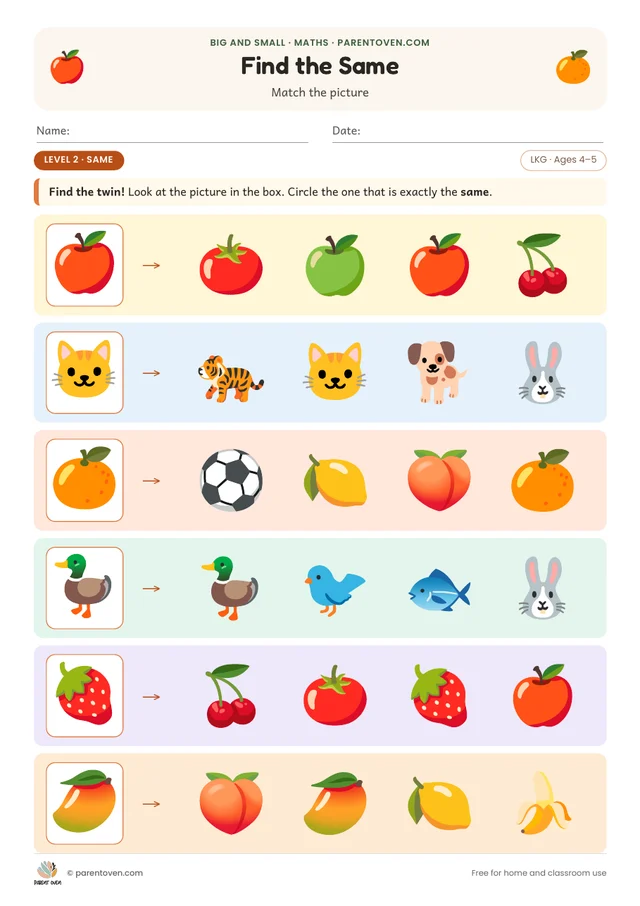
Find the same
Six rows. A picture in a box on the left, then four pictures to choose from, including near misses such as a cherry next to an apple. Children circle the one that is exactly the same.
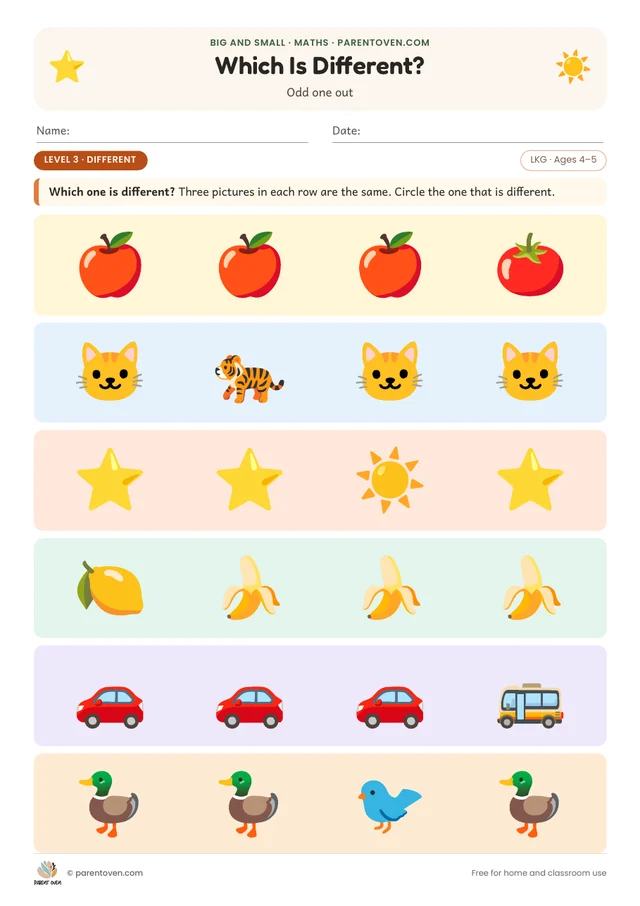
Level 3 · odd one out
Which is different?
Six rows of four pictures. Three are the same and one is different, sometimes only a little (a sun among stars, a tiger among cats). Children circle the different one.
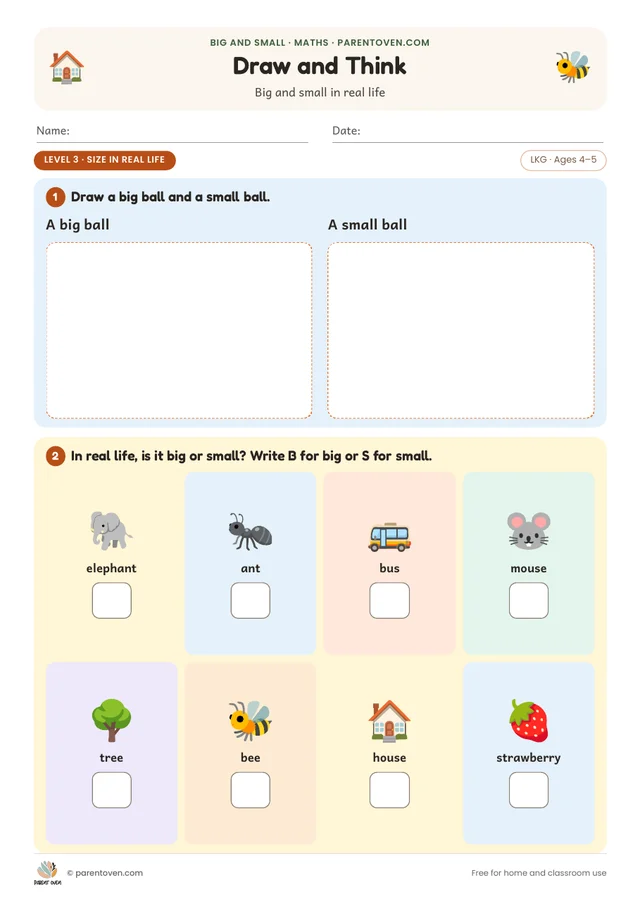
Level 3 · size in real life
Draw and think
First, children draw a big ball and a small ball. Then they look at eight pictures that are all printed the same size (an elephant, an ant, a bus, a mouse, a tree, a bee, a house and a strawberry) and write B or S for big or small in real life.
Saving ink? The black & white version has the same 6 sheets and answer key with white backgrounds and light grey pictures.
What your child will learn
Children practise the words big, small, bigger, smaller, biggest and smallest; comparing two and then three things; deciding whether two things are exactly the same; spotting the one that is different; and thinking about the real size of things, not just the size of a picture.
NCERT’s foundational stage framework lists comparing by size and sorting by one feature among the maths goals for this age. These are thinking skills more than worksheet skills, so the talk around each sheet matters most.
A one-week plan
One sheet a day is plenty at this age. Stop while your child is still enjoying it, and save the answer key for the weekend so they can check their own work.
| Day | Sheet | Skill | Try this too |
|---|---|---|---|
| Monday | Tick the big one (Sheet 1) | Big | Line up shoes from biggest to smallest |
| Tuesday | Tick the smallest (Sheet 2) | Small | Pick the smallest and biggest spoon in the kitchen |
| Wednesday | Same or different? (Sheet 3) | Same and different | Find two things that look the same at home |
| Thursday | Find the same (Sheet 4) | Same | Play spot the difference with two cups |
| Friday | Which is different? (Sheet 5) | Odd one out | Walk and point at big and small things outside |
| Saturday | Draw and think (Sheet 6) | Size in real life | Sort fruit into a big pile and a small pile |
How to teach big and small, same and different
- Use real things first. Put a big spoon and a small spoon on the table. “Which is big? Which is small?” Then try two balls, two shoes, two bowls.
- Add a third. With three spoons, introduce middle, then bigger and smaller, then biggest and smallest. Let your child line them up from small to big.
- Talk about same. Two identical cups are the same. A red cup and a blue cup are both cups but not the same. Children love finding tiny differences once they know to look.
- Ask why. After your child picks the odd one out, ask “why is it different?” There may be more than one good answer; any reason they can explain is real thinking.
- Pictures can trick us. On the last sheet, an elephant and an ant are drawn the same size. Ask “is a real ant big or small?” This teaches children that size words describe real things.
- Keep it playful. Five minutes of comparing during bath time or cooking does as much as a worksheet.
- Move on to numbers. “More and less” with groups of objects comes next, and later comparing numbers. Size words give children the language for it.
Common mistakes and quick fixes
| What you see | What usually helps |
|---|---|
| Always ticks the picture on one side | Point to each picture and ask “is this one big or small?” before ticking. The big one changes sides on purpose. |
| Says an elephant is small because the picture is small | Ask “if the elephant came into our room, would it fit?” Compare with a real thing at home, like a car or a door. |
| Calls things the same because they are the same colour | Hold up two different red things. “Both are red, but is a tomato the same as an apple?” Look at shape and size too. |
| Mixes up biggest and smallest | Practise with three spoons. Say “smallest means the tiniest one”. Point to each one and say small, middle, big. |
| Rushes through odd one out | Ask your child to name all four pictures aloud first. Naming them often makes the different one obvious. |
Games without paper
- Big and small hunt. Find one big and one small thing of the same kind at home: a big pillow and a small pillow, a big book and a small book.
- Nesting cups. Stack steel bowls or cups from biggest to smallest and back again.
- Same or not? Lay out two pairs of socks and one odd sock. Which sock has no twin?
- Giant and mouse. Call out “giant” and your child stretches tall; “mouse” and they curl up small. Mix in “middle”.
- Spot it in books. Look for big and small animals in a picture book and talk about which is really bigger.
More early maths
For sorting by colour, shape and kind, try the sorting worksheets. For shapes, see the shapes worksheets, and for copying and continuing patterns, the patterns worksheets. When comparing sizes is easy, the UKG measurement worksheets move on to tall and short, heavy and light. All LKG topics are on the LKG worksheets page.
Frequently asked questions
What should an LKG child know about size?
By the end of LKG, most children can compare two things and say which is big or small, line up three things by size, and use words like bigger and smaller. Using these words in daily life matters more than worksheets.
Why teach same and different in maths?
Spotting what is the same and what is different is the base of sorting, patterns and comparing numbers. It also trains careful looking, which helps with reading letters like b and d.
My child says a picture of an ant is big. Is that wrong?
It is a good thought: the picture is big! Talk about the real ant. Learning that size words describe real things is part of the skill, and the last sheet is made for this talk.
How long should my child spend on one sheet?
About 5 to 10 minutes. If your child loses interest, stop and come back later, or turn the sheet into a talking game.
Is there a black and white version?
Yes. The ink-saving black and white PDF has the same six sheets and answer key with white backgrounds and grey pictures.
Will these print on US Letter paper?
Yes. They are made for A4 with wide margins. Choose “Fit to page” if an edge is cut off.
Pictures are from Google’s Noto Emoji (Apache 2.0). Skill levels follow NCERT’s NCF-FS 2022 and the NIPUN Bharat goals for the foundational stage. Last reviewed: 21 November 2026 by the Parent Oven team.