Learning Worksheets Maths Measurement worksheets
Free printable PDF · Maths · UKG · ages 5–6 · answer key
Measurement Worksheets for UKG: Long, Tall, Heavy and More
Six measurement worksheets for UKG that teach comparing before counting units: long and short, tall and short, heavy and light, more and less water, measuring with cubes, and putting things in order by size.
Every picture is drawn to scale, so the longer pencil really is longer and the balance really tips to the heavier side. That matters: children learn measurement by looking carefully, and a wrong-sized picture teaches the wrong thing. Answer key and black and white version included.
Free · A4 (prints on US Letter) · 6 sheets + answer key · colour and ink-saving black & white · no sign-up

Jump to: The six sheets · How to teach measurement in UKG · Common mistakes · Games without paper · FAQs
The six sheets
Each sheet is one A4 page. Sheets 1 to 3 compare two or three things, Sheet 4 introduces measuring with a unit (cubes), and Sheets 5 and 6 add capacity and ordering.
Level 1 · long and short
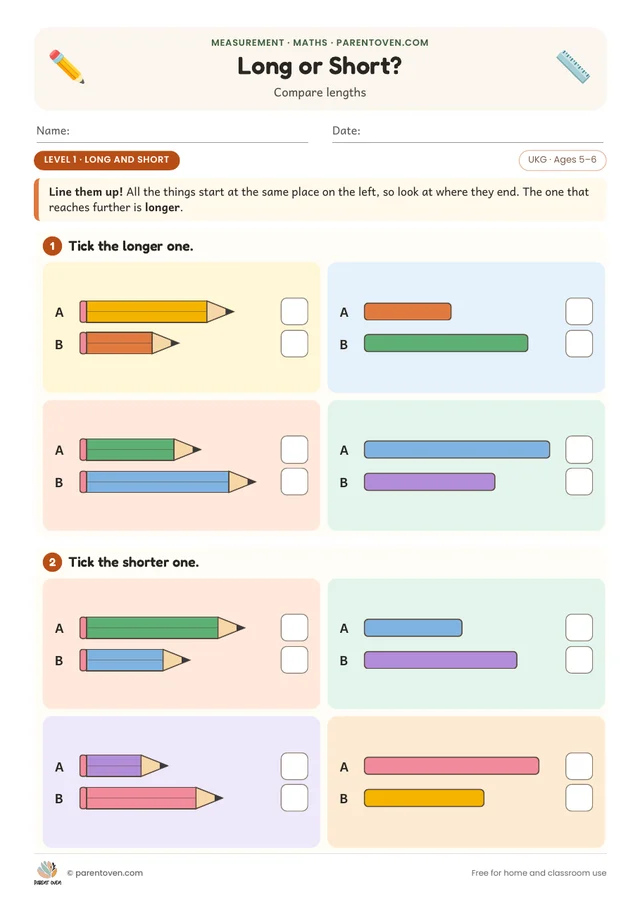
Long or short?
Eight pairs of pencils and ribbons that all start at the same line. Children tick the longer one in four pairs and the shorter one in four more, so they must read the question each time.

Level 1 · tall and short
Tall and short
Six groups of three towers standing on one ground line. Tick the tallest in three groups and the shortest in three more. Comparing three is harder than comparing two.
Level 2 · heavy and light
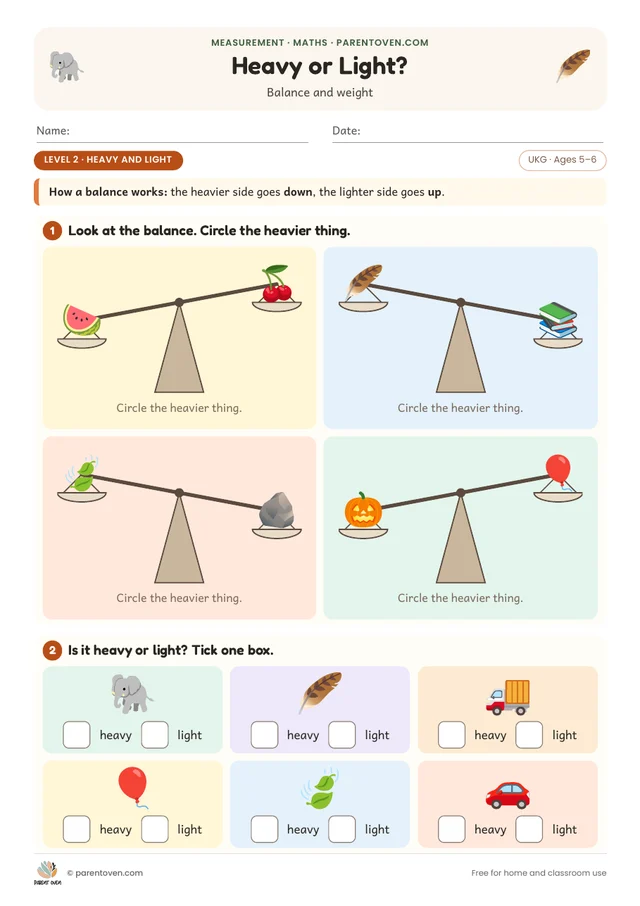
Heavy or light?
Four balance scales: the heavier side goes down. Children circle the heavier thing (watermelon or cherries, books or a feather). Then they tick heavy or light for six everyday things.
Level 2 · measuring length
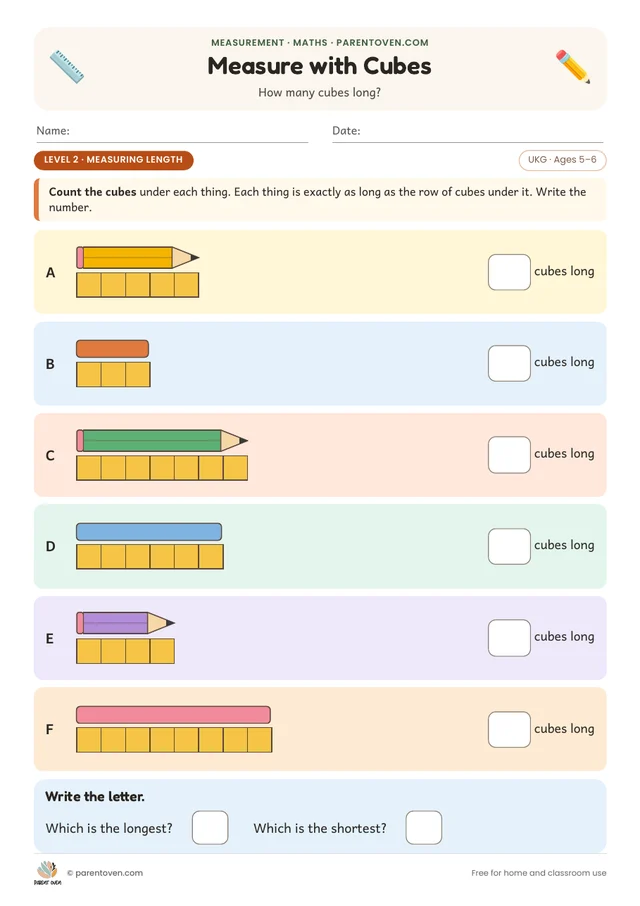
Measure with cubes
Six pencils and ribbons, each with a row of cubes under it. Children count the cubes and write how many cubes long each one is, then find the longest and the shortest.

Level 2 · capacity
More or less?
Four pairs of glasses: tick the one with more water or less water. Then six glasses to label F (full), H (half) or E (empty).
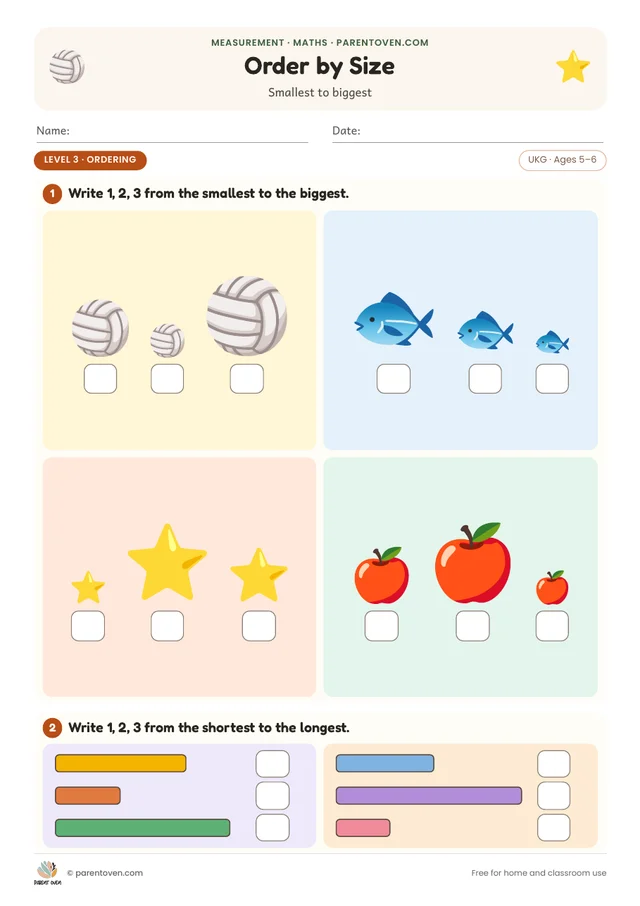
Level 3 · ordering
Order by size
Write 1, 2, 3 under balls, fish, stars and apples from the smallest to the biggest, then order two sets of ribbons from shortest to longest.
Saving ink? The black & white version has the same 6 sheets and answer key with white backgrounds and light grey pictures.
What your child will learn
Children compare length, height, weight and capacity, use the words longer, taller, heavier and more, measure length with equal cubes, and put things in order by size.
These ideas come before rulers and kilograms. A child who has measured a table in hand spans understands why we need a ruler later.
A one-week plan
One sheet a day is plenty at this age. Stop while your child is still enjoying it, and save the answer key for the weekend so they can check their own work.
| Day | Sheet | Skill | Try this too |
|---|---|---|---|
| Monday | Long or short? (Sheet 1) | Long and short | Compare two real spoons |
| Tuesday | Tall and short (Sheet 2) | Tall and short | Line up toys from shortest to tallest |
| Wednesday | Heavy or light? (Sheet 3) | Heavy and light | Hold two things and guess the heavier |
| Thursday | Measure with cubes (Sheet 4) | Measuring length | Measure a book in LEGO bricks |
| Friday | More or less? (Sheet 5) | Capacity | Pour water: full, half, empty |
| Saturday | Order by size (Sheet 6) | Ordering | Order three cups by size |
How to teach measurement in UKG
- Compare real things first. Two spoons, two shoes, two bottles. Ask “which is longer? which is heavier?” before any worksheet.
- Line up the ends. When comparing length, put both things on the same starting line. Sheet 1 does this on purpose; show why it matters.
- Use your hands as a balance. Hold a book in one hand and a pencil in the other. The heavier hand feels pulled down, just like the scale.
- Pour water. Fill cups at the sink: full, half, empty. Pour from a tall thin glass into a short wide one and talk about it.
- Measure with one unit. Blocks, matchboxes or paper clips, all the same size, laid end to end with no gaps. That is what Sheet 4 shows.
- Use comparing words. Long, longer, longest; small, smaller, smallest. Children learn them by hearing them often.
Common mistakes and quick fixes
| What you see | What usually helps |
|---|---|
| Says the pencil that starts further right is longer | Ask where both ends are. Put two real pencils side by side with the ends lined up. |
| Thinks bigger always means heavier | Compare a big balloon with a small stone. Let your child hold both. |
| Counts the cubes but skips one or counts one twice | Touch each cube with a finger as you count, left to right. |
| Calls a half-full glass “empty” | Fill a real glass halfway. Is there any water? Then it is not empty. |
| Orders biggest to smallest when asked smallest first | Read the instruction together and point to where “1” goes before starting. |
Games without paper
- Longer or shorter hunt. Give your child a crayon and ask them to find three things longer and three things shorter.
- Hand balance. Hold two objects and guess which is heavier, then check on a kitchen scale.
- Bath-time capacity. Fill and pour cups and bottles. Which holds more?
- Foot steps. Measure the room in your child’s steps, then in yours. Why are the numbers different?
- Line up by height. Line up toys or family members from shortest to tallest.
More maths practice
Measurement goes well with greater than and less than and counting 1 to 50. For number words, try number names 1 to 20. The full year is on the UKG worksheets page.
Frequently asked questions
What measurement skills should a UKG child have?
Comparing two or three objects by length, height, weight and capacity, using words like longer, taller, heavier and more, and measuring with non-standard units such as cubes or hand spans.
Why use cubes and not a ruler?
Non-standard units come first. Laying identical cubes end to end teaches what measuring means: counting equal units with no gaps. Rulers and centimetres come in Class 1 and 2.
How does a balance scale work?
The heavier side pushes its pan down and the lighter side goes up. When both sides weigh the same, the beam stays level.
Is measurement in the NCERT syllabus for this age?
Yes. NCF-FS 2022 includes comparing and ordering objects by size, length and weight, and NCERT’s Class 1 maths book follows with long-short and heavy-light chapters.
Is there a black and white version?
Yes. The ink-saving PDF has the same six sheets and answer key with white backgrounds and grey drawings.
Pictures are from Google’s Noto Emoji (Apache 2.0). Skill levels follow NCERT’s NCF-FS 2022 and the NIPUN Bharat goals for measurement at the foundational stage. Last reviewed: 21 November 2026 by the Parent Oven team.