
Learning Worksheets Living and non-living things
Free printable PDF · EVS · UKG · ages 5–6 · answer key
Living and Non-living Things Worksheets for UKG
Six worksheets that help children answer a big question: what makes something alive? Living things eat, breathe, grow and have babies. Non-living things do not, even when they move like a car or look friendly like a teddy bear.
Children sort twelve things, match animals to their food, put growth stages in order, find the odd one out, tell plants from animals, and pick the three things a plant needs. The tricky examples (robot, clock, car) are there on purpose, because they start the best conversations. Answer key and black and white version included.
Free · A4 (prints on US Letter) · 6 sheets + answer key · colour and ink-saving black & white · no sign-up

Jump to: The six sheets · How to teach living and non-living things · Common mistakes · Games without paper · FAQs
The six sheets
Each sheet is one A4 page. Sheet 1 introduces the idea, Sheets 2 and 3 look at two signs of life (eating and growing), and Sheets 4 to 6 use the idea to reason.
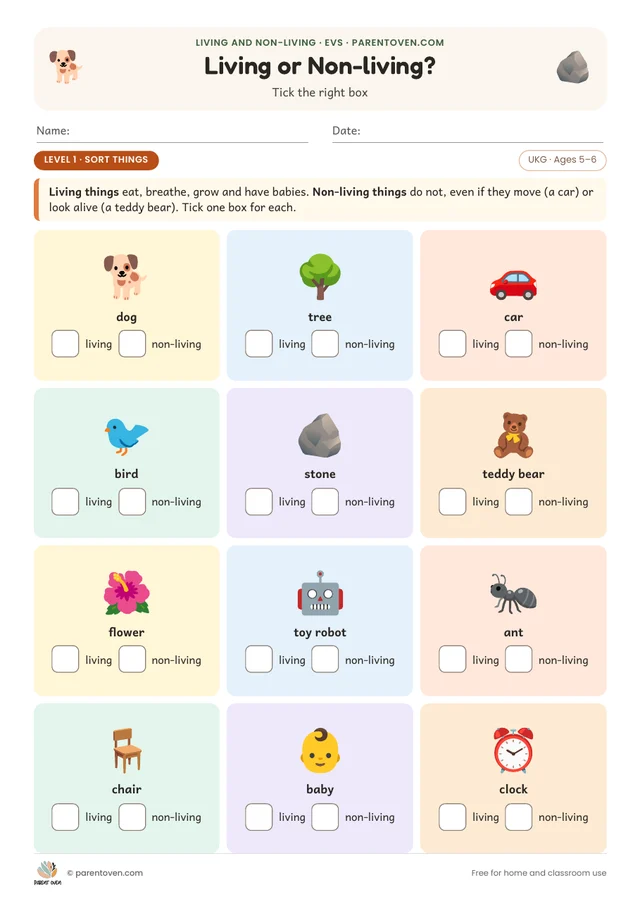
Level 1 · sort things
Living or non-living?
Twelve pictures with tick boxes: dog, tree, car, bird, stone, teddy bear, flower, toy robot, ant, chair, baby and clock.
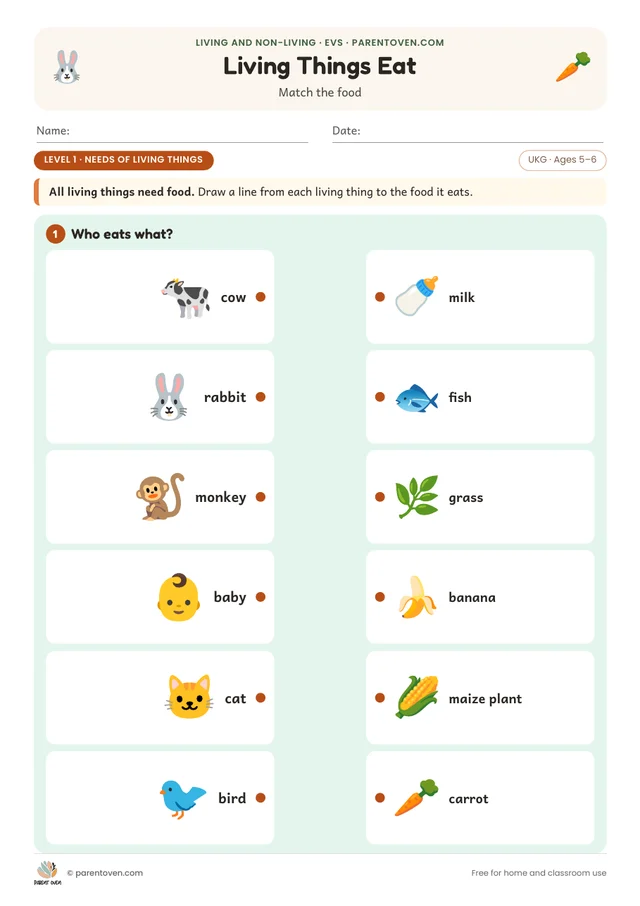
Level 1 · needs of living things
Living things eat
Match the cow to grass, the rabbit to a carrot, the monkey to a banana, the baby to milk, the cat to fish and the bird to maize. The food column is mixed up.
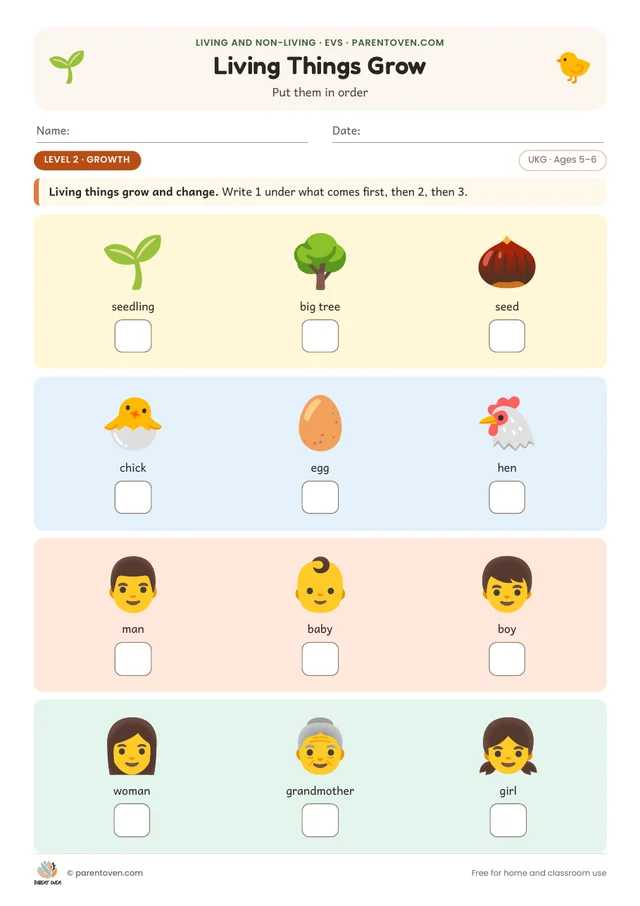
Level 2 · growth
Living things grow
Four rows of three pictures to number 1, 2, 3: seed, seedling, big tree; egg, chick, hen; baby, boy, man; girl, woman, grandmother.
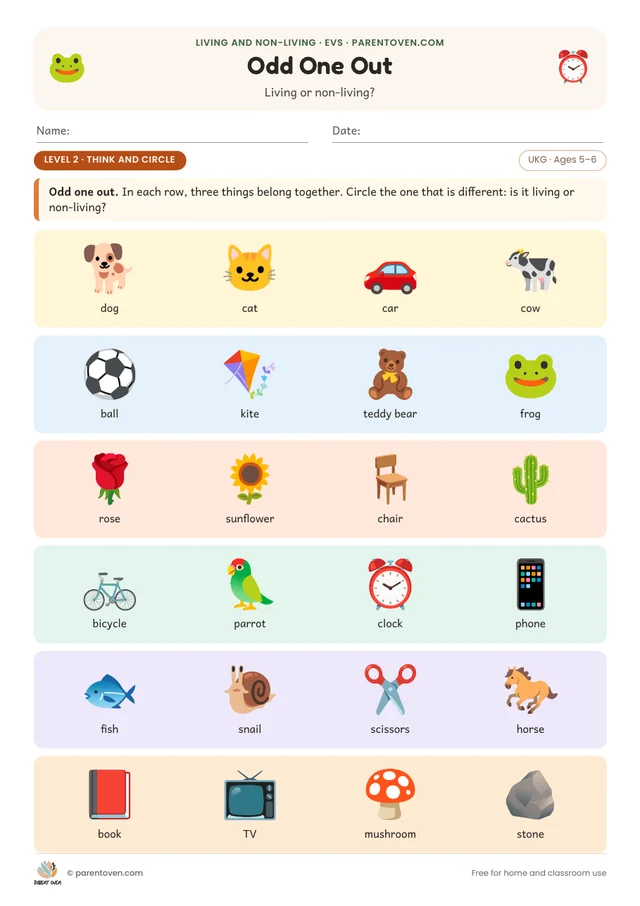
Level 2 · think and circle
Odd one out
Six rows of four pictures. Three belong together; circle the one that is different because it is living or non-living.

Level 3 · plants and animals
Plant or animal?
Eight living things to tick as plant or animal: horse, sunflower, snail, cactus, parrot, frog, rose and maize plant.
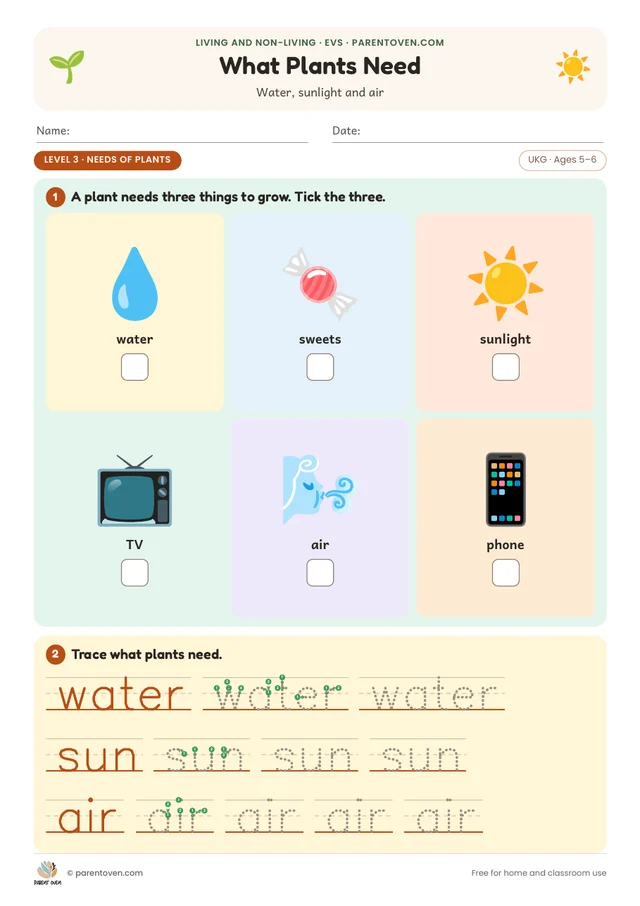
Level 3 · needs of plants
What plants need
Tick the three things a plant needs (water, sunlight, air) from six pictures that include sweets, a TV and a phone, then trace water, sun and air.
Saving ink? The black & white version has the same 6 sheets and answer key with white backgrounds and light grey pictures.
What your child will learn
Children learn the signs of life (eating, breathing, growing, having babies), sort living from non-living things, learn that plants and animals are both living, and name what a plant needs to grow.
This is early science: observe, sort, explain. The best moment is when your child changes their mind about the car or the teddy after asking “Does it eat? Does it grow?”
A one-week plan
One sheet a day is plenty at this age. Stop while your child is still enjoying it, and save the answer key for the weekend so they can check their own work.
| Day | Sheet | Skill | Try this too |
|---|---|---|---|
| Monday | Living or non-living? (Sheet 1) | Sort things | Sort things on a nature walk |
| Tuesday | Living things eat (Sheet 2) | Needs of living things | Feed birds and watch them eat |
| Wednesday | Living things grow (Sheet 3) | Growth | Start seeds on wet cotton |
| Thursday | Odd one out (Sheet 4) | Think and circle | Play twenty questions |
| Friday | Plant or animal? (Sheet 5) | Plants and animals | Look for plants and animals in the park |
| Saturday | What plants need (Sheet 6) | Needs of plants | Water the seeds and check growth |
How to teach living and non-living things
- Use a checklist. Does it eat? Does it breathe? Does it grow? Can it have babies? If the answer is yes, it is living.
- Go outside. Collect a leaf, a stone, a twig and an ant (watch it, don’t catch it). Sort them on the ground.
- Talk about the tricky ones. A car moves but does not eat or grow. A teddy looks like an animal but is made of cloth.
- Grow something. Soak a few moong or rajma seeds on wet cotton. Children can see a living thing grow in three days.
- Plants are alive too. Many children think only animals are living. Show a plant that grew toward the window.
- Use real food chains. What did the cow eat? Grass. What does the cat eat? Living things need food.
Common mistakes and quick fixes
| What you see | What usually helps |
|---|---|
| Says a car or fan is living because it moves | Moving is not enough. Does the car eat or grow bigger? No, so it is non-living. |
| Says a tree is non-living because it does not move | Trees grow, drink water and make seeds. Show a sapling and a big tree. |
| Calls the sun or fire living | They do not eat food or have babies. Many adults find this hard too; keep it simple. |
| Thinks a toy robot is living because it talks | A person made it and it runs on batteries. It cannot grow. |
| Picks the odd one out by colour | Colour is a fair start. Then ask: which one is living (or non-living)? |
Games without paper
- Living or not? Call out words; children stand for living and sit for non-living.
- Seed jar. Grow seeds on cotton in a glass and draw them each day for a week.
- Nature walk bag. Collect five things and sort them at home into two piles.
- Who eats what? Feed birds a few grains on the balcony and watch who comes.
- Twenty questions. Think of a thing; your child asks “Does it eat? Does it grow?” to guess.
More EVS practice
Pair this set with good habits and safety and animal worksheets. Earlier EVS sets: my body and five senses, transport and family and community helpers. The full year is on the UKG worksheets page.
Frequently asked questions
What is the difference between living and non-living things?
Living things eat, breathe, grow and reproduce. Non-living things do not, even if they move (a car) or were once part of something living (a wooden chair).
Are plants living things?
Yes. Plants need water, air and sunlight, they grow, and they make seeds that grow into new plants.
Is a seed living?
A seed is alive but resting. Give it water and warmth and it grows into a plant.
Is living and non-living taught in UKG?
Yes. It is a standard UKG EVS topic in most Indian schools and leads into plants and animals in Class 1.
Is fire living? It grows and needs air.
No. Fire grows and uses air, but it does not eat food, grow from a baby, or have young ones. It is a good question to ask; it shows your child is using the checklist.
Why are mushrooms not on the plant list?
Mushrooms are living, but they are fungi, not plants: they do not make food from sunlight. That is why the set uses a mushroom only as a living thing in the odd-one-out sheet.
Is there a black and white version?
Yes. The ink-saving PDF has the same six sheets and answer key with light grey pictures.
Pictures are from Google’s Noto Emoji (Apache 2.0). Topics follow common Indian UKG EVS syllabuses and NCF-FS 2022 goals for exploring the natural world. Last reviewed: 21 November 2026 by the Parent Oven team.