
Learning Worksheets Good habits and safety
Free printable PDF · EVS · UKG · ages 5–6 · answer key
Good Habits and Safety Worksheets for UKG
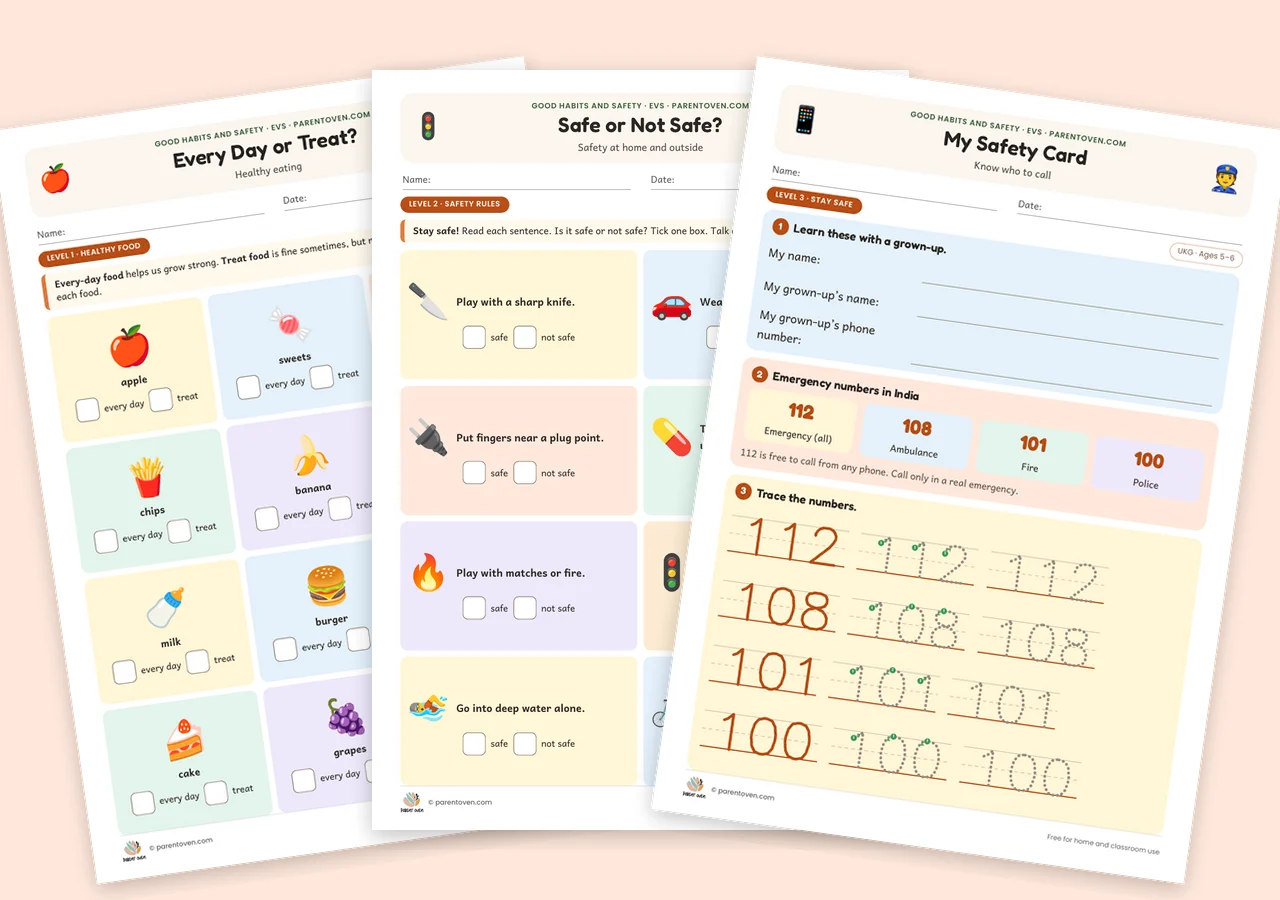
Six worksheets about looking after ourselves: good habits, every-day food and treats, the four steps of hand washing, safe and unsafe actions, a daily routine, and a safety card with India’s emergency numbers.
The sheets are written to start conversations, not to scare. Each safety rule is something a five-year-old can actually do: hold a grown-up’s hand, wear a helmet, take medicine only from a grown-up. Answer key and black and white version included.
Free · A4 (prints on US Letter) · 6 sheets + answer key · colour and ink-saving black & white · no sign-up
Jump to: The six sheets · How to teach good habits and safety in UKG · Common mistakes · Games without paper · FAQs
The six sheets
Each sheet is one A4 page. Sheets 1 to 3 are about health and hygiene, Sheet 4 is about safety, and Sheets 5 and 6 put it into the child’s own day.
Level 1 · good habits
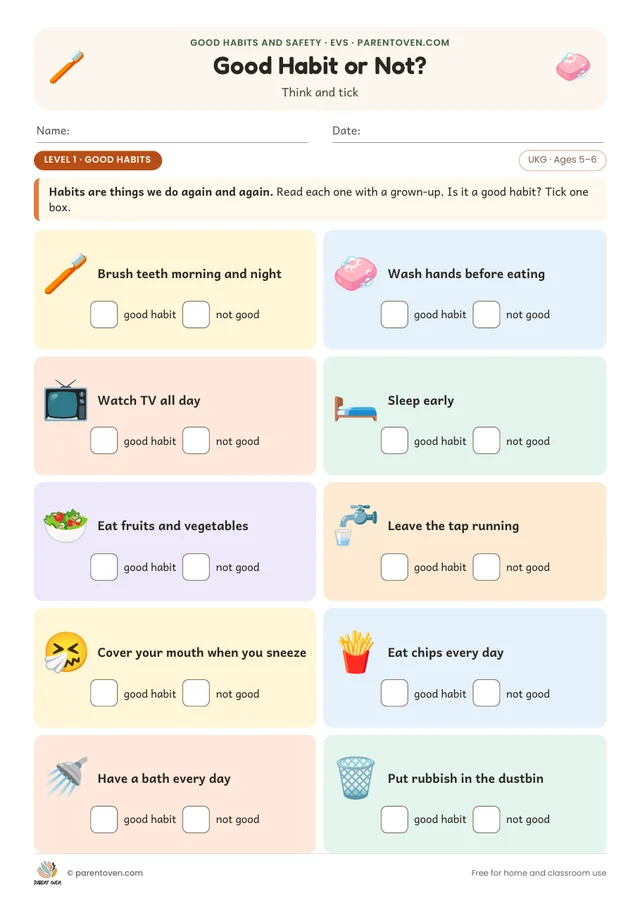
Good habit or not?
Ten habits with pictures, from brushing teeth and washing hands to watching TV all day and leaving the tap running. Tick good habit or not good.
Level 1 · healthy food
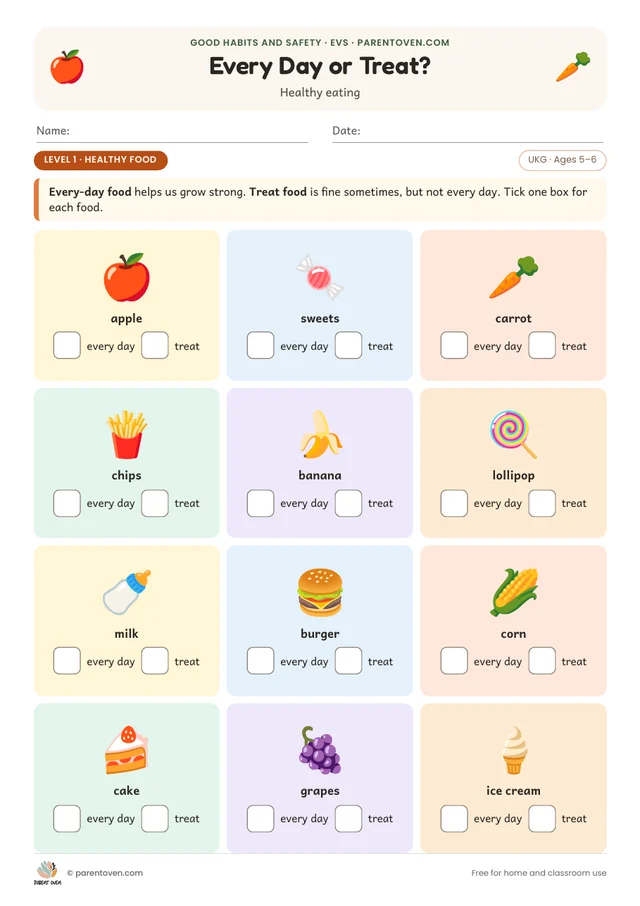
Every day or treat?
Twelve foods: apple, carrot, banana, milk, maize and grapes next to sweets, chips, lollipop, burger, cake and ice cream. Children tick every-day food or treat.
Level 2 · keep clean
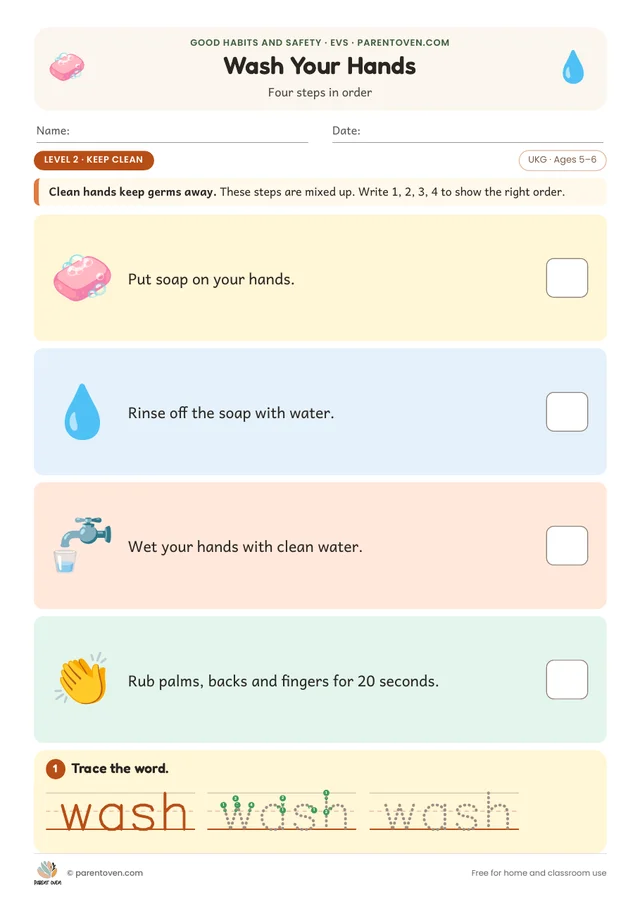
Wash your hands
Four mixed-up hand-washing steps to number in order: wet, soap, rub for 20 seconds, rinse. Then trace the word wash.
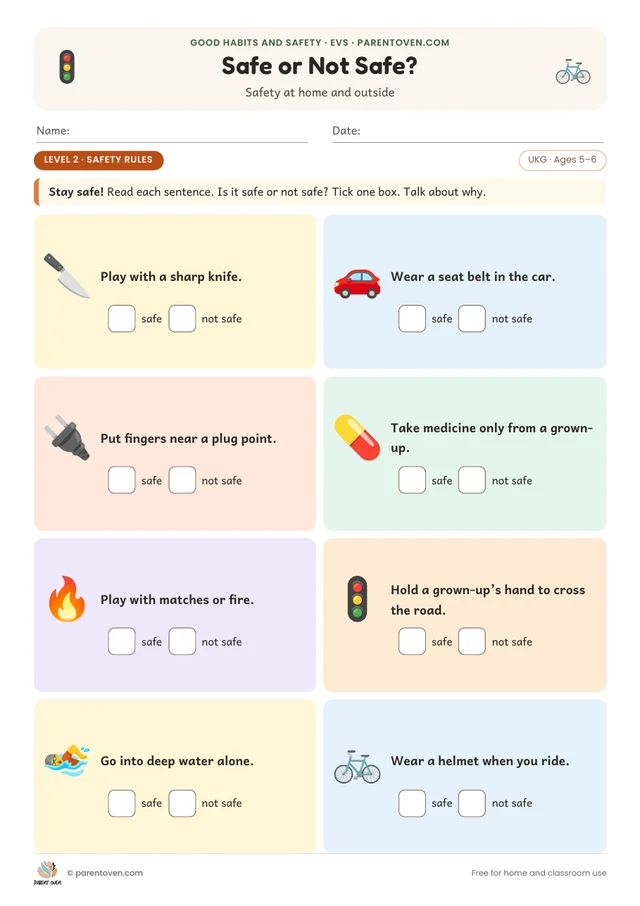
Level 2 · safety rules
Safe or not safe?
Eight situations, such as playing with a knife, wearing a seat belt or going into deep water alone. Tick safe or not safe and talk about why.

Level 3 · routine
My daily routine
Six pictures from wake up to go to sleep. Children write 1 to 6 to put the day in order.

Level 3 · stay safe
My safety card
Lines to write my name, my grown-up’s name and phone number, the emergency numbers 112, 108, 101 and 100, and large dotted numbers to trace.
Saving ink? The black & white version has the same 6 sheets and answer key with white backgrounds and light grey pictures.
What your child will learn
Children learn daily hygiene habits, the difference between every-day food and treats, the four steps of hand washing, simple safety rules, their own daily routine, and who to call in an emergency.
These sheets work best alongside real practice. A child who washes hands in four steps every day, and can say a parent’s phone number, has learned the most important lesson in the set.
A one-week plan
One sheet a day is plenty at this age. Stop while your child is still enjoying it, and save the answer key for the weekend so they can check their own work.
| Day | Sheet | Skill | Try this too |
|---|---|---|---|
| Monday | Good habit or not? (Sheet 1) | Good habits | Brush teeth together |
| Tuesday | Every day or treat? (Sheet 2) | Healthy food | Plan a healthy plate |
| Wednesday | Wash your hands (Sheet 3) | Keep clean | Hand-washing glitter test |
| Thursday | Safe or not safe? (Sheet 4) | Safety rules | Talk through what to do if lost |
| Friday | My daily routine (Sheet 5) | Routine | Make a picture routine for the fridge |
| Saturday | My safety card (Sheet 6) | Stay safe | Say the phone number from memory |
How to teach good habits and safety in UKG
- Model it. Children copy what they see. Brush your teeth together and wash hands together before meals.
- Use a song or count. Hand washing takes about 20 seconds: sing “Happy Birthday” twice or count slowly to twenty.
- Say “every day” and “sometimes”. Avoid “bad food”. Treats are fine sometimes; fruit, dal, roti and milk are every-day food.
- Give the reason. “Knives are sharp and can cut” teaches more than “don’t touch”.
- Practise the phone number. Say it in groups like a rhyme. Practise a pretend 112 call with a toy phone.
- Make a picture routine. Stick the daily routine on the fridge so your child can check what comes next.
Common mistakes and quick fixes
| What you see | What usually helps |
|---|---|
| Ticks all treats as “every day” because they are tasty | Agree that they are tasty! Then ask what gives energy to play and grow. |
| Rinses before using soap | Number the steps with your child at the sink: wet, soap, rub, rinse. |
| Says touching a plug point is fine if the switch is off | Keep the rule simple: fingers never go near plug points. |
| Cannot remember the phone number | Teach four digits at a time over a week. Repeat at bedtime. |
| Puts school before brushing teeth | Accept an order that matches your real day, then talk about why we brush first. |
Games without paper
- Germ glitter. Put a pinch of glitter on hands and see how soap and rubbing remove it.
- Healthy plate. Draw a plate and fill half with fruit and vegetables.
- Traffic walk. On the next walk, practise stop, look both ways, hold hands and cross.
- Habit chart. Tick a chart every evening for brushing, bathing and tidying toys.
- What would you do? Ask “What if you got lost in a market?” and practise the answer.
More EVS practice
Road safety continues in transport worksheets. Pair this set with my body and five senses, community helpers and living and non-living things. The full year is on the UKG worksheets page.
Frequently asked questions
What good habits should a 5-year-old have?
Brushing teeth twice a day, washing hands before eating and after the toilet, bathing daily, eating fruit and vegetables, sleeping on time, putting toys away and covering the mouth when sneezing.
What is the emergency number in India?
112 is India’s single emergency number for police, fire and ambulance. 100 (police), 101 (fire) and 108 (ambulance in most states) also work.
How long should children wash their hands?
At least 20 seconds with soap, rubbing palms, backs, between fingers and under nails, then rinsing with clean water.
Should a UKG child learn a parent’s phone number?
Yes. Most five-year-olds can learn a ten-digit number with practice, and it is one of the most useful safety skills.
How can I make my child brush for two minutes?
Use a sand timer or a two-minute song, brush at the same time as your child, and let them brush a toy’s teeth first. Check the back teeth yourself until about age seven.
Are chips and sweets banned on this sheet?
No. The sheet calls them treats: fine sometimes, not every day. Avoid calling food good or bad; that keeps mealtimes calm.
Is there a black and white version?
Yes. The ink-saving PDF has the same six sheets and answer key with light grey pictures.
Pictures are from Google’s Noto Emoji (Apache 2.0). Emergency numbers from India’s Emergency Response Support System (112). Topics follow NCF-FS 2022 goals for health, hygiene and safety. Last reviewed: 21 November 2026 by the Parent Oven team.